
SLIDE 1
Leveraging Resources for Brownfields Revitalization
Meet the Funders: Infrastructure
One of a series of leveraging webcasts from the U.S. Environmental Protection Agency’s Office of Brownfields & Land Revitalization
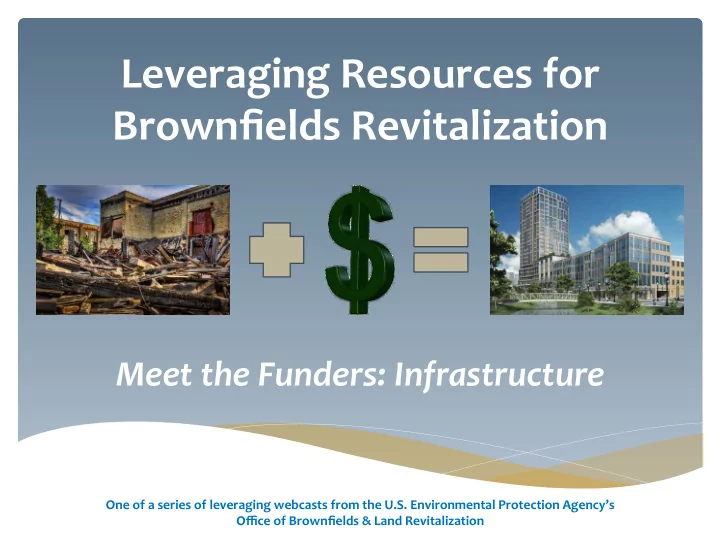
Leveraging Resources for Brownfields Revitalization Meet the Funders: - - PowerPoint PPT Presentation
Leveraging Resources for Brownfields Revitalization Meet the Funders: Infrastructure One of a series of leveraging webcasts from the U.S. Environmental Protection Agencys Office of Brownfields & Land Revitalization Todays Speakers Matt
Meet the Funders: Infrastructure
One of a series of leveraging webcasts from the U.S. Environmental Protection Agency’s Office of Brownfields & Land Revitalization
Andrew Seth Matt Ward CEO President Sustainable Strategies DC Sustainable Strategies DC Aimee Storm Land Revitalization Coordinator U.S. Environmental Protection Agency Danielle Rinsler Team Lead U.S. Department of Transportation Sonia Brubaker Program Manager U.S. Environmental Protection Agency Marc Gerdeman Brownfield Redevelopment Officer City of Toledo David Dysard Engineering Services Administrator City of Toledo Scott Sibley Engineering Services Administrator City of Toledo
Infrastructure * U.S. Department of Transportation * U.S. Environmental Protection Agency * U.S. Army Corps of Engineers
Case Studies * Toledo, Ohio
plan for cleaning up and reusing your brownfield(s)?
be needed
improvements and
area improvements are needed
Consider all sources!
Identify, Plan & Align Resources
* What specific actions are needed to implement the
* Grants * Technical assistance * Local funds * Financing * Partner resources
long-term, and where to start
* Ongoing webcasts on leveraging best
practices and “Meet the Funders” series; next one on sustainability (February 28 @1 – 2:30pm ET) * “Setting the Stage for Leveraging Resources for Brownfields Revitalization” – new EPA guidebook * Brownfields Federal Program guide (updated 2015) * Brownfields Area-Wide Planning Federal Resources Matrix * Ongoing technical assistance on funding/financing available to brownfields communities via the Council
Danielle Rinsler Team Lead U.S. Department of Transportation
U.S. Department of TransportaIon (DOT)
DOT Funding
administraQons and Office of the Secretary administer a wide variety of grant programs
– Office of the Secretary (OST)
(OST)
Bureau)
– Federal Highway AdministraQon (FHWA) – Federal Transit AdministraQon (FTA) – Federal Railroad AdministraQon (FRA) – Federal AviaQon AdministraQon (FAA) – MariQme AdministraQon (MARAD) – Pipeline and Hazardous Materials Safety AdministraQon (PHMSA)
9
DOT Grants – Freight and Surface Transportation
– NaQonally/Regionally Significant Freight Grants. – $4.5 Billion over five years. – Annual ApplicaQon Cycle (NoQce of Funding Opportunity). – May cover up to 60 percent
costs. www.transportaIon.gov/buildamerica/FASTLANEgrants
– Surface TransportaQon Grants ImpacQng NaQon, Metropolitan Area
– $500 million mulQmodal, merit-based discreQonary grant program. – Strong focus on transformaQve projects and creaQng ladders of opportunity. – Eligible applicants: State, local, and tribal governments, transit agencies, MPOs, and other public enQQes – Cost Share or Match
funds may cover up to 80 percent
percent
costs in rural areas
www.transportaIon.gov/Iger/
10
TIGER DiscreIonary Grants
TIGER CompeIIve Grant Program
TIGER Program
impact
SelecIon Criteria
Also...Project Readiness and Ladders of Opportunity
Technical Assistance
through the TIGER process
applicaQon debriefs
cost analysis resource guide
Email quesQons to: TIGERGrants@dot.gov
DOT Grants – Transit and Formula
Capital Investment Grants:
– Fixed guideway Grants for new projects (New Starts/Small Starts) and to Expand Core Capacity. – $2.3 Billion/year through FY 2020. – ApplicaQons accepted at any Qme during the year.
– States receive funding from USDOT via a distribuQon formula. – States and MPOs award grants. – Examples:
Program - $1.1 Billion/year.
14
DOT Funding: FTA Resources
FTA: Office of Program Management (TPM)
naQonal program of capital and operaQng assistance by:
management for FTA assistance programs
and disseminaQon of program guidance and technical assistance
15
DOT Funding: FTA Resources
Office of Transit Programs (TPM-10)
Expand Core Capacity. Manages formula and DiscreQonary Grant Programs for: Urbanized Areas (5307), Passenger Ferries (5307), Fixed Guideway Capital Investments (5309), the Enhanced Mobility of Seniors and Individuals with DisabiliQes (5310), Rural Areas (5311), Tribes (5311), Emergency Relief (5324), State of Good Repair (5337), and Grants for Buses and Bus FaciliQes (5339)
policy, or procedural requirements for the annual apporQonment
programs, including the Rural Transit Assistance Program, and administering the CoordinaQng Council on Access and Mobility (CCAM). hKps://www.transit.dot.gov/grants hKps://www.transit.dot.gov/about/regional-offices/regional-offices#
16
FHWA Apportioned Programs Under FAST
Average annual highway apporIonments, FY 2016-2020 ($ billions)
25.0 23.3 20.0 15.0 10.0 11.7 5.0
2.3 1.2 0.3 0.2 NHPP STBG CMAQ HSIP NHFP Metro Grade planning crossing
DOT Funding: Federal Railroad Administration (FRA) Rail Network Development
§ Rail Program
– High-Speed Intercity Passenger Rail (HSIPR) Grants – Amtrak OperaQng and Capital Grants* – Railroad Safety Technology Grants for PTC – Railroad Safety Infrastructure Improvement Grants – – Rail Line RelocaQon Grants* – Disaster Assistance Grants – TransportaQon Investment GeneraQng Economic Recovery Grants – Research, Development, and Technology Railroad Safety Grants for the Safe TransportaQon of Energy Products by Rail * The Fixing America’s Surface TransportaQon (FAST) Act modifies these grant programs.
18
U.S. Department of TransportaIon (DOT)
Build America Bureau - Programs Bureau Credit Assistance: TIFIA, RRIF Private AcIvity Bonds FASTLANE Grants InnovaIve Finance Best PracIces
20
Transportation Infrastructure Finance and Innovation Act (TIFIA)
What is TIFIA? § Federal program that provides loans, loan guarantees and lines of credit to transportaQon projects § Program’s lending capacity has grown to about $20 billion in credit assistance Why use TIFIA? § Leverages Federal, State and local resources and sQmulates private investment § Accelerates project delivery by accessing addiQonal upfront funds § Provides low interest rates and flexible repayment terms
21
Private Activity Bonds (PABs)
What are PABs? § Allow for tax-exempt bonds for projects with private investment § $15 Billion authorized for allocaQon by U.S. DOT Why use PABs? § Offset higher costs of capital generally incurred by the private sector in Public Private Partnerships (P3s) § Can contribute to making P3 projects financially feasible
22
Railroad Rehabilitation & Improvement Financing (RRIF)
What is RRIF?
§ Federal program that provides direct loans and loan guarantees to finance railroad and intermodal equipment and infrastructure that results in public benefits (safety, economic development, environmental improvements, service and capacity) § Authorized to loan up to $35 billion ($7 billion reserved for freight railroads other than Class I)
Why use RRIF?
§ Direct loans can fund up to 100% of eligible project costs § Small Loans (< $100,000) can be approved § Provides low interest rates and flexible repayment terms
23
RRIF
RRIF Program PrioriIes
rural areas
Build America Bureau – TOD Eligibility
Transit-Oriented Development (TOD)
makes TOD projects eligible under RRIF and TIFIA to – Promote commercial and residenQal development near transit hubs – Increase transit ridership – Promote walkable, sustainable land use
project-specific review (eligible elements might include: property acquisiQon, demoliQon, site preparaQon, walkways, pedestrian and bicycle access,, etc.)
must be physically or funcQonally related to a transportaQon facility (RRIF….to a passenger rail staQon or mulQmodal staQon that includes rail service)
Additional Resources
Processing of ApplicaQons for Financial Assistance Under the Railroad RehabilitaQon and Improvement Financing (RRIF Program), 75 Fed. Reg. 60165 (September 29, 2010) ( hSps://www.fra.dot.gov/eLib/details/L02706)
Form ( hSps://www.fra.dot.gov/eLib/Details/L02705)
Checklist, ApplicaQon Checklist and ApplicaQon Process Quick Guide (www.fra.dot.gov)
InformaQon ( hSp://www.fra.dot.gov/Page/P0185)
U.S. Department of TransportaIon (DOT)
The Status Quo: U.S. Infrastructure Backlog
28
The Status Quo: U.S. Infrastructure Backlog
difficult than actually building it
due to lack of financing dollars: U.S. DOT has over $50 billion available in Federal assistance programs
regulaQons, complex credit structures, and the need to coordinate with mulQple points of contact within the federal government
29
Build America Initiative – The Bureau
Build America AdministraQon-wide iniQaQve. BATIC Working Group forms. Credit/technical funcQons disbursed.
BATIC adds full-Qme core team. Centralized coordinaQon – funcQons remain disbursed.
Obama signs the FAST Act – 5-year legislaQon calling for a NaQonal Surface TransportaQon InnovaQve Finance Bureau.
DOT unveils the Build America
Technical funcQons centralized – some funcQons remain disbursed.
30
FAST Act Establishes the “Bureau” The FAST Act:
long-term Federal transportaQon bill in 10+ years
transportaQon modes.
Finance Bureau (Build America Bureau).
and RRIF Credit Assistance Programs.
31
The Bureau’s Mission
32
Build America Bureau - Components
33
Current and Future Roles of the Bureau
Shop for project sponsors to access DOT technical assistance and credit programs;
FASTLANE Grant program;
DOT credit applicaIon and review processes;
assistance and best pracQces and financing and funding
permiTng;
in miIgaIng project delivery and procurement risks and costs for projects financed by the USDOT infrastructure finance programs;
and the public availability of informaQon regarding projects financed by the USDOT infrastructure finance programs.
34
Additional Bureau Resources
BATIC InsQtute:
– Pennsylvania Rapid Bridge Replacement – Denver Union StaQon – Eagle P3 Commuter Rail
guidance webinars:
– AcQve TransportaQon Networks – State Infrastructure Banks (SIBs) – Ports – Transit Oriented Development (TOD)
PracQces Papers:
– Surface TransportaQon P3s – Availability Payment Concessions P3 Model Contract Guide – Core Toll Concession P3 Model Contract Guide
35
Email: BuildAmerica@dot.gov Phone: 202-366-2300
36
Sonia Brubaker Program Manager U.S. Environmental Protection Agency
U.S. Environmental ProtecIon Agency (EPA)
Water Infrastructure and Resiliency Finance Center
The Water Finance Center is an in informaN
% and assis and assistanc ance c e cen enter er, helping communiNes % make informed decisions for drinking drinking water, % % wa wastewa water, , and s storm
er infr fras astru ruct cture e to % protect human health and the environment. %
Re Research h Ad Advise e In Innovate e Ne Networ
k
%
U.S. Environmental ProtecIon Agency (EPA)
EPA Water Infrastructure Funding
NaQve Villages and Rural CommuniQes Grant Program
Program
(WIFIA)
Clean Water State Revolving Fund & Drinking Water State Revolving Fund
Funds Awarded CumulaIve federal funds awarded DW: $17.5B CW: $39.5B Assistance provided in 2015 DW: $2.1B CW: $5.8B CumulaIve assistance provided DW: $30B CW: $111.2B Funds Status & Uses
interest rate
Rate: 1.7% versus the market rate of 3.8%
terms
rates (amounts established by Congress)
42
Eligible Projects Under the SRFs
DWSRF
§Source (e.g., well replacement, aquifer storage and recovery) §Treatment (includes reuse and desal) §Transmission and distribuIon §Finished water storage §Water system consolidaIon §CreaIon
(limited) §Technical assistance for project planning and design §Climate change miIgaIon / adaptaIon (e.g., energy efficiency, renewables, water conserva:on -- as part
§Resilience and sustainability (e.g., security measures, green infrastructure -- as part
projects)
CWSRF
§ ConstrucIng Publicly Owned Treatment Works (POTWs) § Nonpoint source § NaIonal Estuary Program projects § Centralized systems § Stormwater § Reducing demand for POTW capacity (e.g., through water conserva:on, efficiency and reuse) § Watershed pilot projects § Energy efficiency § Reusing or recycling wastewater, stormwater or subsurface drainage water § Security measures at POTWs § Technical assistance
U.S. Environmental ProtecIon Agency (EPA)
Public-Private & Public-Public Partnerships
The Water Finance Center, in conjuncQon with UNC Environmental Finance Center, is examining previously closed P3s to understand the:
transacQon
Utility Customer Assistance Programs
CAP CAPs ar s are v e volu
ary p y progr
ams that u t uNliN liNes h es have % % cr crea eated f ed for cu
s havin ving d g difficu ifficulty p lty payin ying % % wa water r and d sewer r bills %
In 2014, 46.7 million people (14.8% of the U.S. populaQon) lived in poverty (U.S. Census Bureau) UQliQes oBen find approximately 1% of their customers are unable to pay at any parQcular Qme (WRF 2010)
Compendium available at: http://ow.ly/4nvSyO
Types of CAPs
Ø Bill Discount Ø Flexible Terms Ø Lifeline Rate Ø Temporary Assistance Ø Water Efficiency
Each Type includes:
Short write-ups of examples are included for each type
U.S. Environmental ProtecIon Agency (EPA)
10 University of North Carolina at University California State University at Sacramento CorporaQon
Environmental Finance Centers (EFCs)
The EFCs deliver targeted technical assistance to states, tribes, local governments, and the private sector in providing innovaQve soluQons to help manage the costs
financing and program management
University of Rural Community Southern Maine Michigan Technological Assistance Syracuse University University of Maryland Chapel Hill University of New Wichita State Mexico University
Regional Water Finance Forums
Series of Finance Forums
infrastructure financing needs in an interacIve peer-to-peer networking format.
resilient water infrastructure projects
funding and technical assistance contacts.
Addison, TX
Iselin, NJ
Portland, OR
Big Stone Gap, VA
Durham, NH
R9
Topics range from:
needs to the public
rates
management for preplanning
financing
Wa WaterCARE % % Commu CommuniN iNes es % %
Pr Pred edevelop elopmen ment T t Tech echnic ical al % % As Assistance P ce Prog
%
Community Assistance for Resiliency and Excellence (WaterCARE)
mid-sized communiIes with drinking water and wastewater predevelopment services
and technical guidance for supporQng community investment in water infrastructure
100,000),
an immediate public health need,
consideraQons, and/or
52
US EPA Environmental Financial Advisory Board (EFAB)
“FACA”)
30 board members represenQng a cross secQon of government, tribes, industry, not-for-profit and educaQonal insQtuQons
SRF enactment, EFAB was created to assist EPA build financial experQse. Has been acQve since early 90s
year: Next meeQng is in Washington, DC in late winter/ early spring www.epa.gov/efab/envirofinance Recent RecommendaIons:
Challenges in the Water Sector
Development for Small Water Systems
development AcIviIes in CommuniIes
Stormwater Revenues
U.S. Environmental ProtecIon Agency (EPA)
Water Finance Clearinghouse – Under Development!
Ke Key y Features:
Resources
%
search filters for the user
Resource Search Filters (Draft)
Fu Fundin ing Sou g Sources ces % Se Sectors Spe Special ial Topic pics Re Resource e Type
Webinar/Video
MarkeNng
Website
Program (319)
InnovaNon Act (WIFIA)
Fin Finan ancin cing Ap g Approach
es
Events
(FEMA)
%
Wastewater Rates
%
Tools
%
Au Author
Tax Districts
AdministraNon (NOAA)
%
Advisory Board
%
(EDA)
Programs
OrganizaNon
Sc Scope pe %
%
Da Date
Year
Funds Search Filters (Draft)
Fu Fundin ing Sou g Sources ces Se Sectors Eligible A Eligible Applic pplican ants ts
(FEMA)
Eligible Uses Eligible Uses
AdministraNon (NOAA)
Water UNlity
Wastewater UNlity
(EDA)
%
Ha Have a W e a Water Fin er Finan ance ce % % Qu QuesN esNon
%
Sen Send u d us an email: s an email: % %
waterfinancecenter@epa.gov %
Sonia Brubaker Program Manager, Water Finance Center Brubaker.Sonia@epa.gov
Matt Ward CEO Sustainable Strategies DC
U.S. Army Corps of Engineers
Corps Mission Areas that can support brownfields revitalizaNon:
construcQon services to communiQes and regions on a range of public works projects connected to America’s waterbodies
flood control, dredging, inland waterways navigaQon (1/6 of America’s freight), ports and harbors (300 commercial and 600 other harbors), coastal restoraQon, and water
U.S.)
mission areas include ecosystem restoraQon, cleanup of military installaQons, abandoned mine land restoraQon, EPA Superfund site cleanups, environmental infrastructure, and wetlands and dredge-and- fill regulaQons
Corps roles with contaminaNon:
to address HTRW – Hazardous, Toxic & RadioacQve Wastes
tesQng; site invesQgaQons, feasibility studies, remedial design & remedial acQon; human health & ecological risk assessments; expedited removal acQons; underground storage tank closure; asbestos & lead paint abatement; compliance assessments; ordinance removal; polluQon prevenQon projects; stormwater management; hazardous waste management
cost if contaminaQon is in water, but land-side contaminaQon is typically local sponsor’s responsibility
U.S. Army Corps of Engineers
Corps AuthoriNes & Programs:
to propose water resource projects to Corps District
mission consistency, ranked and prioriQzed, and potenQally created as study, engineering, and/or construcQon project in a USACE-Congressional process
allow localiQes to conduct project partnerships in targeted areas
ConNnuing AuthoriNes Program:
with $100,000 feasibility study funded by Corps, followed by 50/50 cost share on further planning
share varies by program
Streambank & Shoreline Erosion ($10 million max, 35% local match)
Planning Assistance (50% cost share)
NavigaQon Improvements ($10 million max, match for commercial navigaQon varies, 50% local match for recreaQonal navigaQon)
Beneficial Reuse of Dredged Materials ($10 million max, 35% local cost share)
Flood control ($10 million max, 35% cost share)
AquaQc ecosystem restoraQon ($10 million max, 35% local cost share
Project modificaQons for environmental improvement ($10 million max, 25% local cost share)
U.S. Army Corps of Engineers
NavigaNng the Corps Process:
important – work closely with the local Corps District
Offices organized under eight Divisions
delegaQon
Marc Gerdeman Brownfield Redevelopment Officer City of Toledo, Ohio David Dysard Engineering Services Administrator City of Toledo, Ohio Scott Sibley Engineering Services Administrator City of Toledo, Ohio
redeveloping Toledo’s land for higher and better uses.
supplemental grants totaling $8 million and also acquired over $14 million in various federal, state, local and private funding sources to redevelop land in Toledo.
Training (2012)
Roundabouts and Roadway
Metropolitan Planning Organization MPO – for Toledo area the Toledo Metropolitan Area Council of Governments): $2,532,000 Roadway
Metropolitan Planning Organization MPO – for Toledo area the Toledo Metropolitan Area Council of Governments): $3,557,189 State of Ohio
small jurisdictions from a statewide bond fund administered in 12 districts by County Engineers. Bike Paths
Planning Organization MPO – for Toledo area the Toledo Metropolitan Area Council of Governments)
Brownfield (Jeep Site)
hundreds of jobs
connections to:
– Phillips Interchange – Cherry Street – Collingwood Boulevard
§ Berdan & Haverhill § Berdan & Jeep Pkwy § Berdan & Detroit & Cherry § Collingwood & Detroit § Cherry & Collingwood & Manhattan § Manhattan & Phillips § Phillips & Detroit
Improve Connectivity
between the I-75/Phillips and I-75/Willys interchanges
Improve Traffic Operations
Improve Wayfinding and Access/Added Benefits
neighborhoods
Street Legacy Plan
and separated multi-use trail
includes shade trees to enhance the corridor
identify the area, and direct traffic to key destinations
minimize the effects of Combined Sewer Overflows (CSO’s), which will improve water quality in the Maumee River.
part through a $26.2 million low-interest loan from Ohio EPA’s Water Pollution Control Loan Fund.
it mixes with raw sanitary sewage and overwhelms the city’s ability to clean the water before it is discharged to the Maumee River. This project will allow the city to store the excess flow in a 6.9 million gallon CSO storage facility, which can then be sent in a more measured way through the wastewater treatment plant.
T W I P R O G R A M C O S T M A N A G E M E N T
PROGRAM FUNDING SOURCES THRU 2016
PROGRAM SOURCE GRANT LOAN
U.S. Army Corps of Engineers
$5,169.000 $-------------
Assistance Grants
$6,133,000 $-------------
Ohio Water Development Authority
$100,000 $945,000
Ohio Public Works Commission
$14,146,000 $11,430,000
Water Pollution Control Loan Fund
$------------ $399,491,000
TOTALS
$25,548,000 $411,866,000
Federal Grants have all but disappeared as realistic funding options
Restorative Improvements
WetlandOttawa River Wetland Restoration
Stormwater Amphitheatre
USDA, Forest Service GLRI 2012 - $250,000 Ohio Department of Natural Resources, GLRI Phytoremediation Site Issues – Lead contamination in soil and surface water runoff. Solution - Hybrid poplar trees were planted to sequester lead contamination in the soil and construction of a 100’ x 150’ bioswale to mitigate
David Dysard City of Toledo Division of Engineering Services One Lake Erie Center Toledo, Ohio 419.936.2693 david.dysard@toledo.oh.gov Scott Sibley City of Toledo Division of Engineering Services One Lake Erie Center Toledo, Ohio 419.936.2851 scott.sibley@toledo.oh.gov Marc Gerdeman City of Toledo Division of Environmental Services 348 S. Erie St. Toledo, Ohio 419.936.3771 marc.gerdeman@toledo.oh.gov