Lets Talk Three attendees will be selected at random and emailed - - PDF document

let s talk
SMART_READER_LITE
LIVE PREVIEW

Lets Talk Three attendees will be selected at random and emailed - - PDF document

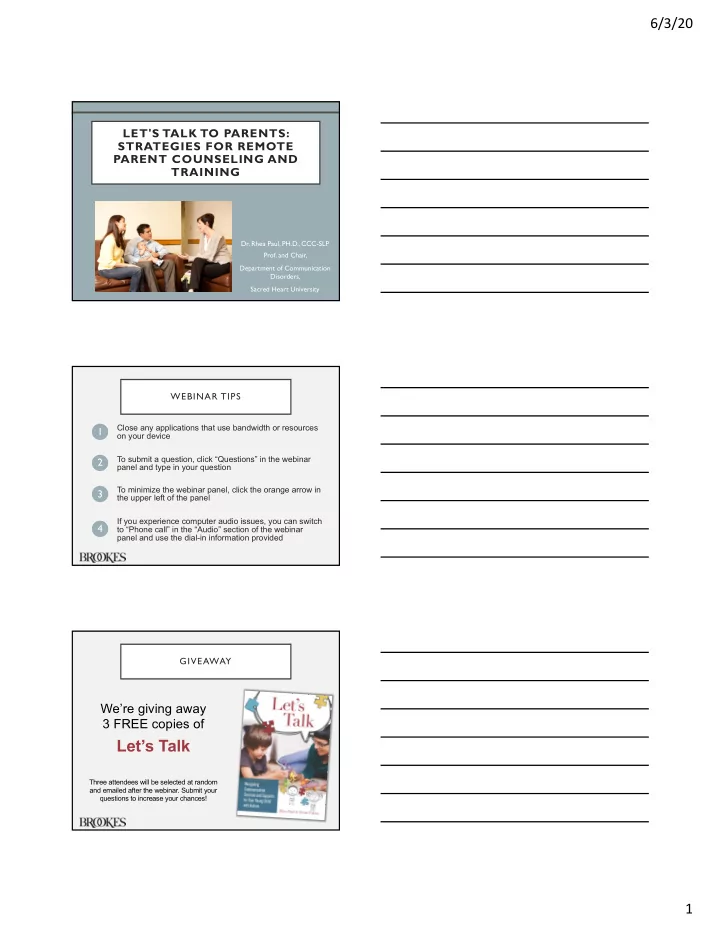
6/3/20 LET'S TALK TO PARENTS: STRATEGIES FOR REMOTE PARENT COUNSELING AND TRAINING Dr. Rhea Paul, PH.D., CCC-SLP Prof. and Chair, Department of Communication Disorders, Sacred Heart University WEBINAR TIPS Close any applications that use


slide-1
SLIDE 1

6/3/20 1

LET'S TALK TO PARENTS: STRATEGIES FOR REMOTE PARENT COUNSELING AND TRAINING

  • Dr. Rhea Paul, PH.D., CCC-SLP
  • Prof. and Chair,

Department of Communication Disorders, Sacred Heart University

WEBINAR TIPS

Close any applications that use bandwidth or resources

  • n your device

To submit a question, click “Questions” in the webinar panel and type in your question To minimize the webinar panel, click the orange arrow in the upper left of the panel If you experience computer audio issues, you can switch to “Phone call” in the “Audio” section of the webinar panel and use the dial-in information provided

1 2 4 3

GIVEAWAY

We’re giving away 3 FREE copies of

Let’s Talk

Three attendees will be selected at random and emailed after the webinar. Submit your questions to increase your chances!

slide-2
SLIDE 2

6/3/20 2

LET'S TALK TO PARENTS: STRATEGIES FOR REMOTE PARENT COUNSELING AND TRAINING

  • Dr. Rhea Paul, PH.D., CCC-SLP
  • Prof. and Chair,

Department of Communication Disorders, Sacred Heart University

  • Dr. Rhea Paul, Prof. and Chair,

Department of Communication Disorders, Sacred Heart University Disclosure:

  • Financial —Author for Elsevier,

Brookes, Wiley, Plural,Pro-Ed Publishers and receives royalty payments.

  • Nonfinancial — None

DISCLOSURES

LEARNING OBJECTIVES Following this course, participants will be able to:

  • Discuss the role of parent counseling with the

work of the SLP .

  • Name four strategies for parent counseling.
  • Discuss characteristics of adult learners for use in

guiding parents to carry over language activities in the home.

  • Name three evidence-based adult learning

strategies.

slide-3
SLIDE 3

6/3/20 3

LUTERMAN (2006)

“SLPs and AuDs need to incorporate both counseling and teaching in our clinical interactions.”

PARENT COUNSELING

  • T
  • ols of counseling (Andrews,

2020)

  • Unconditional positive regard
  • Active listening
  • Silence
  • Open-ended questions
  • Solution-focused questions
  • Summarizing
  • Concerns
  • Feelings
  • Full range of issues and

questions addressed in discussion

EX AM PLES O F O PEN AN D CLO SED Q U ESTIO N S

  • From an early childhood session:
  • “Do you ever play with him?”
  • Preferred: “What does he enjoy doing when you play with

him?”

  • From a parent of a 9-year-old struggling with

reading:

  • “What book does he like the best?
  • Preferred: “You said you noticed that he doesn’t seem to

retain what he reads. He brought a book to school about a basketball player, and he seemed very interested in it. How does he tell you about the book after he reads something that really interests him?”

slide-4
SLIDE 4

6/3/20 4

  • T
  • a client: “How did you have

that fluent conversation with your friend?”

  • T
  • a parent: “That’s a great

idea, how did you think of that?”

  • When talking to a teacher: “He

did it! How did you help him to follow that group

EX AM PLES O F SO LU TIO N - FO CU SED Q U ESTIO N S

A N D R AG O G Y ( K N OW L E S , 2 0 1 4 )

  • Acknowledge parents’ life experience and

prior knowledge.

  • Scaffold:
  • Introduce resources and skills that

learners are likely to know or have already done.

  • Progress by teaching how to use them in

new activities.

  • Highlight successful past experiences to

teach them new skills and their benefits.

  • Collaborate
  • Exchange experiences with others while

connecting them to new learning.

  • Provide opportunities for peer-to-peer

learning, parent-parent discussions, whenever possible (online).

E V I D E N C E - B A S E D S T R AT E G I E S F O R A N D R A G O G Y ( M C C A L L , PA D R O N , & A N D R E W S , 2 0 1 8 )

slide-5
SLIDE 5

6/3/20 5

COUNSELING AND TRAINING AT A DISTANCE

  • Alternate direct service (1/week)

with parent-delivered telehealth Tx 1x/week effective with ASD (Baharav & Reiser (2010).

  • Video conferencing combined with
  • nline instruction to support

parental learning and improve child behaviors was somewhat effective with ASD (Vismara et al., 2013).

  • Parent training led to improvement

when child book-reading; parent— child conversations; and parent— child writing to improve children’s language and literacy in language delay (Reese et al., 2010)

  • Effective procedures include: (a)

verbal instruction and/or instruction manuals, (b) in vivo practice, (c) role playing, (d) modeling by trainer, and (e) reviewing videos of intervention sessions (Lang et al., 2009).

PARENT TRAINING: SUMMARY

  • Collateral behaviors, such as maladaptive behavior, joint attention, and

imitation seem to respond to parent-delivered intervention in children with ASD

  • More general communicative behaviors, such as expressive language

and preliteracy seem less responsive.

  • Less evidence for increasing language and preliteracy skills in children

with language impairments.

  • For non-autistic, more general language and intellectual delays, focus
  • n child book-reading; parent—child conversations around specific

topics and vocabulary; and parent—child writing.

  • For all, teach specific skills rather than general stimulation.

PARENT RESOURCES Books: Let’s Talk: Navigating Social Communicative Supports for your Young Child with ASD by R. Paul & D. Fahmi When your Child has a Disability by M. Batshaw Parent-to-Parent Handbook by B. Santelli et al. Loving Lindsay by L. Atwell Media:

  • Podcast: Let’s Talk about Super

Special Kids and Cake

  • Podcast: Parenting Special Needs
  • Blog:

https://www.friendshipcircle.org

  • Websites:

https://www.parentcenterhub.org

  • https://www.cec.sped.org
  • http://www.familyvoices.org
  • https://fcsn.org
  • Zine: http://www.eparent.com
slide-6
SLIDE 6

6/3/20 6

REFERENCES

Andrews, D. (in press). Counseling and clinical communication. In Paul, R., & Simmons, E.

  • S. Introduction to Clinical Methods in Communication Disorders (4th ed.). Paul H Brookes

Publishing. Baharav, E., & Raiser, C. (2010). Using telepractice in parent training in early autism. Telemedicine and E-Health, 16, 727–731. Knowles, M. (2014). The Adult Learner: The definitive classic in adult education and human resource development (8th edition). N.

  • Y. Routledge.

Lang, R., Machalicek, W., Rispoli, M., & Regester, A. (2009). Training parents to implement communication interventions for children with autism spectrum disorders (ASD. Evidence-Based Communication Assessment and Intervention, 3(3), 174–190. Luterman, D. (2018). The Counseling Relationship. The ASHA Leader. Reese, E., Sparks, A., & Leyva, D. (2010). A Review of parent interventions for preschool children’s language and emergent literacy. Journal of Early Childhood Literacy, 10(1), 97– 117. Vismara, L. A., McCormick, C., Young, G. S., Nadhan, A., & Monlux, K. (2013). Preliminary Findings of a Telehealth Approach to Parent Training in Autism. Journal of Autism and Developmental Disorders, 43(12), 2953–2969.

QUESTIONS?

?

slide-7
SLIDE 7

6/3/20 7

SPECIAL OFFER

SAVE 20%*

at brookespublishing.com Use code

COFFEETALK

*Expires 6/30/20. Not to be combined with any other discounts or offers. Consumer orders only, please. Excludes BOL training, pre-discounted bundles, and online products such as ASQ Online and AEPSinteractive.

BROOKES COFFEE CHATS

Looking for more professional development

  • pportunities?

http://bit.ly/BrookesCoffeeChats

Every Monday, Wednesday, and Friday!

COVID-19 RESOURCES

  • Recommended reading
  • Downloadable resources
  • Professional development

webinars http://bit.ly/COVID-education