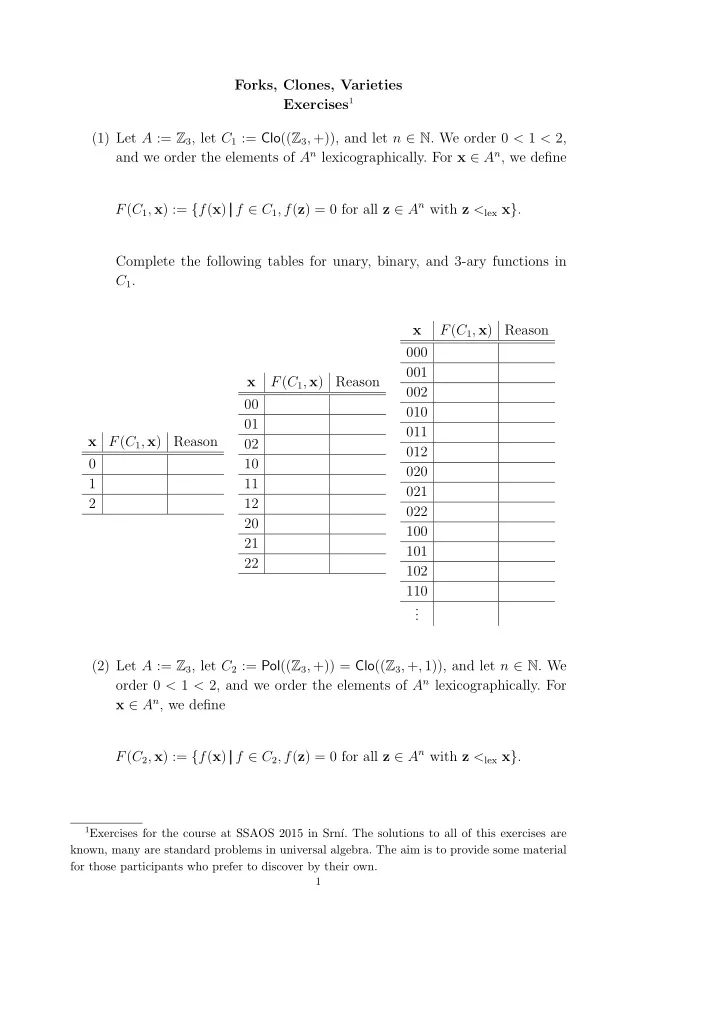
Forks, Clones, Varieties Exercises 1 (1) Let A := Z 3 , let C 1 := - - PDF document

forks clones varieties
SMART_READER_LITE
LIVE PREVIEW

Forks, Clones, Varieties Exercises 1 (1) Let A := Z 3 , let C 1 := - - PDF document

Forks, Clones, Varieties Exercises 1 (1) Let A := Z 3 , let C 1 := Clo (( Z 3 , +)), and let n N . We order 0 < 1 < 2, and we order the elements of A n lexicographically. For x A n , we define | f C 1 , f ( z ) = 0 for all z A


slide-1
SLIDE 1

Forks, Clones, Varieties Exercises1 (1) Let A := Z3, let C1 := Clo((Z3, +)), and let n ∈ N. We order 0 < 1 < 2, and we order the elements of An lexicographically. For x ∈ An, we define F(C1, x) := {f(x)| | | f ∈ C1, f(z) = 0 for all z ∈ An with z <lex x}. Complete the following tables for unary, binary, and 3-ary functions in C1. x F(C1, x) Reason 1 2 x F(C1, x) Reason 00 01 02 10 11 12 20 21 22 x F(C1, x) Reason 000 001 002 010 011 012 020 021 022 100 101 102 110 . . . (2) Let A := Z3, let C2 := Pol((Z3, +)) = Clo((Z3, +, 1)), and let n ∈ N. We

  • rder 0 < 1 < 2, and we order the elements of An lexicographically. For

x ∈ An, we define F(C2, x) := {f(x)| | | f ∈ C2, f(z) = 0 for all z ∈ An with z <lex x}.

1Exercises for the course at SSAOS 2015 in Srn´

ı. The solutions to all of this exercises are known, many are standard problems in universal algebra. The aim is to provide some material for those participants who prefer to discover by their own.

1

slide-2
SLIDE 2

2

Complete the following tables for unary, binary, and 3-ary functions in C2. x F(C2, x) Reason 1 2 x F(C2, x) Reason 00 01 02 10 11 12 20 21 22 x F(C2, x) Reason 000 001 002 010 011 012 020 021 022 100 101 102 110 . . . (3) Let A := Z3, let C3 := Pol((Z3, +, ·)), and let n ∈ N. We order 0 < 1 < 2, and we order the elements of An lexicographically. For x ∈ An, we define F(C3, x) := {f(x)| | | f ∈ C3, f(z) = 0 for all z ∈ An with z <lex x}. Complete the following tables for unary, binary, and 3-ary functions in C3. x F(C3, x) Reason 1 2 x F(C3, x) Reason 00 01 02 10 11 12 20 21 22 x F(C3, x) Reason 000 001 002 010 011 012 020 021 022 100 101 102 110 . . .

slide-3
SLIDE 3

3

(4) (Connections between forks of different arities) Let C be a clone on Z3 that contains all unary constant functions. Prove: (a) F(C, 12) ⊆ F(C, 2). (b) F(C, 2102) = F(C, 212). (5) (Connections between forks of different arities) Let C be a clone on Z3. Prove: (a) F(C, 121) ⊆ F(C, 12). (b) F(C, 1112020) ⊆ F(C, 1120). (6) (Representation of subpowers) Let G be a group, n ∈ N, A ≤ B ≤ Gn

  • subgroups. Assume:

(a) A ⊆ B (b) ∀i ∈ {1, . . . , n}, ∀g ∈ G, ∀ri+1, . . . , rn ∈ G: (0, . . . , 0

i−1

, g, ri+1, . . . , rn) ∈ B ⇒ ∃si+1, . . . , sn ∈ G : (0, . . . , 0, g, si+1, . . . , sn) ∈ A, Show that then A = B. (7) (Generation of subpowers and the fork lemma) Let A be a finite algebra with a Mal’cev term, and let n ∈ N. Prove that every subalgebra of An can be generated by at most n·|A|2 elements. From this, derive that there is a real number c such that for all n ∈ N, An has at most 2cn2 subalgebras. (8) (Varieties) Let F be a type of algebras, let V be a variety of algebras of type F, let k ∈ N, and let ϕ := (s ≈ t) be an equation over F that uses at most k variables. Prove: V | = ϕ if and only if every k-generated algebra in V satisfies ϕ. (9) (Varieties) Let F be a type of algebras, let V be a variety of algebras of type F, let k ∈ N, and let A be a k-generated algebra of type F. Prove: A ∈ V if and only if A satisfies every identity of V with at most k variables. (10) (Chain conditions) Let V be a locally finite variety of arbitrary type F, and let W be a subvariety of V . Prove that the following are equivalent: (a) There exists no infinite strictly ascending chain of varieties V1 ⊂ V2 ⊂ V3 ⊂ · · · with W := V(

i∈N Vi).

(b) W is finitely generated. Remark: This exercise will be frustrating if you are not familiar with the following notions: equational theory of a variety, free algebras, Galois connection between varieties and equational theories, locally finite varie-

  • ties. In the lecture, we will need only the implication (10a)⇒(10b).

(11) Let V be a finitely generated variety. Prove that the following are equi- valent: (a) The subvarieties of V , ordered by ⊆, satisfy (ACC).

slide-4
SLIDE 4

4

(b) Every subvariety of V is finitely generated (12) Let V1 ⊃ V2 ⊃ V3 ⊃ · · · be an infinite strictly descending chain of varieties, and assume that V1 is locally finite. Prove that there is no k ∈ N such that W :=

i∈N Vi is the model of a set of equations such that each of

these has at most k variables; in particular W is not finitely based. (13) Let V be a finitely generated variety. Prove that the following are equi- valent. (a) The subvarieties of V , ordered by ⊆, satisfy (DCC). (b) For every subvariety W of V there is a finite set of identities Φ with W = {A ∈ V | | | A | = Φ}. (W is finitely based relative to V .) (14) (Ideals and expanded groups) Let V be an expanded group. Prove that I is the 0-class of a congruence of V if and only if I is a normal subgroup

  • f (V, +, −, 0) and for all n, for all n-ary fundamental operations f, and

for all vectors a ∈ V n and i ∈ In, we have f(a + i) − f(a) ∈ I. (15) (Ideals and expanded groups) Let V be an expanded group, and let B ⊆ V . Show that the ideal generated by B is given by I = {

n

  • i=1

pi(bi)| | | n ∈ N0, pi ∈ Pol1(V), pi(0) = 0, bi ∈ B for all i ∈ {1, . . . , n}}. (16) (Properties of commutators for expanded groups) Let V be an expanded group, and let I, A, B be ideals of V such that I ≤ A, B ≤ I. Prove that in V/I, we have [A/I, B/I] = ([A, B] + I)/I. (17) (Properties of higher commutators for expanded groups) Let A1, . . . , An be ideals of the expanded group V. Show [A1 + B1, A2, . . . , An] = [A1, A2, . . . , An] + [B1, A2, . . . , An].