Lessons learned f from experience of i f supporting DNAs - - PDF document

lessons learned f from experience of i f supporting dnas
SMART_READER_LITE
LIVE PREVIEW

Lessons learned f from experience of i f supporting DNAs - - PDF document

Institute for Global Environmental Strategies Towards sustainable development - policy oriented, practical and strategic research on global environmental issues Lessons learned f from experience of i f supporting DNAs supporting DNAs with


slide-1
SLIDE 1

Institute for Global Environmental Strategies

Towards sustainable development - policy oriented, practical and strategic research on global environmental issues

Lessons learned f i f from experience of supporting DNAs supporting DNAs with GEFs calculation

Addis Ababa, 20th April 2012 , p Africa Carbon Forum

Akiko Fukui Market Mechanism Group Market Mechanism Group, Institute for Global Environmental Strategies

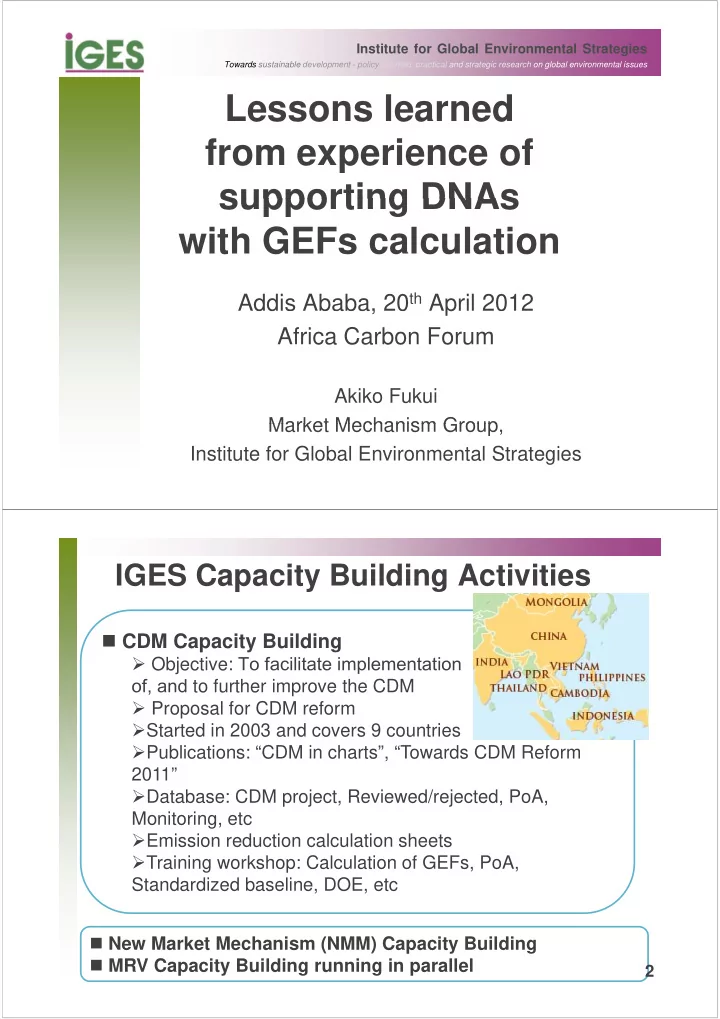
IGES Capacity Building Activities

 CDM Capacity Building p y g

  • Objective: To facilitate implementation
  • f, and to further improve the CDM
  • Proposal for CDM reform
  • Proposal for CDM reform
  • Started in 2003 and covers 9 countries
  • Publications: “CDM in charts”, “Towards CDM Reform

2011”

  • Database: CDM project, Reviewed/rejected, PoA,

Monitoring etc Monitoring, etc

  • Emission reduction calculation sheets
  • Training workshop: Calculation of GEFs, PoA,

Standardized baseline, DOE, etc  New Market Mechanism (NMM) Capacity Building  MRV Capacity Building running in parallel

2

slide-2
SLIDE 2

Supporting GEF calculation

Country Counterpart Activity

Cambodia

Ministry of Environment

  • Training workshop

Publication of the

Cambodia

  • Publication of the

report

Vi t

Ministry of Natural

  • Training workshop

Vietnam

Resources and Environment

  • Review of the

calculation Department of

  • Training workshop

Philippine

p Environment and Natural Resources g p

  • Review of the

calculation Ministry of Natural ・Research for data

Lao PDR

Ministry of Natural Resources and Environment Research for data availability

Tool and database

  • List of Grid Emission Factor

P bli h d GEF i 9 t i GEF i h CDM j t

Tool and database

http://www.iges.or.jp/en/cdm/report_grid.html

Published GEFs in 9 countries, GEFs in each CDM projects

  • CDM Grid Emission Factor Calculation Sheet

3

IGES CDM Grid Emission Factor Calculation Sheet (Simple /Average OM Option A grid power plants version) (Simple /Average OM, Option A, grid power plants version) Automation

  • Identification of low cost /must run resources

Identification of low cost /must run resources

  • Calculation with IPCC’s default values
  • BM sample group selection

4

slide-3
SLIDE 3

When grid emission factor (GEF) is needed?

 To determine CO2 emission factor for the displacement of electricity generated by power plants in an electricity system

  • h

j i i li l i i id

  • where a project activity supplies electricity to a grid
  • or a project activity that results in savings of electricity

th t ld h b id d b th id that would have been provided by the grid

The share of the registered projects with GEF By project type Without GEF 22% 82% 98% 99%

Waste gas/heat utilization Hydro Power Wind Power

22% 70% 73% 79% 82%

Methane recovery & … Biomass Other renewable energies Waste gas/heat utilization

With GEF 78% 40% 44% 45% 45%

SF6 replacement Biogas Fuel switch Cement IGES project database (IGES 2012 Apr)

78% 40% 0% 25% 50% 75% 100%

SF6 replacement

5

Data collection is hurdle for PPs

Required data

Simple OM, Weighted average CM Simple OM, Weighted average CM

Data from each of power units d h id* connected the grid*

  • Net Electricity Generation
  • Type of Fuel

Diffi lt t ll t d t il d t

  • Type of Fuel
  • Date of commission
  • Fuel consumption (if available)

Difficult to collect detail data If the data of the export t i t il bl

p ( ) Data vintage: Ex-ante (3years)  Electricity imported by country

country is not available, 0 CO2 -t/MWh is selected.

*Unit base data is not required in LDC or a country with less than 10 registered CDM projects (Simplified CM)

GEF d b bli h d b DNA

6

GEFs are expected to be published by DNA

slide-4
SLIDE 4

CERs from RE & EE depends on GEFs

Baseline scenario Concept of emission reduction in RE project (ACM0002, AMS I.D.)

GEF

Baseline scenario

CO2 CO2

Baseline Emissions = Electricity Generation X CO2 Emission Factor

GEF

CO2

Thermal Power Thermal Power Thermal Power Thermal Power Emissions ( x MWh) (y t-CO2/MWh)

Project scenario

Electricity Electricity supply to the supply to the grid grid Thermal Power Thermal Power Thermal Power Thermal Power Project E i i = Electricity Generation X CO2 Emission Factor Hydro Power Hydro Power Hydro Power Hydro Power Emissions Generation ( x MWh) X (0 t-CO2/MWh*)

*small volume of GHG is considered depending on a situation

CO2 Emission Reductions = Baseline emissions- Project emissions = xy t-CO2/year ⇒ CERs 7

Low GEFs in LDCs

Angola DR Congo Ethiopia Lao PDR Lesotho Mozambique Nepal Zambia Paraguay Colombia Costa Rica 100%

LDC Non LDC

The share

Low

p Malawi Madagascar Uganda Cameroon Congo Namibia Brazil Colombia

LDC Having project using GEF Having no project using GEF

  • f

renewable energy

Togo Tanzania Madagascar Gabon Zimbabwe Kenya 50%

g

Supposed GEF

Sudan Gabon Viet Nam Source: IGES (CDM project database), IEA (The Electricity Access Cambodia Eritrea China India Indonesia

Hi h

Saudi Arabia (The Electricity Access Database), EIA (International Energy Statistics) Benin Eritrea Timor-Leste Yemen 0% 0% 50% 100%

Electrification rate

High

With GEF l l t d d th t t l bl

South Africa

With GEF calculated under the present tool, renewable energy projects for CDM may not promote electrification.

8

slide-5
SLIDE 5

Why is the exist power source component of the grid the baseline in low electrification rate areas? grid the baseline in low electrification rate areas?

Project power plants might be expected to add the capacity of Definition of BM emission factor : “an emission factor refers to the expected to add the capacity of electricity supply and expand electrification coverage area, an emission factor refers to the group of prospective power plants whose construction and g not substitute to exiting power plants connected to the grid. future operation” But it refers existing power plants in the calculation tool.

Recommendation

in the calculation tool.

Use a default emission factor under the concept of “suppressed demand”

Include prospective power plants in GEF(BM) calculation

・Government approved

“suppressed demand”.

Government approved ・Commences in 5 years

Use of plant/unit capacity dditi i t d f Qt l t i it additions instead of Qt. electricity generated for BM emission factor9

Conclusions

  • GEFs is the most utilized parameter in emission

reduction calculation especially in renewable reduction calculation, especially in renewable energy projects. D t l t d t l t i it ti i t i t

  • Data related to electricity generation import is not

easy be collected. =>Need to build a platform to publish GEFs

  • There are many countries which may have a low

y y GEF due to their power sources (high hydro share) =>Revision of the GEF tool is needed for the >Revision of the GEF tool is needed for the countries with high share of renewable energy power generation and low electrification rate power generation and low electrification rate.

10