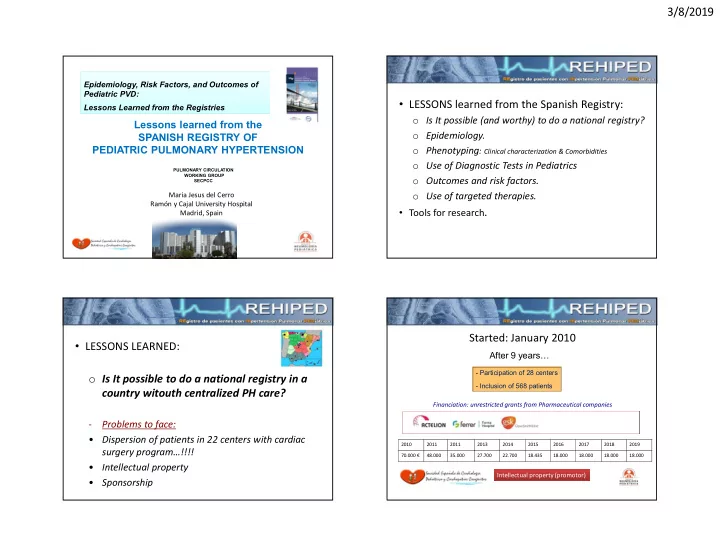
3/8/2019 Epidemiology, Risk Factors, and Outcomes of Pediatric PVD: - - PowerPoint PPT Presentation

3 8 2019
SMART_READER_LITE
LIVE PREVIEW

3/8/2019 Epidemiology, Risk Factors, and Outcomes of Pediatric PVD: - - PowerPoint PPT Presentation

3/8/2019 Epidemiology, Risk Factors, and Outcomes of Pediatric PVD: LESSONS learned from the Spanish Registry: Lessons Learned from the Registries o Is It possible (and worthy) to do a national registry? Lessons learned from the o


slide-1
SLIDE 1

3/8/2019 1

Lessons learned from the SPANISH REGISTRY OF PEDIATRIC PULMONARY HYPERTENSION

PULMONARY CIRCULATION WORKING GROUP SECPCC

Epidemiology, Risk Factors, and Outcomes of Pediatric PVD: Lessons Learned from the Registries Maria Jesus del Cerro Ramón y Cajal University Hospital Madrid, Spain

  • LESSONS learned from the Spanish Registry:
  • Is It possible (and worthy) to do a national registry?
  • Epidemiology.
  • Phenotyping: Clinical characterization & Comorbidities
  • Use of Diagnostic Tests in Pediatrics
  • Outcomes and risk factors.
  • Use of targeted therapies.
  • Tools for research.
  • LESSONS LEARNED:
  • Is It possible to do a national registry in a

country witouth centralized PH care?

  • Problems to face:
  • Dispersion of patients in 22 centers with cardiac

surgery program…!!!!

  • Intellectual property
  • Sponsorship

Started: January 2010

  • Participation of 28 centers
  • Inclusion of 568 patients

After 9 years…

2010 2011 2011 2013 2014 2015 2016 2017 2018 2019 70.000 € 48.000 35.000 27.700 22.700 18.435 18.000 18.000 18.000 18.000

Financiation: unrestricted grants from Pharmaceutical companies Intellectual property (promotor)

slide-2
SLIDE 2

3/8/2019 2

568 PATIENTS

Centros con 2 pacientes incluidos (0,34%) Centros con 1 paciente incluido (0,17%)

  • LESSONS LEARNED:
  • Design of the registry…
  • what kind of patients should we include?
  • Just PAH?
  • starting point…?

Jan 2009

Jan 2010 Jan 2011 Jan 2012 Jan 2013 Jan 2014 Jan 2015 Jan 2016 Jan 2017 Jan 2018

  • CASES: Diagnosed after January 2009
  • CASES Diagnosed before 2009
  • HISTORICAL CASES: Diagnosed and Finished (Exitus /tx) before 2009

(n= 398) 70% (n= 141) 25% (n= 27) 5% Diagnosed after 2009 Historical

(Dx and finished before 2009)

Diagnosed before 2009

2009 2019

25% 5% 70%

385 patients

PULMONARY HYPERTENSION Biventricular Circulation

Survival from diagnosis

slide-3
SLIDE 3

3/8/2019 3

Etiologic Group Nice Classification 385 patients

PULMONARY HYPERTENSION Biventricular Circulation

PAH

Left Heart D Lung Disease

Data: January 2019

Inclusion of patients 2009-2018

100 200 300 400 500 600

2010 2011 2012 2013 2014 2015 2016 2017 2018

PH biventricular Univentricular P

  • LESSONS LEARNED:
  • Epidemiology of Pediatric PH and

Comparison with Adults Epidemiology

NATIONAL REGISTRIES

Cerro et al. AJRCCM 2014

slide-4
SLIDE 4

3/8/2019 4

Pulmonary ARTERIAL Hypertension

82%

15%) 2%

IDIOPATHIC CONGENITAL HEART DEFECT

36%

18,0% 19%

6,2% 7,0%

3,8% 1,7% 4,7%

2,8% %Idiopathic connective TD CHD HIV Portal hypert TOS Venoclus Other 2 or more etiology

IDIOPATHIC

CONNECTIVE TISSUE DISEASE

19%

NATIONAL REGISTRIES

SPAIN

Ajrccm 2014

UK

Heart 2009

FRANCE

Arch Cardiov Dis 2010

Netherands

Circulation 2011

nº pts PH

Nº pts PAH

264 161 216 154 50 50

3263/ 572 156

PAH incidence PAH prevalence 2.56 14 3.7 3 20 IPAH Incidence IPAH prevalenc. 0.49 2.9 0.48 2.07 2.2 0.7 4.4

MULTIFACTORIAL Etiology

SPANISH ADULT REGISTRY SPANISH PEDIATRIC REGISTRY

2.8% 31%

23%

33%

10%

33%

eisenmenger. small defect, high PVR big defect, high PVR ph after defect closure

20% 5% 68% 5%

REHIPED REHAP PEDIATRIC REGISTRY ADULT REGISTRY

Abstract presented at the 6th Pediatric Cardiology World Congress, Cape Town 2013

slide-5
SLIDE 5

3/8/2019 5

  • Lessons learned:
  • Phenotyping:
  • Clinical characterization & Comorbidities

385 patients

PULMONARY HYPERTENSION in Biventricular Circulation

mPAP > 25 mmHg and PVRI > 3 WU.m2

N= 385 (67,8%) Data: January 2019

GENDER

Male Female 189 (49,1%) 196 (50,9%)

385 patients

PULMONARY HYPERTENSION Biventricular Circulation

AGE at diagnosis

Mean: 3,60 + 4,58 years

385 patients

PULMONARY HYPERTENSION Biventricular Circulation

slide-6
SLIDE 6

3/8/2019 6

Etiologic Group Nice Classification 385 patients

PULMONARY HYPERTENSION Biventricular Circulation

PAH

Left Heart D Lung Disease

COMORBIDITIES

AJRCCM 2014

% % % %

CHROMOSOMOPATHY 385 patients

PULMONARY HYPERTENSION Biventricular Circulation

PREMATURITY AND PULMONARY HYPERTENSION

PERSONAL HISTORY In 2012: 21,8% Prematurity < 34 weeks GA

2018

slide-7
SLIDE 7

3/8/2019 7

GROUP I 240 patients

PULMONARY ARTERIAL HYPERTENSION

169 patients

Congenital Heart Disease - PAH

  • Cardiomyopathies (n=16; 38%)
  • Mitral / aortic valve disease (n=22; 52%)
  • Pulmonary vein stenosis (n=9; 21%)

GROUP II 42 patients

PULMONARY HYPERTENSION LEFT HEART DISEASES

  • Bronchopulmonary Dysplasia (n=43; 52%)
  • Other Developmental Lung Disorders (n=27; 33%)
  • Chronic Obstructive Pulmonary Disease (n=6; 7%)
  • Interstitial Lung disease (n=13; 16%)
  • OSAS (n=4; 5%)
  • Cystic fibrosis (n=1; 1%)

82 patients

PH LUNG DISEASE / HYPOXEMIA

GROUP III

slide-8
SLIDE 8

3/8/2019 8

ADULT REGISTRY CTEPH prevalence: 3.2 cases/million CTEPH prevalence: 0.36 cases/million younger than 18 years

GROUP IV 2 patients

PULMONARY HYPERTENSION CHRONIC THROMBOEMBOLIC DISEASE

There are 2 Patients with other etiology who have Chronic Thromboembolic Disease, 1 of group I and 1 of group II.

Metabolic Diseases (n=19, 79%)

–Thyroid disorders (n=1) –Non-ketotic hyperglycinemia (n=12) –Mitochondrial diseases (n=8) –NFU Gene Mutation (n=2) –Lipoic Acid deficit (n=1) –Neonatal Hemochromatosis (n=1)

 Autosomal inheritance diseases  High lethality  Correct diagnosis of the affected child allows prenatal diagnosis.

19 patients

PULMONARY HYPERTENSION “UNKNOWN” ETIOLOGY

GROUP V

Lessons learned …

  • Are we achieving early diagnosis?
  • Use of Diagnostic Tests

Time interval (months) between symptoms and PH diagnosis > 18 years

2,6 + 5,4 YEARS in adult population with HP

  • f I and IV etiology groups.

385 patients

PULMONARY HYPERTENSION Biventricular Circulation

slide-9
SLIDE 9

3/8/2019 9

FUNCTIONAL CLASS (NYHA) at diagnosis

50% PATIENTS

diagnosed in FC III/IV 385 patients

PULMONARY HYPERTENSION Biventricular Circulation

DIAGNOSTIC TESTs 52,7%

CHEST CT / MRI

11,9% PULMONARY VEIN STENOSIS

94,3% synus rythm

17,7% V/Q LUNG SCAN

12,5% PULMONARY HYPOPLASIA

80,0% Abnormal chest X-ray

2012: 6,2%

385 patients

PULMONARY HYPERTENSION Biventricular Circulation

Beguetti M, et al Eur Respir J 2013; 42: 689–700

TOPP registry TOPP

ERJ 2013

REHIPED

AJRCCM 2014

Lung Function Tests 27% 16% Lung Scintigraphy 23% 24% Overnight O2 Sat 28% Polisomnography 15% CT scan 41% 52% CT/MRI MRI 9% 52% CT/MRI CPET 7%

Cerro Mj, et al. AJRCCM 2014

Pediatric Registries:

Use of Diagnostic Tests

CATHETERIZATION DATA

2012: pts catheterized

385 patients

PULMONARY HYPERTENSION Biventricular Circulation

slide-10
SLIDE 10

3/8/2019 10

SEVERE COMPLICATIONS

(4,6%) EXITUS (0,8%)

CATHETERIZATION COMPLICATIONS

2012: 195 pts SEVERE COMPLICATIONS (5,1%) EXITUS

3 (1,5%)

2019: 326 pts

2012 reported in AMRCC 2014

480 catheterizations in 326 patients

PULMONARY HYPERTENSION Biventricular circulation

Acute Vasoreactivity TEST in 277 catheterizations (58%) 480 catheterizations 326 patients

PULMONARY HYPERTENSION Biventricular circulation

480 catheterizations in 326 patients

PULMONARY HYPERTENSION Biventricular circulation

CATHETERIZATION CONDITIONS

SPAIN

AJRCCM 2014

UK

Heart 2009

FRANCE

Arch Cardiov Dis 2010

REVEAL (USA)

Circulation 2011

Dutch

Circulation 2011

TOPP

Lancet 2012 JACC 2016

nº pts PH nº pts PAH 264 161 216 154 50 50 216

3263/ 572 156

356 317

% IPAH

Responders

6%

Barst or Sitbon criteria

7.4% 11% PAH

19% Sitbon 35% Barst 15% Sitbon 30% Barst

Prospective patients

45 % 30% 14% 30%

Catheterization conditions

8% sedation 87% general anesthesia 50% sedation 50% general anesthesia

PEDIATRIC PHVD REGISTRIES

DIFFERENCES IN THE WAY THE VASOREACTIVITITY TESTING WAS DONE?

TOPP: “There were significantly more responders in the patients tested under procedural sedation compared to patients under general anesthesia.”

slide-11
SLIDE 11

3/8/2019 11

PEDIATRIC REGISTRY

Systolic Pulmonary pressure/Systolic Aortic pressure

81,9±27,3

Mean Pulmonary Pressure (MPAP)

44,4±16,8

Cardiac Index

4,2±1,9

PVRI

12,4±9,5

PVRI/ SVRI

0,78±0,50

RAP

9,2±8,0 PWP 12,0±6,0 Grad.Transpulmonar 33,0±17,1

HEMODYNAMIC DATA

49,3 + 15,1 2,5 + 0,8 11.5 + 7,7

ADULT REGISTRY

268 patients catheterized at diagnosis

PULMONARY HYPERTENSION Biventricular circulation

CI (l/min/m2) mPAP (mmHg) PWP (mmHg) PVR (WU.m2) GRUPO I

3,76 46,6 11,34 84,7% 13,39 82%

GRUPO II

4,50 41,8 18,57 80,4% 10,32 73%

GRUPO III

5,21 35,8 11,28 66,3% 9,21 66%

GRUPO IV

2,40 37,00 6,00 85,2% 26,87 59%

GRUPO V

5,90 45,0 8,50 93,6% 9,89 82%

268 patients catheterized at diagnosis

PULMONARY HYPERTENSION Biventricular circulation

HEMODYNAMIC DATA AND ETHIOLOGY

  • LESSONS LEARNED:
  • Outcomes and risk factors .

Assesing Pulmonary Hypertensive Vascular Disease in Childhood: Data from the Spanish Registry Am J resp crit care med 2014 GROUP III LUNG DISEASE

Heart 2008

Data about management & survival of PHVD in lung disease, left heart disease, … Are still needed

slide-12
SLIDE 12

3/8/2019 12

SPAIN

REHIPED Ajrccm 2014

UK

Heart 2009

FRANCE

Arch Cardiov Dis 2010

REVEAL (USA)

Circulation 2011

Dutch

Circulation 2011

TOPP

19 countries Lancet 2012

nº pts PH nº pts PAH 264 161 216 154 50 50 216

3263/ 572 156

356 317 SURVIVAL From

DIAGNOSIS ENROLLMENT ENROLLMENT DIAGNOSIS & ENROLLMENT DIAGNOSIS

Prospective patients 45 % 30% 14% 30%

1 and 3 year Survival

PAH IPAH CHD-PAH 90% , 86% 83%, 80% 91%, 87% 89% , 83% 89%, 76% 89%, 84% 92%, 83% 86% 86%, 82% 96%, 84% 100%, 92% 86%, 71% 73%, 63% 62%, 50% 67%, 60%

Pediatric Registries

SPAIN

AJCCM 2014

UK

Heart 2009

UK IPAH

FRANCE

Arch Cardiov Dis 2010

REVEAL

(USA) Circulation 2011

Dutch

Circulation 2011

Nº pts PAH 161 154 64 50 216

156 Combined Therapy 43%

27% 68%

22% 42% 43%

% receiving

PROSTANOIDS

23% 46% 24%

42%

Calcium Channel blockers

12% 20%

Oral anticoagulation

7% 20%

PEDIATRIC PHVD REGISTRIES

Looking at RISK FACTORS for PAH :

REVEAL Older age at dg Higher PVRI Weight Z score Negative VRT BNP DUTCH Functional class Ratio PAP/AorticP Venous saturation Cardiac Index Uric acid levels ntPro BNP UK IPAH Functional Class Weight Z scores SPANISH Functional class Younger age at dg Cardiac Index Right Atrial Pressure TOPP Weight Z score

< 2 years >8 years 2-8 years

SURVIVAL AND AGE AT DIAGNOSIS 385 patients

PULMONARY HYPERTENSION Biventricular Circulation

 > 8 years  2-8 years  < 2years

INCIDENT CASES DG after 2009

slide-13
SLIDE 13

3/8/2019 13

SURVIVAL AND AGE AT DIAGNOSIS

PREVALENT CASES (Dx before 2009)

 > 8 years  2-8 years  < 2years

< 2 years 2-8 years > 8 years

385 patients

PULMONARY HYPERTENSION Biventricular Circulation

Eisenmenger

Unrestrictive Shunts PAH after defect correction PAH with coincidental defects

169 patients

Congenital Heart Disease - PAH

SURVIVAL CONGENITAL HEART DISEASE PAH

Data: January 2019

Assesing Pulmonary Hypertensive Vascular Disease in Childhood: Data from the Spanish Registry

Am J Resp Crit Care Med 2014

Eisenmenger Postoperative Eisenmenger Postoperative Postoperative

Heart 2008

Circulation 2011 CTD

  • Lessons learneded:

.

  • Use of targeted therapies in Spain.
slide-14
SLIDE 14

3/8/2019 14

SUPPORTIVE THERAPY

205 ptes. (53%) with supportive therapy

385 patients

PULMONARY HYPERTENSION Biventricular Circulation

TARGETED THERAPIES

(n=333)

385 patients

PULMONARY HYPERTENSION Biventricular Circulation

PH TARGETED THERAPIES 333 patients

PULMONARY HYPERTENSION Biventricular Circulation LUNG TRASPLANT …….. 12

 HEART TRASPLANT……. 8

ATRIOSEPTOSTOMY……19 DEFECT CLOSURE after vasodilatadory treatment ... 11

  • clusion test……………………...... 6

direct closure………………..……...52

 PULMONARY ARTERIES ANGIOPLASTY………… 23  PULMONARY VEIN ANGIOPLASTY ………………. 11  OTHER SURGERIES ORL…………………………… 14 NISSEN……………………..… 18 TROMBOENDARECTOMY …..1 PNEUMENECTOMY …………..4 OTHERS……………………… 31

NON PHARMACOLOGIC TREATMENT 385 patients

PULMONARY HYPERTENSION Biventricular Circulation

slide-15
SLIDE 15

3/8/2019 15

568 REHIPED patients TEMPORAL TREND IN PROSTANOIDS USE

5 10 15 20 25

2010 2014 2018

number of patients

Epoprostenol

  • Inh. Iloprost

SC Treprostinil Selexipag

Data 2018 Spanish Registry Pediatric PH (unpublished)

50 100 150 200 250

2010 2014 2018

number of patients

Sildenafil Tadalafil

568 REHIPED patients TEMPORAL TREND IN 5PDE-i USE

Januaary 2019

568 REHIPED patients

20 40 60 80 100 120 140

2010 2014 2018

number of patients

Bosentan Ambrisentan Macitentan

TEMPORAL TREND IN ERA use

  • Lessons learneded:

.

  • Sildenafil dosing and Outcomes
slide-16
SLIDE 16

3/8/2019 16

Sildenafil Dosing And Outcomes In Pediatric Pulmonary Hypertension: Data From The Spanish Registry For Pediatric PH Sildenafil Dosing And Outcomes In Pediatric Pulmonary Hypertension: Data From The Spanish Registry For Pediatric PH EMA RECOMENDATION: 10 mg/8 hours children < 20 kg weight 20 mg/8 hours children > 20 kg weight 289 PEDIATRIC PATIENTS (PH and Fontan pts) RECEIVING SILDENAFIL Poster presented at the ATS Meeting, San Diego, May 2014

  • Lessons learneded:

.

  • Off Label Use of PH Targeted Drugs

in Single Ventricle Phisiology

183 patients

FONTAN Single ventricle physiology

mPAP < 25 mmHg

N= 183 (32,2%) Protein losing Enteropathy or Plastic Bronchitis in Fontan 27; 14,8% Improvement of functional Class (6MWDT or CPET) 67; 36,6% Increase of O2 Sat in single lung or fenestrated Fontan 19; 10,4% Increase of Glenn saturation 56; 30,6% Decrease of RVP previous to Glenn or Fontan 78; 42,6% Decrease of RVP previous to fenestration close in Fontan 30; 16,4% Growth in size of AAPP previous to Glenn/Fontan 39; 21,3%

REASON TO START TREATMENT 183 patients

SINGLE VENTRICLE

slide-17
SLIDE 17

3/8/2019 17

AGE AT DIAGNOSIS

Average: 7,13 + 6,63

183 patients

SINGLE VENTRICLE

GENDER 183 patients

SINGLE VENTRICLE

STAGE OF PALLIATION

FONTAN Procedures

183 patients

SINGLE VENTRICLE

Stage I or Stage II

Single ventricle Patients with catheterization at diagnosis

Systolic Pulmonary pressure/Systolic Aortic pressure 21,6±10,2 Mean Pulmonary Pressure (MPAP) 15,3±5,8

PVRI 5,0±2,4

PVRI/ SVRI 0,34±0,16 PWP 10,4±3,0

Transpulmonary Gradient 4,6±5,1 HEMODYNAMIC DATA 183 patients

SINGLE VENTRICLE

slide-18
SLIDE 18

3/8/2019 18

179 patients

Use of PH TARGETED Therapies in Single Ventricle FUNCTIONAL CLASS (NYHA) Before and after Targeted therapies

183 Patients

Single Ventricle

6-MIN WALK TEST (6MWT) Before and after targeted therapies

453±72 m 561±123 200 400 600

BEFORE AFTER

6MWDT

38 pts with 6MWDT

Januray 2019

Alejandro Rodriguez Ogando1, Carlos Labrandero de Lera2; Alberto Mendoza Soto3; Inmaculada Guillén4; Marta Lopez Ramon5; Amparo Moya Bonora6; Carolina Blanco Rodríguez7; Elena Gomez Guzman8; Soledad Jimenez Casso9, M. Elvira Garrido Lestache10; María Jesús Cerro Marin10 on behalf of REHIPED registry investigators. 1.Servicio de Cardiología. Hospital Universitario Gregorio Marañón. Madrid 2 Servicio de Cardiología Pediátrica. Hospital Universitario La Paz. Madrid . 3 Servicio de Cardiología Pediátrica. Hospital

Universitario Doce de Octubre. Madrid 4 Servicio de Cardiología Pediátrica. Hospital Universitario Virgen del Rocío. Sevilla. 5 Servicio de Cardiología. Hospital Universitario Miguel Servet. Zaragoza (España) 6 Servicio de Cardiología Infantil. Hospital Infantil Universitario La Fe. Valencia (España) 7 Servicio de Cardiología Pediátrica. Hospital Universitario A Coruña. Coruña (España) 8 Servicio de Cardiología Pediátrica. Hospital Universitario Reina Sofía. Córdoba (España) 9 Servivio de Pediatria, Hospital Segovia, 10 Servicio de Cardiología Pediátrica. Hospital Universitario Ramón y Cajal. Madrid (España).

1 . U n i d a d d e B i
  • t
e c n
  • l
  • g
í a C e l u l a r , I n s t i t u t
  • d
e S a l u d C a r l
  • s
I I I , M a d r i d E
  • 2
8 2 1 , S p a i n . 2 . S e r v i c i
  • d
e C a r d i
  • l
  • g
í a P e d i á t r i c a . H
  • s
p i t a l U n i v e r s i t a r i
  • R
a m ó n y C a j a l . M a d r i d . S p a i n . 3 . C e l l A n d G e n e L a b
  • r
a t
  • r
y . H
  • s
p i t a l U n i v e r s i t a r i
  • N
i ñ
  • J
e s ú s . M a d r i d . S p a i n

METHODS

1) The addition of pulmonary vasodilators to conventional treatment resulted in PLE/PB resolution only in a small proportion of patients (23%), similar to previously reported series using conventional treatment. 2) When PLE/PB resolution was observed, it always happened in the first 6 months after the initiation of Pulmonary Vasodilators. 3) Worse Functional class (III/IV), lower Venous Oxygen saturation and longer interval from PLE/PB diagnosis to the initiation of Pulmonary Vasodilators were associated to lack of response and need for cardiac transplantation.

CONCLUSIONS

.

OBJECTIVE

Table 1: Comparison with previously reported series on PLE. *Conventional treatment: diuretics, corticosteroids, diet, anticoagulation, antiagregation, albumin infusions

RESULTS (III). RESULTS (I)

There is limited data about the potential role of pulmonary vasodilators (PV) as a treatment strategy for failing Fontan. To analyze the outcome of Fontan patients with Protein Losing Enteropathy (PLE) or Plastic Bronchitis (PB) who had received PV as part of the therapeutic strategy

Retrospective analysis of REHIPED database. Inclusion criteria: Fontan patientss included in REHIPED from 2009 to 2014 receiving PV as treatment for PLE/PB. We collected:

  • Clinical variables (CHD,age at Fontan, surgical technique, time between

Fontan surgery and PLE/PB diagnosis, functional class at PLE/PB diagnosis)

  • Echocardiographic variables (valvular regurgitacion, ventricular function)
  • Blood tests (total proteins, Albumin, Hemoglobin, hepatic enzymes, BNP )
  • Hemodynamics (CVP, MPAP, CI, PCWP, PVRI, SVRI, Oxygen Venous Saturation,
  • End Diastolic Ventricular Pressure, aortopulmonary collaterals),
  • Pharmacological /interventional treatments received.
  • We analyzed : rate of PLE/PB resolution, safety of PV, survival and potential predictors
  • f death, need for Cardiac transplantation or response to pulmonary vasodilators

(univariant analysis).

  • We compared the rate of PLE/PB resolution in our serie, with previoulsy reported series

using conventional treatments.

26 Fontan pts with PLE/PB

After Pulmonary Vasodilators

BACKGROUND

Median (IQR) Weight (kg) at PV initiation 29 (23-47) Age at FONTAN (years) 5.6 (5 – 6.8) Age at PLE/PB diagnosis 9.4 (6.9 -12.2) Time from Fontan to PLE/PB diagnosis (years) 2.8 (0.8-7.8) Follow up after PLE/BP diagnosis (years) 5.1 (2.5-6.4)

RESULTS (II).

Basal 6 months 12 months 24 months Functional Class I/II Functional Class III/IV Change in Functional Class from baseline after PV initiation

26 Fontan Patients

22 Protein Losing enteropathy 4 Plastic Bronchitis 4 (18%) PLE resolution 2 (50%) PB resolution Pulmonary Vasodilators NO SAEs of PVs reported

Treatments Received PLE n=22 PB n=4 Sildenafil 15 4 Bosentan 2 Sild+bosentan 5 Anticoagulation 12 3 Antiagregation 9 Oral budesonide 17 Inhaled Fibrinolytics 4 Fenestration 2 1 Collateral embolization 2 Stents (conduit/ PA) 13 1 Pacemaker/ Arrythmia ablation 4 2 Death/Cardiac Tx OR (p value) Response to PV OR (P value) Time from Fontan to PLE diagnosis 3.71( p=0.05) 1.46 (p=0,27) Time from PLE dg to PV start 4.23 (p=0.042) 5 (p=0.029) NYHA III or IV at PLE diagnosis 4.44 (p=0.033) 4.23 (p=0.039) Central Venous Pressure 5.18 (p=0.023) 1.74 (p=0.187) PVRI 1.9 (p=0.168) 0.93 (p=0.334) Cardiac Index 8.4 (p=0.02) 0.855 Mixed Venous O2 saturation 7.35 (p=0.05) 6.4 (p=0.01) Univariant Analysis: risk factors for death or Cardiac Tx and lack of response to PV

5 Years survival after PLE/PB diagnosis: 88% 5 Year survival free from Cardiac Tx: 77% n Follow-Up Years 5 year Survival 5 Year S Free from Cardiac TX Conventional Treatment* interventional Treatment Pulmonary Vasodilators % of PLE resolution Feldt (1996) 47 10 46% + + 8.5% Mertens (1999) 114 18 38-54% + + + 19-25% T acker (2010) 8 4 78% Meadows (2011) 25 8 78% 72% + + 19% Turner (2012) 8 2 + Ohuchi (2012) 26 8 87% + + + (6 pts, 23%) John (2014) 42 8 88% + + + (7 pts, 16%) 16% REHIPED 22 88% 77% + + + (100%) 18% Schumacher (2019) 80 pts referred for Tx + + + (30 pts, 57%)

LimitationS: retrospective, lack of control group without PV, managament not standarized between centers

Time interval Fontan surgery 1992-2010 PLE/PB diagnosis 1993-2010 Inclusion in REHIPED 2009-2014

Poster Presented at the 11th Neonatal & Childhood Pulmonary Vascular disease Conference, San Francisco March 2019

slide-19
SLIDE 19

3/8/2019 19

  • LESSONS LEARNED:
  • Registries as Tools for Research.

REGISTRIES AS TOOL FOR TRANSLATIONAL RESEARCH…

 Phenotyping patients through registries to guide genetic research  Biobanks  Proteomics, PVDomics….

INGEMM

MEDICAL AND MOLECULAR GENETICS INSTITUTE “LA PAZ” HOSPITAL

GENETIC TESTING

REHAPSpanish Registry

for ADULT PAH and CTEPH

BioBANK CIBERES

  • Spanish Registry as Research Network …
  • PULMESCELL:

feasibility & safety of ucd-MSCs for BPD

Role of hypoxia and inflammation in the dysfunction of Role of hypoxia and inflammation in the dysfunction of endothelial progenitor cells in pulmonary arterial hypertension associated with congenital heart disease.

L Moreno. Farmacilogy Dpt , Medicine Universidad Complutense Madrid,

contributions in other PUBLICATIONS

slide-20
SLIDE 20

3/8/2019 20

  • LESSONS LEARNED:
  • Can the registry be used also in other countries ?

Colombian centers have Joined the Registry

Thank you for your attention …on behalf of all REHIPED members

32,2 % patients (183)

receiving PH drugs SINGLE VENTRICLE PHYSIOLOGY mPAP < 25 mmHg

67,8% patients (385)

PULMONARY HYPERTENSION mPAP > 25 mmHg and PVRI > 3 WU.m2

N= 183 (32,2%) N= 369 (67,1%)

slide-21
SLIDE 21

3/8/2019 21

AGE at inclusion

Average: 6,05 + 5,87

385 patients

PULMONARY HYPERTENSION Biventricular Circulation

MULTIFACTORIAL ETIOLOGY

2012: 31%

385 patients

PULMONARY HYPERTENSION Biventricular Circulation

REASON TO START TREATMENT 703 Specific PH treatment in 333 patients

PULMONARY HYPERTENSION Biventricular Circulation

 Congenital Heart Disease - PAH  Pulmonary Arterial Hypertension (No CHD)  Left Heart Diseases  Lung Diseases  Metabolic Diseases I CHD-PAH II Left Heart D III Lung D V:Metabolic D

385 patients

PULMONARY HYPERTENSION Biventricular Circulation

SURVIVAL AND ETIOLOGY

I PAH (No CHD)

slide-22
SLIDE 22

3/8/2019 22

568 REHIPED patients TREATMENTS - IPDE-5

by etiology

20 40 60 80 100 120

number of patients

Sildenafil Tadalafil

568 REHIPED patients PROSTANOIDS Treatment by Etiologic Group 568 REHIPED patients TREATMENTS - ERA

By etiology

HOSPITAL PATIENTS

Hospital Universitario Gregorio Marañón 96 Hospital Universitario Ramón y Cajal 93 Hospital Universitario de la Paz 82 Hospital Universitario 12 de octubre 79 Hospital Universitario Vall d´Hebron 70 Hospital Universitario Virgen del Rocío 40 Hospital Universitario y Politécnico La Fe 21 Hospital Teresa Herrera 20 Clínica Shaio 18 Hospital Universitario Reina Sofía 11 Hospital Universitario Miguel Servet 8 Hospital Universitario Donostia 5 Clínica Cardio VID 4 Unidad de Cardiopatías Congénitas (UCC) 4

HOSPITAL PATIENTS

Hospital Universitario Virgen de las Nieves 3 Hospital Universitario de Salamanca 2 Hospital Clínico Universitario Virgen de la Arrixaca 2 Hospital Regional Universitario de Málaga 2 Hospital Universitario Son Espases 2 Fundación Neumológica Colombiana 1 Hospital General de Segovia 1 Hospital Universitario Marqués de Valdecilla 1 Hospital Universitario Puerta de Hierro - Majadahonda 1 Hospital Virgen de la Salud 1 Complejo Hospitalario Universitario Insular Materno-Infantil 1 Clínica Fundación Valle del Lili Hospital Universitario Río Hortega TOTAL 568

slide-23
SLIDE 23

3/8/2019 23

568 PATIENTS

Centros con 2 pacientes incluidos (0,34%) Centros con 1 paciente incluido (0,17%)

568 REHIPED patients USE OF PROSTANOIDS By Etiologic group SURGERIES BEFORE GLENN 183 patients

SINGLE VENTRICLE

568 REHIPED patients PROSTANOIDS

2 4 6 8 10 12 14 16

Epoprostenol

  • Inh. Iloprost

SC Treprostinil Selexipag

slide-24
SLIDE 24

3/8/2019 24

HOSPITAL FONTAN PATIENTS TOTAL PATIENTS Hospital Universitario Gregorio Marañón 61 96 Hospital Universitario 12 de octubre 37 79 Hospital Universitario Ramón y Cajal 20 93 Hospital Universitario Vall d´Hebron 19 70 Hospital Universitario y Politécnico La Fe 12 21 Hospital Universitario La Paz 11 82 Hospital Universitario Virgen del Rocío 10 40 Hospital Teresa Herrera 7 20 Hospital Universitario Miguel Servet 4 8 Hospital General de Segovia 1 1 Hospital Universitario Reina Sofia 1 11

TOTAL 183 568

Patients receiving PH drugs SINGLE VENTRICLE PHYSIOLOGY mPAP < 25 mmHg GROUP FONTAN 32% N=183

HOSPITAL PAH pts TOTAL pts

  • H. U. Ramón y Cajal

53 93

  • H. U. Vall d´Hebron

35 70

  • H. U. de la Paz

27 82

  • H. U. Gregorio Marañón

22 96

  • H. U. 12 de octubre

22 79

  • H. U. Virgen del Rocío

18 40 Clínica Shaio 15 18

  • H. Teresa Herrera

12 20

  • H. U. P. La Fe

6 21

  • H. U. Reina Sofía

5 11

  • H. U. Miguel Servet

4 8 Unidad de Cardiopatías Congénitas 4 4 Clínica Cardio VID 4 4

  • H. U. Donostia

3 5

  • H. C. U. Virgen de la Arrixaca

2 2

  • H. R. U. de Málaga

2 2

  • H. U. Virgen de las Nieves

1 3

  • H. U. de Salamanca

1 2

  • H. U. Son Espases

1 2

  • H. U. Marqués de Valdecilla

1 1

  • H. Virgen de la Salud

1 1 Complejo H. U. Insular 1 1

TOTAL 240 568

GROUP I (PAH) N=240 (42% of registry pts) GROUP I ACTIVE PATIENTS n=151 (63% of Group I)

HOSPITAL

GROUP I ACTIVE PATIENTS TOTAL GROUP I

  • H. U. Ramón y Cajal

45 53

  • H. U. Gregorio Marañón

21 22

  • H. U. Vall d´Hebron

14 35

  • H. U. de la Paz

13 27

  • H. U. Virgen del Rocío

12 18 Clínica Shaio 12 15

  • H. U. 12 de octubre

11 22

  • H. Teresa Herrera

6 12

  • H. U. P. La Fe

3 6 Clínica Cardio VID 3 4

  • H. C. U. Virgen de la Arrixaca

2 2

  • H. R. U. de Málaga

2 2

  • H. U. Reina Sofía

1 5

  • H. U. Miguel Servet

1 4

  • H. U. Donostia

1 3

  • H. U. de Salamanca

1 1

  • H. U. Son Espases

1 1

  • H. Virgen de la Salud

1 1 Complejo H. U. Insular 1 1 Unidad de Cardiopatías Congénitas 4

  • H. U. Virgen de las Nieves

1

  • H. U. Marqués de Valdecilla

1 TOTAL 151 240

Patient Inclusion dynamic in REHIPED

2011 2012 2013 2014

147 PAC. INCLUIDOS 94 PAC. INCLUIDOS 49 PAC. INCLUIDOS

126 273 367 416

39 PAC. INCLUIDOS

2015 2010 2016

33 PAC. INCLUIDOS 27 PAC. INCLUIDOS 126 PAC. INCLUIDOS

455 488 515 550

35 PAC. INCLUIDOS 18 PAC. INCLUIDOS

568 2017 2018

slide-25
SLIDE 25

3/8/2019 25

Jan 2009

Jan 2010 Jan 2011 Jan 2012 Jan 2013 Jan 2014 Jan 2015 Jan 2016 Jan 2017 Jan 2018

  • CASES: Diagnosed after January 2009
  • CASES Diagnosed before 2009
  • HISTORICAL CASES: Diagnosed and Finished (Exitus /tx) before 2009

(n= 398) 70% (n= 141) 25% (n= 27) 5%

32,2 % patients (183)

receiving PH drugs SINGLE VENTRICLE PHYSIOLOGY mPAP < 25 mmHg

67,8% patients (385)

PULMONARY HYPERTENSION mPAP > 25 mmHg and PVRI > 3 WU.m2 Comparing with 2012 Single ventricle from 119 to 183 pts (increase 54%) Comparing with 2012 PH 225 to 385 pts (increase 71%)

N= 183 (32,2%) N= 369 (67,1%)

Inclusion of patients 2009-2018

100 200 300 400 500 600

2010 2011 2012 2013 2014 2015 2016 2017 2018

PH biventricular Univentricular P

385 patients

PULMONARY HYPERTENSION in Biventricular Circulation

mPAP > 25 mmHg and PVRI > 3 WU.m2

N= 385 (67,8%)

slide-26
SLIDE 26

3/8/2019 26

GENDER

Male Female 189 (49,1%) 196 (50,9%)

385 patients

PULMONARY HYPERTENSION Biventricular Circulation

AGE at diagnosis

Mean: 3,60 + 4,58 years

385 patients

PULMONARY HYPERTENSION Biventricular Circulation

AGE at inclusion

Average: 6,05 + 5,87

385 patients

PULMONARY HYPERTENSION Biventricular Circulation

Symptoms at diagnosis

Dyspnea (n=278) 72,2% HF (n=163) 42,3%

  • R. Bronchitis (n=124)

32,2% Edemas (n=48) 12,5% Syncope (n=47) 12,2% Chest pain (n=27) 7,1% Hemoptysis (n=9) 2,3% Ascitis (n=11) 2,9%

2012 ANALYSIS in AMRCC 2014

385 patients

PULMONARY HYPERTENSION Biventricular Circulation

slide-27
SLIDE 27

3/8/2019 27

Time interval (months) between symptoms and PH diagnosis

> 18 years

2,6 + 5,4 YEARS in adult population with HP

  • f I and IV etiology groups.

385 patients

PULMONARY HYPERTENSION Biventricular Circulation

FUNCTIONAL CLASS (NYHA) at diagnosis

50% PATIENTS

diagnosed in FC III/IV 385 patients

PULMONARY HYPERTENSION Biventricular Circulation

PREMATURITY AND PULMONARY HYPERTENSION

PERSONAL HISTORY

In 2012: 21,8%

385 patients

PULMONARY HYPERTENSION Biventricular Circulation

COMORBIDITIES

 Gastroesophageal Reflux : 17,9% (n=69) Obesity: 2,1% (n=8)  Thoracic cage : 7,8% (n=30)  OSAS: 9,4% (n=36)  Neurologic psicomotor deficit: 22,9% (n=88)  Hypothyroidism 12,2% (n=47)

21,6% (n=83) more than one Comorbidity

2012

385 patients

PULMONARY HYPERTENSION Biventricular Circulation

 Chromosomopathy or MCAS: 22%

slide-28
SLIDE 28

3/8/2019 28

CHROMOSOMOPATHY 385 patients

PULMONARY HYPERTENSION Biventricular Circulation

DIAGNOSTIC TESTs 52,7%

CHEST CT / MRI

11,9% PULMONARY VEIN STENOSIS

94,3% synus rythm

17,7% V/Q LUNG SCAN

12,5% PULMONARY HYPOPLASIA

80,0% Abnormal chest X-ray

2012: 6,2%

385 patients

PULMONARY HYPERTENSION Biventricular Circulation

Etiologic Group Nice Classification

2012: 142 pts 2012: 31 pts 2012: 41 pts 2012: 2 ptes

385 patients

PULMONARY HYPERTENSION Biventricular Circulation

PAH

Left Heart D Lung Disease

MULTIFACTORIAL ETIOLOGY

2012: 31%

385 patients

PULMONARY HYPERTENSION Biventricular Circulation

slide-29
SLIDE 29

3/8/2019 29

GROUP I 240 patients

PULMONARY ARTERIAL HYPERTENSION The 50% of this patients also have Other Cardiac Injuries

169 patients

Congenital Heart Disease - PAH

The 31% of this patients also have Other Cardiac Injuries

  • Cardiomyopathies (n=16; 38%)
  • Mitral / aortic valve disease (n=22; 52%)
  • Pulmonary vein stenosis (n=9; 21%)

GROUP II 42 patients

PULMONARY HYPERTENSION LEFT HEART DISEASES

Patients with other main etiology who have associated Left Heart Diseases

  • Mitral / aortic valve disease

(n=8 in group I and n=1 in group V)

  • Pulmonary vein stenosis

(n=4 in group I and n=3 in group III)

  • Bronchopulmonary Dysplasia (n=43; 52%)
  • Other Developmental Lung Disorders (n=27; 33%)
  • Chronic Obstructive Pulmonary Disease (n=6; 7%)
  • Interstitial Lung disease (n=13; 16%)
  • OSAS (n=4; 5%)
  • Cystic fibrosis (n=1; 1%)

82 patients

PH LUNG DISEASE / HYPOXEMIA

GROUP III

Patients with other etiology who have Respiratory Pathology

Group I Group II Group V Bronchopulmonary Dysplasia 9 2 Developmental Lung Disorders 10 2 Chronic Obstructive Pulmonary Disease 16 Interstitial Lung disease 2 1 1 OSAS 6 1 Chronic exposure to high altitude 2

slide-30
SLIDE 30

3/8/2019 30

ADULT REGISTRY CTEPH prevalence: 3.2 cases/million CTEPH prevalence: 0.36 cases/million younger than 18 years

GROUP IV 2 patients

PULMONARY HYPERTENSION CHRONIC THROMBOEMBOLIC DISEASE

There are 2 Patients with other etiology who have Chronic Thromboembolic Disease, 1 of group I and 1 of group II.

Metabolic Diseases (n=15, 79%)

–Thyroid disorders (n=1) –Non-ketotic hyperglycinemia (n=12) –Mitochondrial diseases (n=8) –NFU Gene Mutation (n=2) –Lipoic Acid deficit (n=1) –Neonatal Hemochromatosis (n=1)

 Autosomal inheritance diseases  High lethality  Correct diagnosis of the affected child allows prenatal diagnosis.

19 patients

PULMONARY HYPERTENSION “UNKNOWN” ETIOLOGY

GROUP V

2 Patients with other etiology have Haematological Disorders 2 Patients with other etiology have Metabolic Diseases

CATHETERIZATION DATA

2012: pts catheterized

385 patients

PULMONARY HYPERTENSION Biventricular Circulation

480 catheterizations in 326 patients

PULMONARY HYPERTENSION Biventricular circulation

CATHETERIZATION CONDITIONS

slide-31
SLIDE 31

3/8/2019 31

22 SEVERE COMPLICATIONS

in 480 catheterizations (4,6%)

4 EXITUS in 480 catheterizations

(0,8%)

CATHETERIZATION COMPLICATIONS

2012: 195 pts SEVERE COMPLICATIONS

10 (5,1%) EXITUS

3 (1,5%)

2018: 326 pts

2012 reported in AMRCC 2014

480 catheterizations in 326 patients

PULMONARY HYPERTENSION Biventricular circulation

Acute Vasoreactivity TEST in 277 catheterizations (58%) 480 catheterizations in 326 patients

PULMONARY HYPERTENSION Biventricular circulation

PEDIATRIC REGISTRY

Systolic Pulmonary pressure/Systolic Aortic pressure

81,9±27,3

Mean Pulmonary Pressure (MPAP)

44,4±16,8

Cardiac Index

4,2±1,9

PVRI

12,4±9,5

PVRI/ SVRI

0,78±0,50

RAP

9,2±8,0 PWP 12,0±6,0 Grad.Transpulmonar 33,0±17,1

HEMODYNAMIC DATA

49,3 + 15,1 2,5 + 0,8 11.5 + 7,7

ADULT REGISTRY

268 patients catheterized at diagnosis

PULMONARY HYPERTENSION Biventricular circulation

CI (l/min/m2) mPAP (mmHg) PWP (mmHg) PVR (WU.m2) GRUPO I

3,76 46,6 11,34 84,7% 13,39 82%

GRUPO II

4,50 41,8 18,57 80,4% 10,32 73%

GRUPO III

5,21 35,8 11,28 66,3% 9,21 66%

GRUPO IV

2,40 37,00 6,00 85,2% 26,87 59%

GRUPO V

5,90 45,0 8,50 93,6% 9,89 82%

268 patients catheterized at diagnosis

PULMONARY HYPERTENSION Biventricular circulation

HEMODYNAMIC DATA AND ETHIOLOGY

slide-32
SLIDE 32

3/8/2019 32

SUPPORTIVE THERAPY

205 ptes. (53%) with supportive therapy

385 patients

PULMONARY HYPERTENSION Biventricular Circulation

SPECIFIC PH DRUGS

333 ptes. with Specific PH drugs

385 patients

PULMONARY HYPERTENSION Biventricular Circulation

REASON TO START TREATMENT 703 Specific PH treatment in 333 patients

PULMONARY HYPERTENSION Biventricular Circulation

Monotherapy 163 ILO 6 TREsub 1 EPO 1 BOS 32 SIL 123

START PH TREATMENTS

Two drugs 120 EPO+BOS 1 EPO+SIL 4 EPO+TREsub 1 ILO+BOS 3 ILO+SIL 18 TREsub+SIL 1 TREiv+SIL 1 BOS+SIL 89 SIL+AMB 2 Three drugs 47 EPO+ILO+SIL 2 EPO+BOS+SIL 10 EPO+SIL+AMB 1 ILO+BOS+SIL 22 TREiv+BOS+SIL 1 TREsub+BOS+SIL 11 Four drugs 3 EPO+ILO+BOS+SIL 1 ILO+TREsub+BOS+SIL 2

333 patients with PH treatment

PULMONARY HYPERTENSION Biventricular Circulation

slide-33
SLIDE 33

3/8/2019 33

Monotherapy 77 BOS 12 SIL 57 TAD 4 ILO 4

ACTIVE SPECIFIC PH TREATMENTS

Three drugs 25 BOS+SIL+ILO 8 BOS+SIL+TREsub 7 BOS+SIL+EPO 1 BOS+TAD+TREsub 2 BOS+ILO+TREsub 1 BOS+TAD+MAC 1 TAD+TREsub+AMB 4 TAD+SEL+AMB 1 TAD+TREsub+MAC 1 Four drugs 1 BOS+SIL+ILO+TREsub 1

219 active patients

PULMONARY HYPERTENSION Biventricular Circulation

Two drugs 51 BOS+SIL 35 BOS+TAD 9 BOS+TREsub 1 SIL+ILO 3 SIL+MAC 1 TAD+AMB 1 TAD+MAC 1

Currently, there are 154 active patiens who are under PH treatment (70%).

LUNG TRASPLANT …….. 12

 HEART TRASPLANT……. 8

ATRIOSEPTOSTOMY……19 DEFECT CLOSURE after vasodilatadory treatment ... 11

  • clusion test……………………...... 6

direct closure………………..……...52

 PULMONARY ARTERIES ANGIOPLASTY………… 23  PULMONARY VEIN ANGIOPLASTY ………………. 11  OTHER SURGERIES ORL…………………………… 14 NISSEN……………………..… 18 TROMBOENDARECTOMY … 1 NEUMENECCTOMY ………………. 4 OTHERS……………………… 31

NON PHARMACOLOGIC TREATMENT 385 patients

PULMONARY HYPERTENSION Biventricular Circulation

To be analyzed in 2019

Diagnosed after 2009 Historical

(Dx and finished before 2009)

Diagnosed before 2009

2009 2019

25% 5% 70%

385 patients

PULMONARY HYPERTENSION Biventricular Circulation

SURVIVAL AND AGE AT DIAGNOSIS

PREVALENT CASES (Dx before 2009)

 > 8 years  2-8 years  < 2years

< 2 years 2-8 years > 8 years

385 patients

PULMONARY HYPERTENSION Biventricular Circulation

slide-34
SLIDE 34

3/8/2019 34

< 2 years >8 years 2-8 years

SURVIVAL AND AGE AT DIAGNOSIS 385 patients

PULMONARY HYPERTENSION Biventricular Circulation

 > 8 years  2-8 years  < 2years

INCIDENT CASES DG after 2009

 Congenital Heart Disease - PAH  Pulmonary Arterial Hypertension (No CHD)  Left Heart Diseases  Lung Diseases  Metabolic Diseases I CHD-PAH II Left Heart D III Lung D V:Metabolic D

385 patients

PULMONARY HYPERTENSION Biventricular Circulation

SURVIVAL AND ETIOLOGY

I PAH (No CHD)

Eisenmenger

Unrestrictive Shunts PAH after defect correction PAH with coincidental defects

169 patients

Congenital Heart Disease - PAH

SURVIVAL AND CONGENITAL HEART DISEASES

183 patients

FONTAN Single ventricle physiology

mPAP < 25 mmHg

N= 183 (32,2%)

slide-35
SLIDE 35

3/8/2019 35

AGE AT DIAGNOSIS

Average: 7,13 + 6,63

183 patients

SINGLE VENTRICLE

AGE AT INCLUSION

Average: 9,03 + 6,55

183 patients

SINGLE VENTRICLE

GENDER 183 patients

SINGLE VENTRICLE

SURGERIES BEFORE GLENN 183 patients

SINGLE VENTRICLE

slide-36
SLIDE 36

3/8/2019 36

STAGE OF PALLIATION

FONTAN Procedures

183 patients

SINGLE VENTRICLE

Single ventricle Patients with catheterization at diagnosis

Systolic Pulmonary pressure/Systolic Aortic pressure 21,6±10,2 Mean Pulmonary Pressure (MPAP) 15,3±5,8 PVRI 5,0±2,4 PVRI/ SVRI 0,34±0,16 PWP 10,4±3,0 Transpulmonary Gradient 4,6±5,1

HEMODYNAMIC DATA 183 patients

SINGLE VENTRICLE

HEMODYNAMIC DATA Before and after Targeted therapies

mPAP (mmHg) PWP (mmHg) PVR (WU.m2)

Before Vasodilator Treatment

15,84 10,09 21,47% 4,95 31,27%

After Vasodilator Treatment

13,33 9,72 19,56% 5,07 30,96%

49 patients have caths before and after the Vasodilator Treatment 183 patients

SINGLE VENTRICLE

FUNCTIONAL CLASS (NYHA) Before and after Targeted therapies 183 patients

SINGLE VENTRICLE

slide-37
SLIDE 37

3/8/2019 37

Before Vasodilator Treatment After Vasodilator Treatment

6-MIN WALK TEST (6MWT)

453±72 m 561±123 200 400 600

BEFORE AFTER

6MWDT

183 patients

SINGLE VENTRICLE

MRI

Before Vasodilator Treatment After Vasodilator Treatment

183 patients

SINGLE VENTRICLE

Resolution/Improvment, losing proteins or plastic bronchitis in Fontan

27; 14,8%

Improvement of functional class (6 minutes test or VO2 effort test)

67; 36,6%

Increase of sat in fenestrade Fontan / single lung

19; 10,4%

Increase of Glenn saturation

56; 30,6%

Decrease of RVP previous to Glenn or Fontan

78; 42,6%

Decrease of RVP previous to fenestration close in Fontan

30; 16,4%

Growth in size of AAPP previous to Glenn/Fontan

39; 21,3%

REASON TO START TREATMENT 183 patients

SINGLE VENTRICLE

Monotherapy 141 Sildenafil 112 Bosentan 28 Epoprostenol 1 Two drugs 34 Sildenafil + Bosentan 33 Sildenafil + Epoprostenol 1 Three drugs 4 Sildenafil + Bosentan + Iloprost 1 Sildenafil + Bosentán + Epoprostenol 2 Sildenafil + Bosentán + Macitentán 1

179 patients with PH treatment

SINGLE VENTRICLE

Only 4 patiens without PH treatment (2%)

START PH TREATMENTS

slide-38
SLIDE 38

3/8/2019 38

Monotherapy 94 Sildenafil

80

Bosentan

14

Two drugs 18 Sildenafil + Bosentan

17

Sildenafil + Macitentan

1

Three drugs

2

Sildenafil + Bosentan + Iloprost

1

Sildenafil + Bosentan + Macitentan

1

156 active patients

SINGLE VENTRICLE Currently, there are 114 active patients who are under PH treatment (73%)

ACTIVE SPECIFIC PH TREATMENTS 568 REHIPED patients PROSTANOIDS

Chronic Treatment by start year of prostanoid

568 REHIPED patients PROSTANOIDS

5 10 15 20 25

2010 2014 2018

number of patients

Epoprostenol

  • Inh. Iloprost

SC Treprostinil Selexipag

2018 Spanish Registry Pediatric PH (unpublished)

568 REHIPED patients PROSTANOIDS

slide-39
SLIDE 39

3/8/2019 39

568 REHIPED patients PROSTANOIDS

2 4 6 8 10 12 14 16

Epoprostenol

  • Inh. Iloprost

SC Treprostinil Selexipag

568 REHIPED patients CHRONIC TREATMENTS - PROSTANOIDS

Chronic Treatment by etiology

568 REHIPED patients CHRONIC TREATMENTS - IPDE-5

Chronic Treatment by start year of IPDE-5

50 100 150 200 250

2010 2014 2018

number of patients

Sildenafil Tadalafil

568 REHIPED patients

Chronic Treatment Evolution

CHRONIC TREATMENTS - IPDE-5

slide-40
SLIDE 40

3/8/2019 40

568 REHIPED patients TREATMENTS - IPDE-5

by etiology

20 40 60 80 100 120

number of patients

Sildenafil Tadalafil

568 REHIPED patients TREATMENTS - ERA

20 40 60 80 100 120 140

2010 2014 2018

number of patients

Bosentan Ambrisentan Macitentan

568 REHIPED patients TREATMENTS - ERA

By etiology POSTERS IN INTERNATIONAL MEETINGS

  • 6th world congress paediatric cardiology and cardiac surgery. Cape Town (2013). Epidemiology
  • f PAH in Spanish pediatric population- REHIPED y REHAP
  • 6th world congress paediatric cardiology and cardiac surgery. Cape Town (2013). Management

and clinical features of pediatric PAH in Spain- REHIPED.

  • 6th world congress paediatric cardiology and cardiac surgery. Cape Town (2013). PAH

associated to CHD- REHAP y REHIPED

  • 6th world congress paediatric cardiology and cardiac surgery. Cape Town (2013). Outcomes of

Pediartic Pulmonary Hypertension- REHIPED

  • 5 th World Symposium on Pulmonary Hypertension. Niza (2013). Management and Clinical

Features of Pediatric Pulmonary Arterial Hypertension (PAH) in Spain: Data from the REHIPED Registry.

  • 5 th World Symposium on Pulmonary Hypertension. Niza (2013). Epidemiology and outcames of

the different ethiologies of Pulmonary Hypertension in pediatrics. Data from the Spanish Registry for Pediatric Pulmonary Hypertension (REHIPED).

  • 5 th World Symposium on Pulmonary Hypertension. Niza (2013). Clinical profiles of pulmonary

arterial hypertension associated to congenital heart disease in pediatric and adult Spanish population: Insight from REHIPED and REHAP Registries.

  • 5 th World Symposium on Pulmonary Hypertension. Niza (2013). Incidence and prevalence of

PAH- Data from REHIPED and REHAP Registries.

16 ABSTRACTS presented (14 international, 2 national meetings)

slide-41
SLIDE 41

3/8/2019 41

  • 1st European Congress on Neonatal and paediatric pulmonary vascular disease. Groningen

(2013). Sildenafil dising and outcomes in pediatric pulmonary hypertension. Data from the Spanish Registry for Pediatric Pulmonary Hypertension (REHIPED)

  • American Thoracic Society International Conference. San Diego (2014). Sildenafil Dosing and

Outcomes in pediatric pulmonary hypertension. Data from the Spanish Registry for Pediatric Pulmonary Hypertension (REHIPED).

  • Congreso de la Sociedad Española de Cardiología Pediátrica y Cardiopatías Congénitas

(SECPCC), Valencia (2014) Tratamiento con vasodilatadores pulmonares en pacientes Fontan. Datos del Registro Español de Hipertensión Pulmonar Pediátrica (REHIPED)

  • 2nd European Conference on Neonatal and Paediatric Pulmonary Vascular Disease.

Groningen (2015). Pulmonary arterial hypertension in children with transposition of the great arteries corrected with arterial switch operation in the neonatal period.

  • 48th Annual Meeting of the German Society for Pediatric Cardiology. Leipzig (2016).

Pulmonary Vasodilatador Treatment in Failing Fontan: Data from the Spanish Registry for Pediatric Pulmonary Hypertension (REHIPED).

  • 1ª Reunión de Investigación en Hipertensión Pulmonar. Barcelona (2017). Registro Español de

Hipertensión Pulmonar Pediátrica (REHIPED). 3 FEBRERO 2017

  • 7th World Congress of Pediatric Cardiology & Cardiac Surgery (WCPCCS). Barcelona (2017).

Use of Prostanoids in Pediatric Pulmonary Hypertension: Data from the Spanish Registry (REHIPED).

  • 7th World Congress of Pediatric Cardiology & Cardiac Surgery (WCPCCS). An overview of

current Pulmonary Hypertension Treatment in Spain: Data from the REHIPED Registry.

American Journal of respiratory and Critical Care Medicine. 2014 Dec 15;190(12):1421-9. “Assessing pulmonary hypertensive vascular disease in childhood. Data from the spanish registry”.

PUBLICATIONS

IMPACT FACTOR: 12,996 HEART IMPACT FACTOR:

  • 5. 693

contributions in other PUBLICATIONS contributions to other PUBLICATIONS

IMPACT FACTOR: 1,85

slide-42
SLIDE 42

3/8/2019 42

REHIPED planned PUBLICATIONS:

  • Use of Pulmonary vasodilators in failing Fontan:

data from the REHIPED registry”.

(Dr Alejandro Rodriguez Ogando) Sent to CARDIOLOGIA in 2015 (rejected) Sent to PEDIATRIC CARDIOLOGY

  • Sildenafil Dosing and Outcomes in Pediatric Pulmonary

Hypertension: ”Data From The Spanish Pediatric Registry (REHIPED).

(Dr Mj del Cerro) Sent to CIRCULATION in 2017 (rejected)

dat to be reviewed, updated, and reevaluate publication

  • Prostanoid use in pediatric pulmonary hypertension;

data from the Spanish registry

(Dra Natalia Rivero)

In revision

  • Clinic characterization, treatment and outcomes of PAH associated to

Congenital heart disease: spanish pediatric & adult population (REHAP Y REHIPED)

  • Dr. Escribano
  • Comparison of the use of prostanoids in PH in Spain:

REHAP & REHIPED.

  • CAPACITANCE PULMONARY INDEX , prognostic value in

pediatric PH.

  • Dra. Lina Caicedo
  • Clinical and hemodynamic outcomes after closure of cardiac

defects in pediatric patients with borderline PVR.

  • Dra. Inmaculada Guillén.
  • Changes in Hemodynamics, CPET, and functional class in Fontan

Patients after Pulmnary Vasodialtors. Dra elvira Garrido-Lestache

NEW RESEARCH PROPOSALS

Next challenges REHIPED …

INCREASE patients included Increase publicactions and abstracts to scientific meetings  Collaborations with REHAP  Increase the number of Patients With Genetic Testing (IPAH/FPAH , and CH-PAH).  INCORPORATION IN OTHER RESEARCH NETWORKS CIBERES, CIBERER, BIOBANCO IDIBAPS

¡ Thank you REHIPED group !

slide-43
SLIDE 43

3/8/2019 43

Beguetti et al, Int J Cardiol 2016

Severe Complications

(4,6%) EXITUS

(0,8%)

2012

EXITUS (1,5%)

2018

Severe Complications

(5,1%)

Cerro et al. AJRCCM 2014