LEPSI LEPSI Laboratoire d Electronique et de Physique des 1 - - PowerPoint PPT Presentation

lepsi lepsi
SMART_READER_LITE
LIVE PREVIEW

LEPSI LEPSI Laboratoire d Electronique et de Physique des 1 - - PowerPoint PPT Presentation

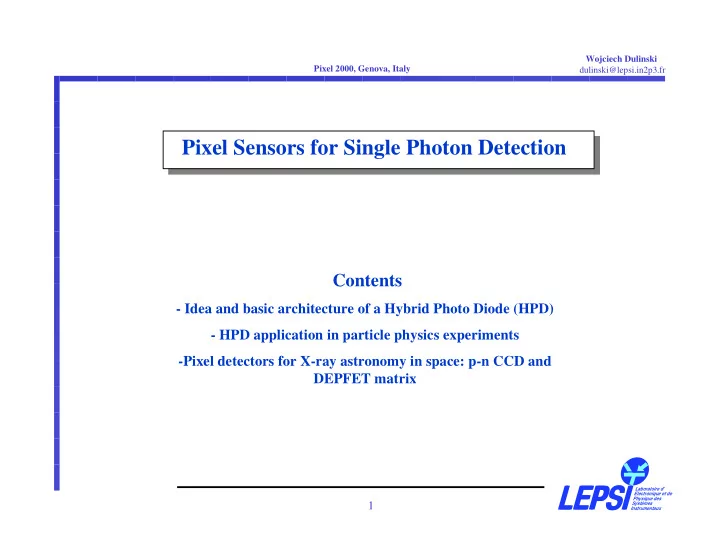
Wojciech Dulinski Pixel 2000, Genova, Italy dulinski@lepsi.in2p3.fr Pixel Sensors for Single Photon Detection Contents - Idea and basic architecture of a Hybrid Photo Diode (HPD) - HPD application in particle physics experiments -Pixel


slide-1
SLIDE 1

LEPSI LEPSI

Laboratoire d’ Electronique et de Physique des Systèmes Instrumentaux

1

Wojciech Dulinski dulinski@lepsi.in2p3.fr Pixel 2000, Genova, Italy

Pixel Sensors for Single Photon Detection

Contents

  • Idea and basic architecture of a Hybrid Photo Diode (HPD)
  • HPD application in particle physics experiments
  • Pixel detectors for X-ray astronomy in space: p-n CCD and

DEPFET matrix

slide-2
SLIDE 2

LEPSI LEPSI

Laboratoire d’ Electronique et de Physique des Systèmes Instrumentaux

2

Wojciech Dulinski dulinski@lepsi.in2p3.fr Pixel 2000, Genova, Italy

Hybrid Photo Diode (Hybrid Photo Detector)

slide-3
SLIDE 3

LEPSI LEPSI

Laboratoire d’ Electronique et de Physique des Systèmes Instrumentaux

3

Wojciech Dulinski dulinski@lepsi.in2p3.fr Pixel 2000, Genova, Italy

Single (visible) photon counting efficiency comes from limited QE of HPD photocathode

slide-4
SLIDE 4

LEPSI LEPSI

Laboratoire d’ Electronique et de Physique des Systèmes Instrumentaux

4

Wojciech Dulinski dulinski@lepsi.in2p3.fr Pixel 2000, Genova, Italy

Highly-segmented silicon sensor with low noise VLSI readout electronics as an active element of HPD

slide-5
SLIDE 5

LEPSI LEPSI

Laboratoire d’ Electronique et de Physique des Systèmes Instrumentaux

5

Wojciech Dulinski dulinski@lepsi.in2p3.fr Pixel 2000, Genova, Italy

Next logical step : silicon pixel array bump-bonded to a binary readout chip (LHC1)

M.Alemi et al., CERN-EP/99-110 (1999)

slide-6
SLIDE 6

LEPSI LEPSI

Laboratoire d’ Electronique et de Physique des Systèmes Instrumentaux

6

Wojciech Dulinski dulinski@lepsi.in2p3.fr Pixel 2000, Genova, Italy

Some remaining problems before having a practical device...

M.Alemi et al., CERN-EP/99-110 (1999)

slide-7
SLIDE 7

LEPSI LEPSI

Laboratoire d’ Electronique et de Physique des Systèmes Instrumentaux

7

Wojciech Dulinski dulinski@lepsi.in2p3.fr Pixel 2000, Genova, Italy

Potential application for back-illuminated, thinned CMOS APS devices for HPD integrated sensor

  • excellent noise figures
  • high spatial resolution
slide-8
SLIDE 8

LEPSI LEPSI

Laboratoire d’ Electronique et de Physique des Systèmes Instrumentaux

8

Wojciech Dulinski dulinski@lepsi.in2p3.fr Pixel 2000, Genova, Italy

Pixel-HPD application : LHCb-RICH detector

M.Albrecht et al., NIM A 442 (2000) 164

slide-9
SLIDE 9

LEPSI LEPSI

Laboratoire d’ Electronique et de Physique des Systèmes Instrumentaux

9

Wojciech Dulinski dulinski@lepsi.in2p3.fr Pixel 2000, Genova, Italy

Particle tracking using: HPD + scintillating fibres

  • r phosphor scintillator + CMOS Imager

IEEE TNS Vol.43, No.3 June 1996, 2115 TOTEM experiment at CERN LHC

slide-10
SLIDE 10

LEPSI LEPSI

Laboratoire d’ Electronique et de Physique des Systèmes Instrumentaux

10

Wojciech Dulinski dulinski@lepsi.in2p3.fr Pixel 2000, Genova, Italy

Pixel-HPD application : ISPA (Imaging Silicon Pixel Array) Camera for Gamma Rays

  • D. Puertolas et al., IEEE TNS Vol.42, No.6

December 1996, p.2221

slide-11
SLIDE 11

LEPSI LEPSI

Laboratoire d’ Electronique et de Physique des Systèmes Instrumentaux

11

Wojciech Dulinski dulinski@lepsi.in2p3.fr Pixel 2000, Genova, Italy

ISPA Camera for Gamma Rays energy resolution (122 keV) and spatial resolution

  • D. Puertolas et al., IEEE TNS Vol.44, No.6

October 1997, p.1747

slide-12
SLIDE 12

LEPSI LEPSI

Laboratoire d’ Electronique et de Physique des Systèmes Instrumentaux

12

Wojciech Dulinski dulinski@lepsi.in2p3.fr Pixel 2000, Genova, Italy

Fully Depleted pn-CCD

  • derivative of the silicon drift detector (Gatti and Rehak, 1983)
  • JFET electronics integrated (1993)
  • large area detectors (1995-1997) for (soft) X-ray astronomy in space

Fully depleted detector volume (silicon, 300 mm thick) + extremely low noise level (ENC ~5 el.) = high quantum efficiency (single photon counting mode)

slide-13
SLIDE 13

LEPSI LEPSI

Laboratoire d’ Electronique et de Physique des Systèmes Instrumentaux

13

Wojciech Dulinski dulinski@lepsi.in2p3.fr Pixel 2000, Genova, Italy

pn-CCD : principal features

P.Hall et al., SPIE, 3114: 126-133, 1977C

slide-14
SLIDE 14

LEPSI LEPSI

Laboratoire d’ Electronique et de Physique des Systèmes Instrumentaux

14

Wojciech Dulinski dulinski@lepsi.in2p3.fr Pixel 2000, Genova, Italy

pn-CCD : QE + Fe spectrum

slide-15
SLIDE 15

LEPSI LEPSI

Laboratoire d’ Electronique et de Physique des Systèmes Instrumentaux

15

Wojciech Dulinski dulinski@lepsi.in2p3.fr Pixel 2000, Genova, Italy

pn-CCD : for X-ray Astronomy: XMM-Newton Observatory

slide-16
SLIDE 16

LEPSI LEPSI

Laboratoire d’ Electronique et de Physique des Systèmes Instrumentaux

16

Wojciech Dulinski dulinski@lepsi.in2p3.fr Pixel 2000, Genova, Italy

Use of a high-energy physics detector technology : Back-illuminated, fully-depleted CCD image sensors for use on optical and near-IR astronomy

D.E.Groom et al, NIM A 442 (2000) 216

slide-17
SLIDE 17

LEPSI LEPSI

Laboratoire d’ Electronique et de Physique des Systèmes Instrumentaux

17

Wojciech Dulinski dulinski@lepsi.in2p3.fr Pixel 2000, Genova, Italy

DEPFET Pixel Sensor for X-rays

  • can be back illuminated, can have a fill factor of 1, can be made very

large (all pros of CCD)

  • does not need a charge transfer, no out-of-time events, every pixel is

xy-addressable (all pros of APS)

  • in addition, can have a non destructive multiple readout to reach very

low noise figures

Device concept: combination of FET transistor with sideward depletion (drift chamber)

J.Kemmer, G.Lutz et al. NIM A 288 (1990) 92

slide-18
SLIDE 18

LEPSI LEPSI

Laboratoire d’ Electronique et de Physique des Systèmes Instrumentaux

18

Wojciech Dulinski dulinski@lepsi.in2p3.fr Pixel 2000, Genova, Italy

DEPFET as pixel detector

slide-19
SLIDE 19

LEPSI LEPSI

Laboratoire d’ Electronique et de Physique des Systèmes Instrumentaux

19

Wojciech Dulinski dulinski@lepsi.in2p3.fr Pixel 2000, Genova, Italy

DEPFET : excellent noise figures (9 electrons rms.) at room temperature!

slide-20
SLIDE 20

LEPSI LEPSI

Laboratoire d’ Electronique et de Physique des Systèmes Instrumentaux

20

Wojciech Dulinski dulinski@lepsi.in2p3.fr Pixel 2000, Genova, Italy

Instead of conclusion and prospects...

Posted: 2 Jun 2000 Quantum dots detect single photons A single-photon detector based on quantum dots has been developed for the first time by researchers at Toshiba's European laboratories in the UK. Conventionally single photons are detected by multiplying a photo-generated electron using an avalanche process. The Toshiba researchers, in collaboration with Cambridge University, developed a device for detection of single photons based on a GaAs/AlGaAs modulation doped field effect transistor (MODFET) which does not rely on avalanche processes.

SPIE Web

slide-21
SLIDE 21

LEPSI LEPSI

Laboratoire d’ Electronique et de Physique des Systèmes Instrumentaux

21

Wojciech Dulinski dulinski@lepsi.in2p3.fr Pixel 2000, Genova, Italy

Acknowledgements

I’m very grateful to Thierry Gys (CERN) and Gerhard Lutz (MPI), for their efficient help in the preparation of this talk!