legal cases surgical techniques, the economy Bob Barker paper - - PDF document

legal cases
SMART_READER_LITE
LIVE PREVIEW

legal cases surgical techniques, the economy Bob Barker paper - - PDF document

1/5/2016 Teaching, Supporting & Including Students on the Autism Spectrum Session I: Using Special Interests, Fascinations & Passions in the Classroom Paula Kluth, Ph.D. www.paulakluth.com paula.kluth@gmail.com What do we mean by


slide-1
SLIDE 1

1/5/2016 1

Teaching, Supporting & Including Students on the Autism Spectrum

Session I: Using Special Interests, Fascinations & Passions in the Classroom Paula Kluth, Ph.D. www.paulakluth.com paula.kluth@gmail.com

Klin et al. (2007). Circumscribed interests in HF individuals with ASD: An exploratory study. JASH.

  • facts/verbal memory (facts about US Civil War)
  • facts/visual memory (designing LEGO skyscrapers)
  • sensory behaviors (running fingers through water)
  • math (appreciation of triangles, solving problems)
  • classifying (organizing books by year of pub)
  • dates & times (keeping track of birthdays)
  • collecting (saving rubber bands)
  • letters & numbers (memorizing license plates)

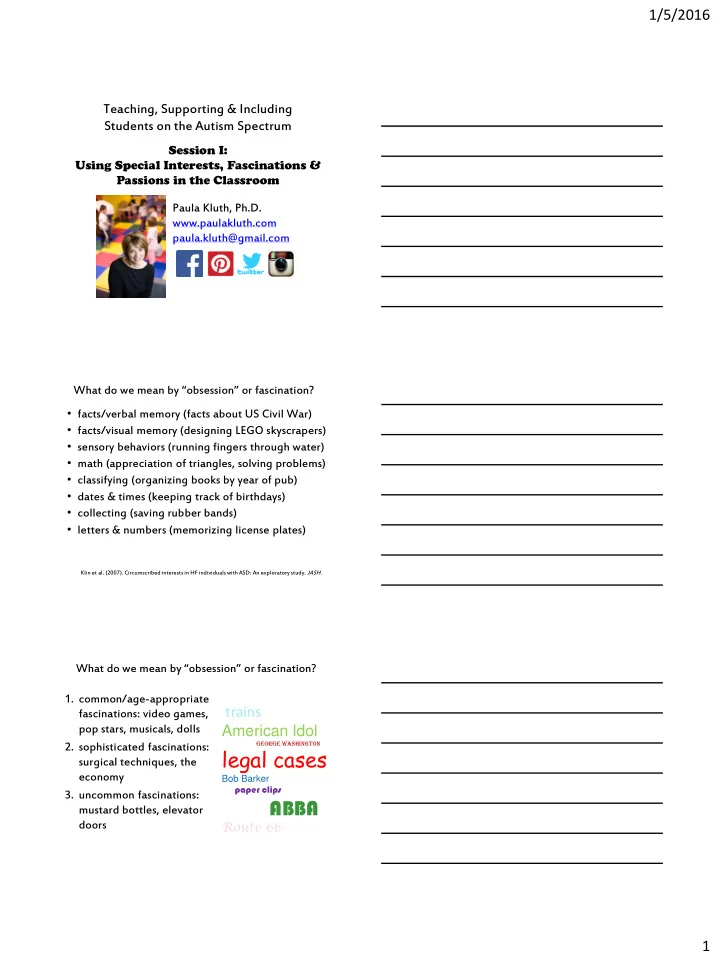
What do we mean by “obsession” or fascination?

  • 1. common/age-appropriate

fascinations: video games, pop stars, musicals, dolls

  • 2. sophisticated fascinations:

surgical techniques, the economy

  • 3. uncommon fascinations:

mustard bottles, elevator doors What do we mean by “obsession” or fascination?

trains American Idol

George Washington

legal cases

Bob Barker paper clips

ABBA

Route 66

slide-2
SLIDE 2

1/5/2016 2

I have a question for teenagers here. Q: When is an obsession not an obsession?

  • A. When it is about football.

How unfair is that? It seems that our society fully accepts the fact that a lot of men and boys eat, sleep, and breathe football and people seem to think that if someone doesn’t, then they are not fully male. Stupid! (p. 47)

Jackson, L. (2002). Freaks, geeks, and Asperger syndrome. Jessica Kingsley.

We are SIA snobs!

Frith (1991) noted that the response

  • f the neurotypical world to the SIA
  • f an individual with AS depends largely on

how acceptable the SIA feels to the

  • bserver. She observed that “a child who

talks about electricity pylons all the time is more likely to be thought oddly fixated than

  • ne who talks about horses or football

teams” (p. 239).

“Just Give Him the Whale”

What does Pedro’s story mean for teachers? For parents? For other students without autism? For students without disabilities?

slide-3
SLIDE 3

1/5/2016 3

It’s not about “giving in” it’s about providing a way to get from here to there.

bridges vs. carrots

Winter-Messiers, et al (2007) engagement w/ SIAs may result in

SENSORY: Improved sensory processing EMOTIONAL: Lower anxiety

SOCIAL: More willing to interact

ACADEMIC SKILL: Higher motivation & interest levels

COMMUNICATION: Focused convers., advanced vocab.

EXECUTIVE FUNCTIONING: Improved focus & memory FINE MOTOR:

Higher level abilities working w/ computers, clay, etc.

slide-4
SLIDE 4

1/5/2016 4

use fascinations & strengths…

to expand social opportunities

Use things the autistic individual enjoys to spark her interest. If she likes music and hums to herself, use music as an introduction to relating to other

  • people. It is a falsehood that autistics do not relate.

Rather, they relate in their own ways.

(O’ Neill, p. 83)

an entire school talking about “the whale”

slide-5
SLIDE 5

1/5/2016 5

to inspire learning & facilitate inclusion

  • plan

curriculum

  • plan

instruction

  • create
  • pportunities

for participation & success

Emeril as inclusion facilitator

  • menu vs. schedule
  • chef hat & “bam”
  • desk Emeril
  • cooking-related lessons
  • Emeril recommends: (Kid’s Cook, Garden Fun)
  • Pampered Chef writing supports

Cursive writing is cool!

slide-6
SLIDE 6

1/5/2016 6

language arts

  • weather section of newspaper
  • disaster fiction
  • teach e-mail & web skills & Twitter;

surf for weather stats

Example of fascinations support map (Kluth, 2010)

science

  • how to read barometer and
  • ther gadgets
  • weather-related experiments
  • explore websites like National

Weather Service

social skills/relationships

  • teach about feelings- “are you

feeling gloomy and rainy today or sunny”?

  • teach music- “Singing in the

Rain”; “Sunny Weather”

communication skills

  • support communication skills;

teach others about weather or give daily weather fact

math

  • study the distance certain

storms travel

  • focus on weather statistics, look

for patterns across regions

  • graph the weather daily

social studies

  • learn about jobs (e.g., weather

person, disaster relief volunteer)

  • study weather history of the

community

  • look at weather stories in history

(weather almost postponed D- Day)

art

  • explore how weather is

portrayed by artists?

to create & select classroom materials

^ http://mathmindsblog.wordpress.com/

slide-7
SLIDE 7

1/5/2016 7

OnStar….come in!

  • keep it simple, if possible
  • you may only need to create a small change (e.g.,

add a picture, change your language) to provide support

to address challenges

  • Avoid using favorites only as

rewards…use them as tools for including & supporting

  • Use them to calm &

encourage

slide-8
SLIDE 8

1/5/2016 8

Strengths & Strategies Pages

Gifts, Strengths, Talents, Interests: TARA

– Loves the Jonas Brothers & knows many of the lyrics to songs – Can read her portfolio book independently – Likes to talk in the author’s chair – Plays with High School Music dolls and creates stories with the characters – Exceptional memory- knows friends and staff members – Knows how to play 4 computer games on her own – Interested in Twitter – Likes to look at magazines- especially American Girl magazine – Loves her class job of organizing the library kiosk – Enjoys “playing” games like Boggle & Scrabble Jr – Interested in plants and growing things – Loves watching Antiques Road Show with mom – Very interested in the globe (loves to spin it)– has the Leap Frog globe at home and can identify several locations including most continents and some countries (Madagascar, Mexico) – Likes the concept of “sets” and “subsets” and likes to create these with manipulatives – Knows how to add with a calculator – Knows left from right – Can navigate the upper unit on her own – Can and will get her iPod when she feels upset/stressed – Knows how to use the iPad – Likes to color with black crayon/black marker – Loves using any stencils and likes making stencils – Drawing is an interest- likes to put letters (alphabet) into her drawings

Strengths & Strategies Pages

Things That Work: TARA

– showing as well as telling (illustrate, sign language, written words) – telling her the mantra, “this too shall pass” – letting her review her “recess choice” book before going on the playground – having her start the day by looking at her CD covers – give her CD covers when she is stressed – do a lot of previewing for her– let her know what is coming next – let her sit next to Jess, Em, Reg, or Lara – it is very motivating for her – give her red school supplies- esp. notebook – she likes sitting on the loveseat for SSR or guided reading – letting her “read” more than one book at a time, she likes to spread them out and review two at

  • nce

– allowing her to write or draw on the board – give her opportunities to help other kids (she likes to organize desks) – ask her to help with organizing things in the classroom (e.g., straighten library books) – show her how instead of telling her (act out the thing she needs to do) – give her opportunities to share her portfolio – sometimes likes to know exactly where her work space is (you can tape it off to show her) – may need to take little “safe spot” or relaxation breaks – use Jonas Brothers to interest her in activities- for instance, let her write stories about them – using photographs to interact with her (have students bring photos to show her and let her show her photos to others) – letting her help to teach a part of a lesson (she likes to help the teacher)

slide-9
SLIDE 9

1/5/2016 9

Thomas the Tank Engine

Thomas the Tank Engine loves being a helpful and nice engine but sometimes it is difficult for him to be nice to everyone. At the end of a long day of running the tracks, he is often tired and it is difficult for him to be nice to his friends. But Thomas has learned it is important to smile at his friends and say nice things to everyone even when he is tired. He has learned that if he can’t say something nice, it is better to smile and say nothing at all. Thomas stops and thinks before he says anything. Just like Thomas, it is important for kindergartners to think before they talk.

Reference: Gagnon, E. (2001). Power cards: Using special interests to motivate children and youth with Asperger Syndrome and autism. Autism Asperger Publishing Co: Shawnee Mission, Kansas

to make life worth living

When, as parents, teachers, and peers, we deny a child or youth the importance of his or her SIA, we are literally denying the student his or her identity. If children and youth with AS cannot feel safe and supported in

  • penly revealing their SIA at

school, we are forcing them to leave themselves at home. As the author’s son once told her, “Airplanes are who I am.”

Winter-Messiers: From Tarantulas to Toilet Brushes

slide-10
SLIDE 10

1/5/2016 10

keep in mind:

You don’t have to understand someone’s passion in order to honor it! So, honor, support, listen and…. …just give him the whale!

Content from this session is primarily drawn from these two texts:

slide-11
SLIDE 11

1/5/2016 11

www.differentiationdaily.com www.paulakluth.com