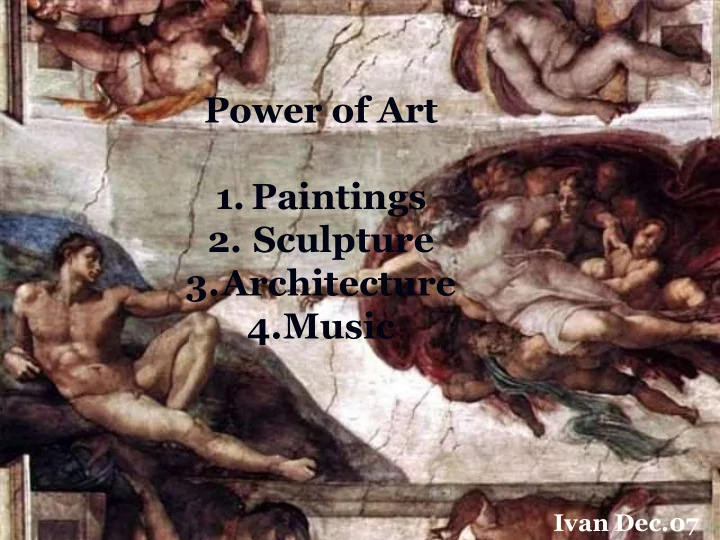
SLIDE 1 Power of Art
- 1. Paintings
- 2. Sculpture
3.Architecture 4.Music
Ivan Dec.07
SLIDE 2
Art and Love is man’s greatest gift. Art, like any other form of communication, reflects the intention as well as vision or genius of the creator.
SLIDE 3 Leonardo Da Vinci
Art elevates the human mind, sublimates his base emotions, and cultivates his sense to be more sensitive to the finer things of life. Art gives peace and vitality to the human mind and soul; and as children are to women
- f whom they are born, so is art to its creator, the artistic genius. To cultivate ones mind so that art may
"speak," is to raise oneself above the level of the animal kingdom; it is to give freedom to man's spirit which is the real joy of life.
SLIDE 4 Salvador Dalí
What makes something, a piece of good art, as opposed to bad art? What makes something a piece of printed page, or piece of music art? Ultimate question in the philosophy
- f art is not only what art is
but what its purpose, function, and importance it has are in our lives.
SLIDE 5 Tolstoys view on art: If a man is infected (is moved by or is very passionate about it) by the author's condition of soul, if he feels this emotion and this union with others, then the object which has effected this is art.Degree of infectiousness is also the sole measure of excellence in art. The stronger the infection, the better is the art as art, speaking now apart from its subject matter, i.e., not considering the quality of the feelings it transmits. And the degree of the infectiousness of art depends on three conditions: 1. Individuality of the feeling transmitted; 2. Clearlesness with which the feeling is transmitted; 3. Sincerity of the artist.
Boticcelli
SLIDE 6
Goya Art is an adventure into an unknown world, which can only be explored by those willing to take the risks.
SLIDE 7
Renoir An intellectual is a man who says a simple thing in a difficult way;an artist is a man who says a difficult thing in a simple way.
SLIDE 8
Pablo Picasso Art has many forms: Paintings, Sculpture, Architecture, Photography, Music, etc
SLIDE 9 Van Gogh
The power of the greatest art is the power to shake us into revelation and rip us from our default mode
- f seeing. After an encounter with that force, we
don't look at a face, a colour, a sky, a body, in quite the same way again. We get fitted with new sight: in-
- sight. Visions of beauty or a rush of intense pleasure
are part of that process, but so too may be shock, pain, desire, pity, even revulsion. That kind of art seems to have rewired our senses. We apprehend the world differently.
SLIDE 10 Rembrant
Beauty is matter of insight into the divine and manifestation to ultimate truth. With beauty life has been further expanded. Beauty is skin deep, hower by integration body and soul, sense of wholeness can be
- achieved. Beauty can also be
irresistable weapon and could be deceptive and corrupting.. It steals the institutions power, seduces congregation.
SLIDE 11 Michelangelo Merisi di Caravaggio
In this painting of the victory of virtue
- ver evil it's supposed to be David
who is the centre of attention, but have you ever seen a less jubilant victory? On his sword is inscribed Is humility conquers pride. This is the battle that has been fought
- ut inside Caravaggio's head
between the two sides of the painter that are portrayed here.
SLIDE 12
Klimt Creativity arises out of the tension between spontaneity and limitations, the latter (like the river banks) forcing the spontaneity into the various forms which are essential to the work of art.
SLIDE 13 Van Dyck
Perspective
Perspective is the way in which
artists create an illusion of depth on a flat surface. For hundreds of years painters have tried to represent accurately a scene that exists in three dimensions on a two- dimensional canvas. One of the ways to create this illusion is to make the objects that are far away smaller than those that are closer to the viewer.
SLIDE 14
Monet Just as stage designers use lighting to spotlight a performer, painters will often highlight important elements in paintings
SLIDE 15 Gaugin Use of different colors provide emphasis, emotion,
- etc. Often colors highlight parts of an image to
draw specific attention to it.
SLIDE 16
shadows, artists give volume to their subjects.
give figures three- dimensional form is to reflect light off their bodies and paint shadows cast by them.
SLIDE 17
Rubens What I am seeking is not the real and not the unreal but rather the unconscious, the mystery of the instinctive in the human race.
SLIDE 18 Diego Rivera Every great work of art has two faces,
time and one toward the future, toward eternity.
SLIDE 19 “There are three forms of visual art: Painting is art to look at, sculpture is art you can walk around, and architecture is art you can walk through”
SLIDE 20 Rodin The sculptor represents the transition from one pose to
- another. He indicates how insensibly the first glides into
the second.In his work we still see a part of what was and we discover a part of what is to be.
SLIDE 21
Rodin
SLIDE 22
Rodin As picture teaches the colouring, so sculpture the anatomy of form.
SLIDE 23
Pieta Michelangelo
SLIDE 24
David Michelangelo
SLIDE 25
Moses Michelangelo
SLIDE 26
Bernini
Painting is so poetic, while sculpture is more logical and scientific and makes you worry about gravity.
SLIDE 27 Chihuli Looking at Art
Light Perspective Movement Color Form Proportion Symbolism Lines
SLIDE 28
Architecture is frozen music.
SLIDE 29
- St. Catherine’s palace
- St. Petersburg
Of all the arts , architecture is the most Tangible and influential in the lives of men everywhere . We shop, work and seek entertainment In buildings. Thus the form of structure influences are activities.
SLIDE 30 Gaudi Noble life demands a noble architecture for noble uses
Lack of culture means what it has always meant: ignoble civilization and therefore imminent downfall
SLIDE 31
Gaudi
SLIDE 32 Our experience in great cathedrals i a special
can combine a number
Music, sculpture, paintings as well as spatial design.
SLIDE 33
Park Guëll Older cultures seem always to have known practicality of beauty. That which is without beauty quickly deteriorates.
SLIDE 34
Moscow
SLIDE 35
Paris
SLIDE 36
Santorini
SLIDE 37
Sidney
SLIDE 38
Washington
SLIDE 39
Russia
SLIDE 40
Vienna
SLIDE 41
Coloseum- Rome
SLIDE 42 Johann Straus
Music in some way is the most subtle form of art, it bypasses the left brain rationality. Music brings as most readily tears to
SLIDE 43 Ludwig Van Beethoven
Beethoven was going through
- ne of these sorrowful, sombre
and gloomy periods when he created the best music
Music should strike fire from the heart of man, and bring tears from the eyes of woman.
SLIDE 44
Antonín DVOŘÁK Johan Amadeus Mozart After silence that which comes nearest to expressing the inexpressible is music.
SLIDE 45 Johann Sebastian Bach Peter Ilyitch Tchaikovsky
The energy to classical music has a very positive impact
- n learning capacities and increases level of consciousness
SLIDE 46
Chopin Puccini The exposure to classical music in childhood results in attraction to peace, truth and beauty,and aversion to violence.
SLIDE 47
Without music, life would be an error.
SLIDE 48
Music washes away from the soul the dust of everyday life.
SLIDE 49
Art of Ballet Why waste money on psychotherapy when you can listen to music or watch ballet?
SLIDE 50 Essence of beauty does not change,
END