LEED CERTIFICATION gsf, EUI, site energy, source energy intent, - - PowerPoint PPT Presentation

leed certification
SMART_READER_LITE
LIVE PREVIEW

LEED CERTIFICATION gsf, EUI, site energy, source energy intent, - - PowerPoint PPT Presentation

Outline Overview US Energy flows and role of buildings Digression: define basic concepts LEED CERTIFICATION gsf, EUI, site energy, source energy intent, implementation, and results Energy efficiency potential for buildings


slide-1
SLIDE 1

1

October 20, 2014 www.thepragmaticsteward.com 1

LEED CERTIFICATION intent, implementation, and results

John H. Scofield Department of Physics & Astronomy Oberlin College www.thepragmaticsteward.com

October 20, 2014 www.thepragmaticsteward.com 2

Outline

  • Overview – US Energy flows and role of buildings
  • Energy efficiency potential for buildings
  • LEED Certification – Intent and Implementation
  • Do LEED buildings save energy – what evidence?
  • Energy Benchmarking in major cities
  • 2011 NYC benchmarking data for office buildings

LEED shows no reduction in GHG emission or energy use

  • Summariz

Digression: define basic concepts gsf, EUI, site energy, source energy

October 20, 2014 www.thepragmaticsteward.com 3

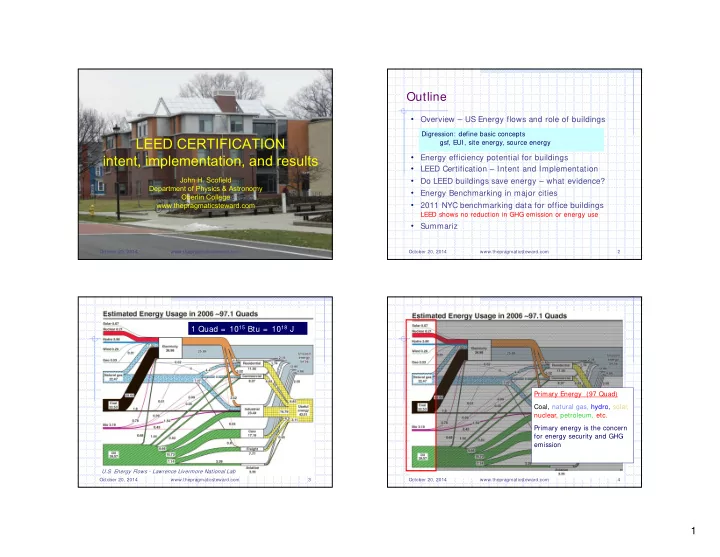
U.S. Energy Flows - Lawrence Livermore National Lab

1 Quad = 1015 Btu = 1018 J

October 20, 2014 www.thepragmaticsteward.com 4

Primary Energy (97 Quad) Coal, natural gas, hydro, solar, nuclear, petroleum, etc. Primary energy is the concern for energy security and GHG emission

slide-2
SLIDE 2

2

October 20, 2014 www.thepragmaticsteward.com 5

End Use Sectors Buildings 19.5 Q Industry 23.5 Q Transportation 28 Q 71 Q where is the missing 26 Q?

October 20, 2014 www.thepragmaticsteward.com 6

Electric Power Sector Secondary energy – not harvested 26 quads of waste must be “apportioned” to end use sectors  Buildings “use” about 39 Q or 40% the nation’s primary energy

October 20, 2014 www.thepragmaticsteward.com 7

Where does the energy go?

October 20, 2014 www.thepragmaticsteward.com 8

slide-3
SLIDE 3

3

Sidebar – gsf, EUI, source energy

October 20, 2014 www.thepragmaticsteward.com 9

gross square footage (gsf) total building floor area For most houses, climate dominates

energy use (surface effect)

For commercial buildings E dominated by

internal loads (E scales with volume)

Energy Use Intensity energy flows:

electric, natural gas, district steam district hot water, home heating oil chilled water, etc.

   

annual energy used total gsf EUI 

October 20, 2014 www.thepragmaticsteward.com 10

Site Energy

Energy used on site irrespective

  • f energy lost off site.

8.37 Q = electric + nat. gas + oil But …

How much energy do commercial buildings use?

October 20, 2014 www.thepragmaticsteward.com 11

Electric Energy Secondary energy (generated from primary energy) More valuable form of energy (work not heat) 3 units of primary energy  1 unit electric energy   2 units waste heat

October 20, 2014 www.thepragmaticsteward.com 12

Building Source Energy

5 Q electric energy used on-site by commercial sector required 15 Q of primary energy in electric power sector.

Total on- and off-site energy 18.4 Q = 3(5.02Q) + …

slide-4
SLIDE 4

4

October 20, 2014 www.thepragmaticsteward.com 13

Source Energy

  • Building source energy correlates with primary energy use,

energy cost ($), and GHG emission

  • EPA uses source energy for Building ENERGY STAR scores
  • Commercial buildings use 8.4Q site energy, 18.4 source energy

Source Energy = 3 (Electric Energy) + (non-Electric Energy)

To adjust for building size we look at energy

  • intensity. For all U.S. commercial buildings:

Site energy intensity = 91 kBtu/sf Source energy intensity = 190 kBtu/sf

October 20, 2014 www.thepragmaticsteward.com 14

Example: site vs source energy

October 20, 2014 www.thepragmaticsteward.com 15

Energy Efficiency potential for buildings

  • R&D in energy efficiency goes back to 1973 Arab Oil Embargo
  • Numerous studies going back to the 70’s demonstrate building

energy can be reduced 30-50% using existing, cost-effective EE technologies

  • Bottom fell out of oil market in mid-80’s
  • From 1970 – 2000 little success in lowering US building energy use
  • In 2008 the American Physical Society (APS)

published a study affirming the role of efficiency in buildings (Scofield coauthor of report)

October 20, 2014 www.thepragmaticsteward.com 16

US Green Building Council LEED rating

  • Leadership in Energy & Environmental Design
  • Green building rating introduced in 1998 by USGBC
  • Goal is to promote sustainable building practices
  • The Natural Resources Defense Council writes:

The LEED green-building rating system ... is designed to promote design and construction practices that increase profitability while reducing the negative environmental impacts

  • f buildings and improving occupant health and well-being.

Intent of LEED – to save energy, reduce GHG emission, and lower environmental impact LEED brought “sex-appeal” to energy efficiency

slide-5
SLIDE 5

5

October 20, 2014 www.thepragmaticsteward.com 17

LEED Certification Process

  • constantly being updated – now on version 4
  • many different systems:

new construction (NC), core & shell (CS), schools (schools), existing buildings, operation and maintenance (EB:OM), etc.

  • level of certification depends on points earned

certified (40), silver (50), gold (60), platinum (70) of 110

  • Point categories:

location/transportation, sustainable sites, water eff., energy & atmosphere, material & resources, indoor env. quality, innovation, regional priority

October 20, 2014 www.thepragmaticsteward.com 18 October 20, 2014 www.thepragmaticsteward.com 19

Energy Efficiency in LEED

  • largest category – 33 pts possible
  • no performance requirement (except EB:OM)
  • For NC points determined by energy “projections”

more points awarded for lower EER

  • For EB:OM points determined by ENERGY STAR score

higher the score the more points awarded for EE

  • For v.3 (v2009) added requirement to monitor annual energy use

and report to USGBC for five years

simulated design energy simulated baseline model energy EER  Energy and GHG savings only part of LEED – but it is the first part – w/o it no one would care

LEED proponents claim significant savings in energy and lowering of green house gas emission

October 20, 2014 www.thepragmaticsteward.com 20

slide-6
SLIDE 6

6

October 20, 2014 www.thepragmaticsteward.com 21

from LEED BASICS, City of Blue Springs, MO

October 20, 2014 www.thepragmaticsteward.com 22

http://ofcc.ohio.gov/Services/EnergyServices/GreenSchools.aspx

October 20, 2014 www.thepragmaticsteward.com 23

http://www.midwestenergynews.com/2013/04/26/in-ohio-schools-reap-benefits-of-energy-efficiency-push/

Ohio leads the nation in energy-efficient LEED schools, saving millions of dollars. “Those green schools average about a third less energy use in wattage than traditional schools,” notes Rob Delane, deputy executive director at the Ohio School Boards

  • Association. Depending on a

school’s size, savings “could be upwards of $100,000 per year.” October 20, 2014 www.thepragmaticsteward.com 24

Oberlin College Kahn Dormitory LEED Silver NC 2,2

slide-7
SLIDE 7

7

Energy savings claims are based on design simulations – not on measured energy performance

October 20, 2014 www.thepragmaticsteward.com 25

Documented gap between energy simulations and measured performance

October 20, 2014 www.thepragmaticsteward.com 26 Johnson, J. 2002, “Is What They Want What They Get? Examining Field Evidence for Links between Design Intent and As-Built Energy Performance of Commercial Buildings.” In Proceedings

  • f the 2002 ACEEE Summer Study on Energy Efficiency in Buildings, 4:161-170. Washington, D.C.

American Council for an Energy-Efficient Economy.

  • J. L. Barrientos Sacari, U. Bhattacharjee, T. Martinez and J. J. Duffy, “Green Buildings in

Massachusetts: Comparison Between Actual and Predicted Energy Performance,” Proceedings of the American Solar Energy Society, Cleveland, OH, July 9-13, 2007. Cathy Turner Mark Frankel, “Energy Performance of LEED for New Construction Buildings—Final Report,” New Buildings Institute, White Salmon, WA, 2008.

  • Sacari et al. found measured EUI, on

average, to be 40% higher than predicted EUI for green buildings.

  • NBI found limited correlation between

predicted EUI and measured EUI for LEED buildings.

How many LEED certified commercial buildings are there in the U.S. for which we would expect energy savings data to exist?

October 20, 2014 www.thepragmaticsteward.com 27 October 20, 2014 www.thepragmaticsteward.com 28

slide-8
SLIDE 8

8

October 20, 2014 www.thepragmaticsteward.com 29

# of LEED-Certified Buildings (9/29/14)

October 20, 2014 www.thepragmaticsteward.com 30

U.S. LEED‐Certified Buildings LEED System Total GSF Number Total GSF Number LEED for Retail (NC) 4,400 1 4,400 1 LEED for Schools 48,198,581 548 30,462,222 366 LEED FOR SCHOOLS v2009 19,572,898 241 4,121,258 63 LEED v4 BD+C: NC 114,298 1 LEED v4 O+M: EB 783,005 3 LEED‐CS 1.0 Pilot 26,770,285 103 26,770,285 103 LEED‐CS 2.0 174,678,615 806 154,798,722 713 LEED‐CS v2009 57,160,124 311 10,018,044 82 LEED‐EB 1.0 Pilot 1,668,000 3 1,668,000 3 LEED‐EB 1.0 Pilot (original) 8,899,042 22 8,899,042 22 LEED‐EB 2.0 125,270,013 372 119,159,028 306 LEED‐EB O&M 360,609,567 779 347,813,913 747 LEED‐EB:OM v2009 624,184,507 1,721 314,102,075 871 LEED‐NC 1.0 Pilot 1,589,895 10 1,589,895 10 LEED‐NC 2.0 33,068,635 282 33,033,689 281 LEED‐NC 2.1 172,476,156 1,493 169,107,537 1,459 LEED‐NC 2.2 599,445,758 6,113 478,261,825 4,914 LEED‐NC Retail v2009 5,615,722 238 1,399,453 70 LEED‐NC v2009 193,841,971 2,611 49,958,986 845 Totals 2,453,951,472 15,658 1,751,168,375 10,856 1,931 Before 9/29/2014 Before 1/1/2013

  • Only U.S. buildings
  • LEED systems that

address whole-building energy (not CI)

  • as of Sept. 29 more

than 15,000

  • as of 1/1/2013 nearly

11,000

  • ver 1900 report

energy to USGBC

What energy consumption data have been disclosed for these 11,000 U.S. LEED-certified buildings?

October 20, 2014 www.thepragmaticsteward.com 31 October 20, 2014 www.thepragmaticsteward.com 32

Published LEED energy performance data

1. Cathy Turner, Report prepared by NBI for the Cascadia Region Green Building Council. Jan. 30, 2006. 2. Rick Diamond et al., 2006 ACEE Summer Study on Energy Efficiency in Buildings, Aug. 13, 2006. 3.

  • J. L. Barrientos Sacari et al, American Solar Energy Society Conference, Cleveland, OH, 2007.

4. Cathy Turner and Mark Frankel, New Buildings Institute, White Salmon, WA, March 2008. 5. Kim M. Fowler and Emily M. Rauch, PNNL-17393, July 2008. 6. David Baylon and Poppy Storm, 2008 ACEEE Summer Study on Energy Efficiency in Buildings, Aug. 08. 7. John H Scofield, International Energy Program Evaluation Conference, Portland, OR, Aug. 12-15, 2009. 8. Guy Newsham et al, Energy & Buildings, 41 (8), pp. 897-905 (2009). 9. John H. Scofield, Energy & Buildings, 41 (12), pp. 1386-1390 (2009). 10. Doug Widener et al, U.S. Green Building Council – Chicago Chapter, Fall 2009. 11. Kim Fowler et al, PNNL-19369, September 2011. 12. Kathryn Eggers and Doug Widener, U.S. Green Building Council – Chicago Chapter, Fall 2009. 13. Dixon Oates, Kenneth T. Sullivan, J. of Construction Eng. and Mgmt, 138 (6) , pp. 742-750 (2012). 14. Carol Menassa et al, Journal of Performance of Constructed Facilities, 25 (1), pp. 46-53 (2012). 15. John H. Scofield, Energy & Buildings, 67, pp. 517-524 (2013)

  • 6 of these publications were produced

by gov. or non-gov. orgs with vested interest in promoting green buildings w/o blind peer review

  • 9 publications were peer-reviewed
  • Many studies use same data
  • Collectively data from 252 buildings

(or fewer)
slide-9
SLIDE 9

9

October 20, 2014 www.thepragmaticsteward.com 33

Energy Performance of LEED for New Construction

Turner & Frenkel, New Buildings Institute

“…on average, LEED buildings are delivering anticipated savings. Each of three views of building performance show average LEED energy use 25- 30% better than the national average, a level similar to that anticipated by LEED modeling.” October 20, 2014 www.thepragmaticsteward.com 34

NBI LEED Study

  • Long assumed that LEED buildings are energy-efficient
  • Until 2007 little empirical data to support this
  • USGBC engaged the New Buildings Institute to conduct a broad

study of energy consumption by LEED commercial buildings

  • NBI gathered energy consumption data volunteered by 121 of

the 552 commercial buildings certified from 2000-6 under NCv2

  • March 2008 NBI issued final report which concludes

LEED buildings, on average, achieve 25-30% energy savings

  • Study immediately drew criticism (e.g., Henry Gifford) for

comparing medians with means

  • Cathy Turner (NBI) made summary LEED data available for

independent analysis

October 20, 2014 www.thepragmaticsteward.com 35

American Physical Society

Energy Efficiency Study

http://www.aps.org/energyefficiencyreport/

2007-8 study chaired by Burt Richter (Stanford) – Nobel laureate Re: the NBI LEED building study “Whatever their efficiency, these 121 LEED buildings consume more total energy per square foot (either site or primary) than the average for the entire commercial building stock.”

October 20, 2014 www.thepragmaticsteward.com 36

Re-evaluation of the NBI LEED Energy Consumption Study

Proceedings of the International Energy Program Evaluation Conference (IEPEC), Portland, OR, Aug. 12-15, 2009, pp. 765-777.

Do LEED-certified buildings save energy? Not really …

Energy and Buildings, 41, 1386-1390 (2009).

Scofield analysis of LEED building energy data

  • NBI Study contained mathematical errors and

inconsistencies

  • LEED buildings used 10-15% less site energy

than comparable non-LEED buildings

  • LEED buildings demonstrated no savings in

source energy

slide-10
SLIDE 10

10

October 20, 2014 www.thepragmaticsteward.com 37

Published LEED energy performance data

1. Cathy Turner, Report prepared by NBI for the Cascadia Region Green Building Council. Jan. 30, 2006. 2. Rick Diamond et al., 2006 ACEE Summer Study on Energy Efficiency in Buildings, Aug. 13, 2006. 3.

  • J. L. Barrientos Sacari et al, American Solar Energy Society Conference, Cleveland, OH, 2007.

4. Cathy Turner and Mark Frankel, New Buildings Institute, White Salmon, WA, March 2008. 5. Kim M. Fowler and Emily M. Rauch, PNNL-17393, July 2008. 6.

  • D. Baylon and P

. Storm, 2008 ACEEE Summer Study on Energy Efficiency in Buildings, Aug. 2008. 7. John H Scofield, International Energy Program Evaluation Conference, Portland, OR, Aug. 12-15, 2009. 8. Guy Newsham et al, Energy & Buildings, 41 (8), pp. 897-905 (2009). 9. John H. Scofield, Energy & Buildings, 41 (12), pp. 1386-1390 (2009). 10. Doug Widener et al, U.S. Green Building Council – Chicago Chapter, Fall 2009. 11. Kim Fowler et al, PNNL-19369, September 2011. 12. Kathryn Eggers and Doug Widener, U.S. Green Building Council – Chicago Chapter, Fall 2009. 13. Dixon Oates, Kenneth T. Sullivan, J. of Construction Eng. and Mgmt, 138 (6) , pp. 742-750 (2012). 14. Carol Menassa et al, Journal of Performance of Constructed Facilities, 25 (1), pp. 46-53 (2012). 15. John H. Scofield, Energy & Buildings, 67, pp. 517-524 (2013)

October 20, 2014 www.thepragmaticsteward.com 38

  • Subsequent peer-reviewed studies confirm my

results

  • All these studies rely on data volunteered by willing

building owners – self-selected data that skews results (Gifford – voluntary breathalyzer tests)

  • These 252 buildings represent just 2% of the

11,000 eligible LEED-certified buildings

What about the energy data collected since 2009 by the USGBC?

Should have data from nearly 2000 buildings, nearly 10X the number of buildings collectively contained in other studies.

October 20, 2014 www.thepragmaticsteward.com 39 October 20, 2014 www.thepragmaticsteward.com 40

USGBC puts out marketing literature with energy savings claims, dated October 21, 2013

  • USGBC received energy data from

1,861 MRP6-compliant buildings

  • 450 of these (24%) “showed they

experienced” a source EUI that was 31% lower than national median

  • The mean ENERGY STAR score for

404 buildings was 85

  • These are meaningless sound bites!
slide-11
SLIDE 11

11

Energy Benchmarking Laws in major US cities are “lifting the veil.”

Soon building energy data will made public for hundreds – even thousands of LEED-certified buildings.

October 20, 2014 www.thepragmaticsteward.com 41 October 20, 2014 www.thepragmaticsteward.com 42 October 20, 2014 www.thepragmaticsteward.com 43 October 20, 2014 www.thepragmaticsteward.com 44

slide-12
SLIDE 12

12

October 20, 2014 www.thepragmaticsteward.com 45 October 20, 2014 www.thepragmaticsteward.com 46

Empire State Building

338 Fifth Avenue 2.75 million gsf Site EUI = 83 kBtu/sf Source EUI = 198 kBtu/sf Energy Star 80

October 20, 2014 www.thepragmaticsteward.com 47

Can we cross-reference addresses to identify LEED-certified buildings in NYC Benchmarking data? Restrict to just Office Buildings. Sam Roudman did work

October 20, 2014 www.thepragmaticsteward.com 48

NYC LEED Office Buildings

slide-13
SLIDE 13

13

October 20, 2014 www.thepragmaticsteward.com 49

Efficacy of LEED-certification in reducing energy consumption and greenhouse gas emission for large New York City

  • ffice buildings

Energy and Buildings, Vol. 67, 517-524 (December 2013).

Scofield analysis of NYC LEED Office Buildings

  • Identifed 23 NYC LEED-certified office buildings
  • Compared their energy performance to those
  • f 953 NYC office buildings
  • On average LEED offices showed no reduction

in energy use or GHG emission

  • LEED offices generally earned higher ENERGY

STAR scores (by 10 pts)

October 20, 2014 www.thepragmaticsteward.com 50 October 20, 2014 www.thepragmaticsteward.com 51 October 20, 2014 www.thepragmaticsteward.com 52

Wrap Up

  • LEED buildings have captured public’s imagination
  • increased interest in sustainable practices
  • is leading to better buildings
  • But there is little evidence that, on average, LEED-certification is

actually saving primary energy or lowering greenhouse gas emission

  • Claims of 30-50% energy savings are based on faith not science
  • LEED certification adds real costs to building design & construction
  • There is insufficient justification for governments to require that

buildings be LEED certified

  • LEED does deliver green publicity and green image
  • Time to abandon green labels and seek green substance
  • I look forward to the day when performance data show energy savings