Lecture 9: Processor design multi cycle Arent single cycle - - PowerPoint PPT Presentation

lecture 9 processor design multi cycle
SMART_READER_LITE
LIVE PREVIEW

Lecture 9: Processor design multi cycle Arent single cycle - - PowerPoint PPT Presentation

Lecture 9: Processor design multi cycle Arent single cycle processors good enough? No! Speed: cycle time must be long enough for the most complex instruction to complete But the average instruction needs less time Cost:


slide-1
SLIDE 1

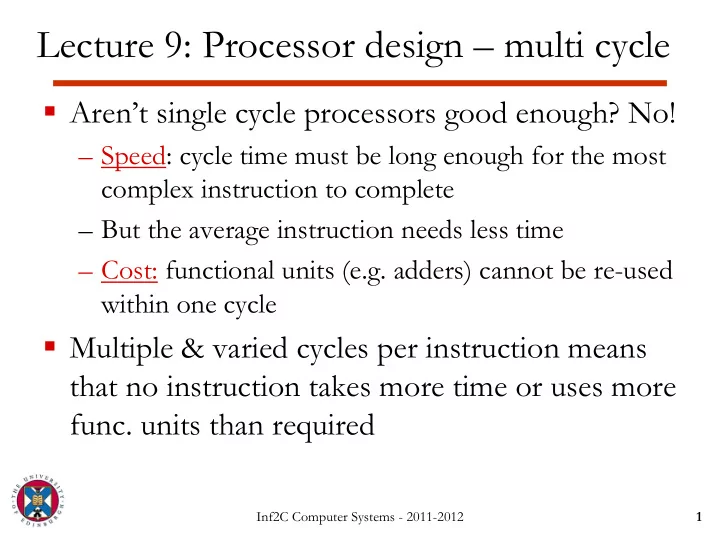
Lecture 9: Processor design – multi cycle

Aren’t single cycle processors good enough? No!

– Speed: cycle time must be long enough for the most complex instruction to complete – But the average instruction needs less time – Cost: functional units (e.g. adders) cannot be re-used within one cycle

Multiple & varied cycles per instruction means that no instruction takes more time or uses more

  • func. units than required

Inf2C Computer Systems - 2011-2012 1

slide-2
SLIDE 2

Lecture outline

Brief processor performance evaluation Determine the components Build the datapath Build the control

Inf2C Computer Systems - 2011-2012 2

slide-3
SLIDE 3

Measuring processor speed

Execution time is instruction count x cycles per instruction x cycle time

Inf2C Computer Systems - 2011-2012 3

slide-4
SLIDE 4

Determine the components

Processor task Instruction fetch from memory Read registers Execution

– Data processing instructions – Data transfer instructions – Branch instructions

Component list PC register Memory (instructions) Adder: PC+4 Register file

– 2 read, 1 write

ALU

Inf2C Computer Systems - 2011-2012 4

slide-5
SLIDE 5

Design guidelines

Cycle time determined by the delay through the slowest functional unit Reuse functional units as much as possible

– Multiplexors added to select the different inputs

At end of each cycle, data required in subsequent cycles must be stored somewhere

– Data for other instructions are kept in the memory, register file, or the PC – Data for same instruction are kept in new registers not visible to the programmer

Inf2C Computer Systems - 2011-2012 5

slide-6
SLIDE 6

Multi-cycle datapath

Inf2C Computer Systems - 2011-2012 6

slide-7
SLIDE 7

How to design the control part

The control unit of a multicycle processor is an FSM Determine exactly what happens in each cycle and what is the next step Be careful with register load-enable control signals

Inf2C Computer Systems - 2011-2012 7

slide-8
SLIDE 8

What happens in each cycle – 1 & 2

1. Instruction fetch

IR <= Mem[PC] PC <= PC+4

2. Instruction decode and register fetch

A <= Reg[IR[25:21]] B <= Reg[IR[20:16]] ALUOut <= PC+sgnext(IR[15:0]<<2)

Inf2C Computer Systems - 2011-2012 8

slide-9
SLIDE 9

What happens in each cycle – 3

  • 3a. Memory address generation

ALUOut <= A+sgnext(IR[15:0])

  • 3b. R-type arithmetic-logical instruction

ALUOut <= A op B

  • 3c. Branch completion

if (A == B) PC <= ALUOut

  • 3d. Jump completion

PC <= {PC[31:28],IR[25:0],2’b00}

Inf2C Computer Systems - 2011-2012 9

slide-10
SLIDE 10

What happens in each cycle – 4

  • 4a. Memory access (load)

MDR <= Mem[ALUOut]

  • 4b. Memory access (store) & completion

Mem[ALUOut] <= B

  • 4c. R-type arith-logical instruction completion

Reg[IR[15:11]] = ALUOut

Inf2C Computer Systems - 2011-2012 10

slide-11
SLIDE 11

What happens in each cycle – 5

  • 5. Load instruction completion

Reg[IR[20:16]] <= MDR

Inf2C Computer Systems - 2011-2012 11

slide-12
SLIDE 12

Inf2C Computer Systems - 2011-2012

State diagram

1

12