Lecture 7: Hands-On MPI Department of Electrical & p Computer - - PDF document

lecture 7 hands on mpi
SMART_READER_LITE
LIVE PREVIEW

Lecture 7: Hands-On MPI Department of Electrical & p Computer - - PDF document

ECE-451/566 - Intro. to Parallel & Distributed Prog. ECE-451/ECE-566 - Introduction to Parallel and Distributed Programming Lecture 7: Hands-On MPI Department of Electrical & p Computer Engineering Rutgers University MPI Programs:


slide-1
SLIDE 1

ECE-451/566 - Intro. to Parallel & Distributed Prog. 1

ECE-451/ECE-566 - Introduction to Parallel and Distributed Programming

Lecture 7: Hands-On MPI

Department of Electrical & p Computer Engineering Rutgers University

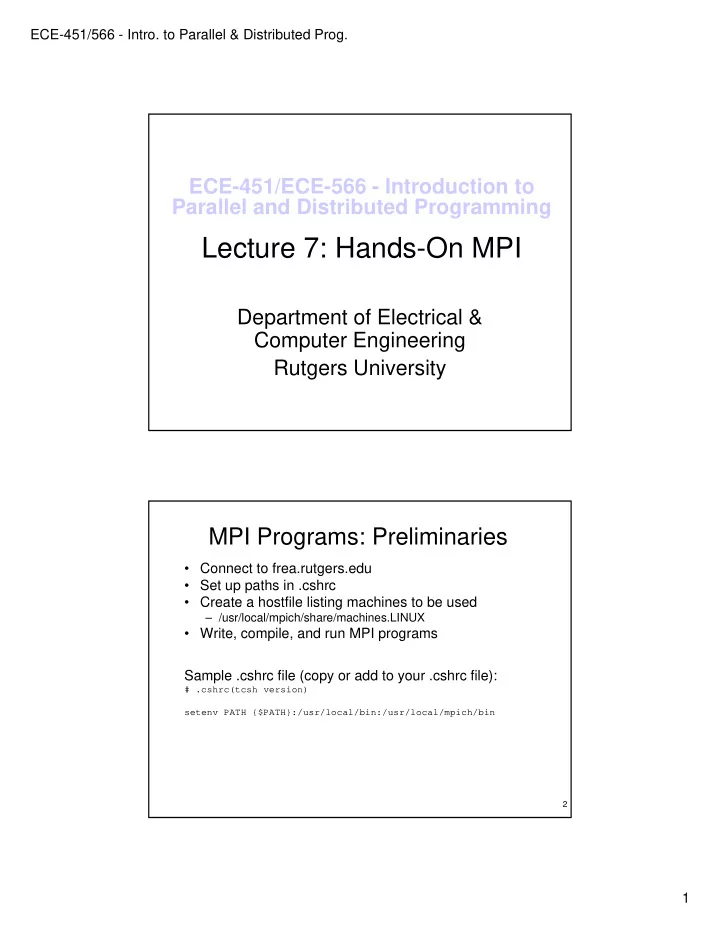
MPI Programs: Preliminaries

  • Connect to frea.rutgers.edu
  • Set up paths in .cshrc
  • Create a hostfile listing machines to be used

Create a hostfile listing machines to be used

– /usr/local/mpich/share/machines.LINUX

  • Write, compile, and run MPI programs

Sample .cshrc file (copy or add to your .cshrc file):

# .cshrc(tcsh version) setenv PATH {$PATH}:/usr/local/bin:/usr/local/mpich/bin

2

setenv PATH {$PATH}:/usr/local/bin:/usr/local/mpich/bin

slide-2
SLIDE 2

ECE-451/566 - Intro. to Parallel & Distributed Prog. 2

Compiling/Executing MPI Programs

  • To compile MPI program (in C/C++):

mpicc -o file file.c

  • r

mpiCC -o file file.cpp

  • To execute MPI program:

To execute MPI program:

mpirun <OPTIONS> -np num_procs file <ARGS> Options:

  • v ⇒ verbose
  • h ⇒ help
  • machinefile hostfile ⇒ specify list of possible machines to run on
  • nolocal ⇒ do not run on the local machine
  • gdb ⇒ start the first process under gdb (GNU debugger)

Example:

3

mpirun –v –machinefile all8 -gdb -np 4 file | tee myout

  • To find process status of your jobs:

ps –u <user_name>

  • To terminate suspended or hung processes:

kill -9 <process_num_id>

  • on Discover: zp (zap process)

4

slide-3
SLIDE 3

ECE-451/566 - Intro. to Parallel & Distributed Prog. 3

5

Demo Programs

slide-4
SLIDE 4

ECE-451/566 - Intro. to Parallel & Distributed Prog. 4

7 8

slide-5
SLIDE 5

ECE-451/566 - Intro. to Parallel & Distributed Prog. 5

9

Hello World (1)

/* "Hello World" example for 2 processors. Initially, both processors have status "I am alone!". Each sends out a "Hello World" to the other. Upon receiving each other's message, the status changes to what is received. / */ #include "mpi.h" #include <stdio.h> int main(int argc, char** argv) { int MyProc, tag=0; char msg[12]="Hello World"; char msg_recpt[12]="I am alone!"; MPI Status status; 10 _ MPI_Init(&argc, &argv); MPI_Comm_rank(MPI_COMM_WORLD, &MyProc); printf("Process # %d started \n", MyProc); MPI_Barrier(MPI_COMM_WORLD);

slide-6
SLIDE 6

ECE-451/566 - Intro. to Parallel & Distributed Prog. 6

Hello World (2)

if (MyProc == 0) { printf("Proc #0: %s \n", msg_recpt) ; printf("Sending message to Proc #1: %s \n" msg) ; printf( Sending message to Proc #1: %s \n , msg) ; MPI_Send(&msg, 12, MPI_CHAR, 1, tag, MPI_COMM_WORLD); MPI_Recv(&msg_recpt, 12, MPI_CHAR, 1, tag, MPI_COMM_WORLD, &status); printf("Received message from Proc #1: %s \n", msg_recpt) ; } else { printf("Proc #1: %s \n", msg_recpt) ; MPI_Recv(&msg_recpt, 12, MPI_CHAR, 0, tag, MPI_COMM_WORLD, &status); i tf("R i d f P #0 % \ " t) 11 printf("Received message from Proc #0: %s \n", msg_recpt) ; printf("Sending message to Proc #0: %s \n", msg) ; MPI_Send(&msg, 12, MPI_CHAR, 0, tag, MPI_COMM_WORLD); } MPI_Finalize(); }

Hello World – any (1)

/* "Hello World" example for "p" number of processors. Initially, all processors have status "I am alone!". Each sends out a "Hello World" to all others. Upon receiving the messages, each processors's status changes to what is received. */ */ #include "mpi.h" #include <stdio.h> int main(int argc, char** argv) { int MyProc, size, tag = 0; int send_proc = 0, recv_proc = 0; char msg[12]="Hello World"; char msg_recpt[12]="I am alone!"; 12 MPI_Status status; MPI_Init(&argc, &argv); MPI_Comm_rank(MPI_COMM_WORLD, &MyProc); MPI_Comm_size(MPI_COMM_WORLD, &size); printf("Process # %d started \n", MyProc); printf("Proc #%d: %s \n", MyProc, msg_recpt) ; MPI_Barrier(MPI_COMM_WORLD);

slide-7
SLIDE 7

ECE-451/566 - Intro. to Parallel & Distributed Prog. 7

Hello World – any (2)

for (send_proc = 0; send_proc < size; send_proc++) { if (send_proc != MyProc) { printf("Proc #%d sending message to Proc #%d: %s \n", MyProc, printf( Proc #%d sending message to Proc #%d: %s \n , MyProc, send_proc, msg); MPI_Send(&msg, 12, MPI_CHAR, send_proc, tag, MPI_COMM_WORLD); } } for (recv_proc = 0; recv_proc < size; recv_proc++) { if (recv_proc != MyProc) { MPI_Recv(&msg_recpt, 12, MPI_CHAR, recv_proc, tag, MPI_COMM_WORLD, &status); 13 ); printf("Proc #%d received message from Proc #%d: %s \n", MyProc, recv_proc, msg_recpt); } } //MPI_Barrier(MPI_COMM_WORLD); MPI_Finalize(); }

Can this deadlock? If yes, where and why?

14

slide-8
SLIDE 8

ECE-451/566 - Intro. to Parallel & Distributed Prog. 8

15

Ring (1)

/* Ring.c -> MPI example from http://www-unix.mcs.anl.gov/mpi Write a program that takes data from process zero (0 to quit) and sends it to all of the other processes by sending it in a ring. That is, process i should receive the data and send it to process i+1, until the last process is reached. Assume that the data consists of a single integer. Process zero reads the data from the user. */ #include <stdio.h> #include "mpi.h" int main( argc, argv ) int argc; 16 char **argv; { int rank, value=1, size; MPI_Status status; MPI_Init( &argc, &argv ); MPI_Comm_rank( MPI_COMM_WORLD, &rank ); MPI_Comm_size( MPI_COMM_WORLD, &size );

slide-9
SLIDE 9

ECE-451/566 - Intro. to Parallel & Distributed Prog. 9

Ring (2)

do { if (rank == 0) { printf( "\nEnter a number (0 to quit): "); scanf( "%d", &value ); MPI Send( &value, 1, MPI INT, rank + 1, 0, MPI COMM WORLD ); MPI_Send( &value, 1, MPI_INT, rank + 1, 0, MPI_COMM_WORLD ); } else { MPI_Recv( &value, 1, MPI_INT, rank - 1, 0, MPI_COMM_WORLD, &status ); if (rank < size - 1) MPI_Send( &value, 1, MPI_INT, rank + 1, 0, MPI_COMM_WORLD ); } printf( "Process %d got %d\n", rank, value ); } while (value != 0); MPI Finalize( ); 17 MPI_Finalize( ); return 0; } 18

slide-10
SLIDE 10

ECE-451/566 - Intro. to Parallel & Distributed Prog. 10

19 20

slide-11
SLIDE 11

ECE-451/566 - Intro. to Parallel & Distributed Prog. 11

Integer Sum (1)

/* This program computes the sum of all integers in an interval whose end- points (left and right limits) are specified by the user. This data is read by the root process and broadcast to all other processors in the

  • communicator. Each processor determines its local range of integers

and computes the partial sums These partial sums are sent back to the and computes the partial sums. These partial sums are sent back to the root where the grand total is generated and reported to the user. */ #include "mpi.h" #include <stdio.h> int main(int argc, char **argv) { int MyProc, tag=1, size; char msg='A', msg_recpt ; MPI Status *status ; 21 MPI_Status *status ; int root ; int left, right, interval ; int number, start, end, sum, GrandTotal; int mystart, myend; MPI_Init(&argc, &argv); MPI_Comm_rank(MPI_COMM_WORLD, &MyProc); MPI_Comm_size(MPI_COMM_WORLD, &size);

Integer Sum (2)

root = 0; if (MyProc == root) /* Proc root reads the limits in */ { printf("Give the left and right limits of the interval\n"); scanf("%d %d", &left, &right); scanf( %d %d , &left, &right); printf("Proc root reporting : the limits are : %d %d\n", left, right); } MPI_Bcast(&left, 1, MPI_INT, root, MPI_COMM_WORLD); /*Bcast limits to all*/ MPI_Bcast(&right, 1, MPI_INT, root, MPI_COMM_WORLD); if (((right - left + 1) % size) != 0) interval = (right - left + 1) / size + 1 ; /*Fix local limits of summing*/ else interval = (right - left + 1) / size; mystart = left + MyProc*interval ; myend mystart + interval ; 22 myend = mystart + interval ; /* set correct limits if interval is not a multiple of size */ if (myend > right) myend = right + 1 ; sum = root; /* Sum locally on each proc */ if (mystart <= right) for (number = mystart; number < myend; number++) sum = sum + number ;

slide-12
SLIDE 12

ECE-451/566 - Intro. to Parallel & Distributed Prog. 12

Integer Sum (3)

/* Do reduction on proc root */ MPI_Reduce(&sum, &GrandTotal, 1, MPI_INT, MPI_SUM, root, MPI_COMM_WORLD) ; MPI_Barrier(MPI_COMM_WORLD); /* Root reports the results */ if(MyProc == root) printf("Proc root reporting : Grand total = %d \n", GrandTotal); MPI_Finalize(); } 23

Computing Pi

/* PI calculation -> MPI example from http://www-unix.mcs.anl.gov/mpi

1

This exercise presents a simple program to determine the value of

  • pi. The algorithm suggested here

is chosen for its simplicity. The method evaluates the integral of 4/(1+x*x) between -1/2 and 1/2. The method is simple: the integral is approximated by a sum

  • f n intervals; the approximation

to the integral in each interval is (1/n)*4/(1+x*x). The master process (rank 0) asks the user for the number of intervals; the master sho ld then broadcast this 24 master should then broadcast this number to all of the other

  • processes. Each process then adds

up every n'th interval (x = - 1/2+rank/n, - 1/2+rank/n+size/n,...). Finally, the sums computed by each process are added together using a reduction. */

1

slide-13
SLIDE 13

ECE-451/566 - Intro. to Parallel & Distributed Prog. 13

Computing Pi (1)

#include "mpi.h" #include <math.h> int main(argc,argv) int argc; int argc; char *argv[]; { int done = 0, n, myid, numprocs, i; double PI25DT = 3.141592653589793238462643; double mypi, pi, h, sum, x; MPI_Init(&argc,&argv); MPI_Comm_size(MPI_COMM_WORLD,&numprocs); MPI_Comm_rank(MPI_COMM_WORLD,&myid); while (!done) { 25 { if (myid == 0) { printf("\nEnter the number of intervals: (0 quits) "); scanf("%d",&n); } MPI_Bcast(&n, 1, MPI_INT, 0, MPI_COMM_WORLD); if (n == 0) break;

Computing Pi (2)

h = 1.0 / (double) n; sum = 0.0; for (i = myid + 1; i <= n; i += numprocs) { x = h * ((double)i - 0.5); sum += 4 0 / (1 0 + x*x); sum + 4.0 / (1.0 + x x); } mypi = h * sum; MPI_Reduce(&mypi, &pi, 1, MPI_DOUBLE, MPI_SUM, 0, MPI_COMM_WORLD); if (myid == 0) printf("\nPI is approximately %.16f, Error is %.16f\n", pi, fabs(pi - PI25DT)); } MPI_Finalize(); t 26 return 0; }

slide-14
SLIDE 14

ECE-451/566 - Intro. to Parallel & Distributed Prog. 14

Fairness in Message Passing? (1)

/* Fairness in message passing -> MPI example from http://www- unix.mcs.anl.gov/mpi Write a program to test how fair the message passing implementation is. p g g p g p To do this, have all processes except process 0 send 100 messages to process 0. Have process 0 print out the messages as it receives them, using MPI_ANY_SOURCE and MPI_ANY_TAG in MPI_Recv. Is the MPI implementation fair? */ #include "mpi.h" #include <stdio.h> int main(argc, argv) int argc; char **argv; { 27 { int rank, size, i, buf[1]; MPI_Status status; MPI_Init( &argc, &argv ); MPI_Comm_rank( MPI_COMM_WORLD, &rank ); MPI_Comm_size( MPI_COMM_WORLD, &size );

Fairness in Message Passing? (2)

if (rank == 0) { for (i=0; i<100*(size-1); i++) { MPI_Recv( buf, 1, MPI_INT, MPI_ANY_SOURCE, MPI_ANY_TAG, MPI_COMM_WORLD, &status ); printf( "Msg from %d with tag %d\n" printf( Msg from %d with tag %d\n , status.MPI_SOURCE, status.MPI_TAG ); } } else { for (i=0; i<100; i++) MPI_Send( buf, 1, MPI_INT, 0, i, MPI_COMM_WORLD ); } MPI_Finalize(); return 0; } 28

slide-15
SLIDE 15

ECE-451/566 - Intro. to Parallel & Distributed Prog. 15

Fair Message Passing (1)

/* Fairness using Waitsome -> MPI example from http://www- unix.mcs.anl.gov/mpi Write a program to provide fair reception of message from all sending p g p p g g

  • processes. Arrange the program to have all processes except process

0 send 100 messages to process 0. Have process 0 print out the messages as it receives them. Use nonblocking receives and MPI_Waitsome. */ #define large 128 #include "mpi.h" #include <stdio.h> int main(argc, argv) int argc; h ** 29 char **argv; { int rank, size, i, sbuf = 1, cnt; MPI_Init( &argc, &argv ); MPI_Comm_rank( MPI_COMM_WORLD, &rank ); MPI_Comm_size( MPI_COMM_WORLD, &size );

Fair Message Passing (2)

if (rank == 0) { MPI_Request requests[large]; MPI_Status statuses[large]; int indices[large]; int buf[large]; int buf[large]; int j, ndone; cnt = (size-1)*100; for (i=1; i<size; i++) MPI_Irecv( buf+i, 1, MPI_INT, i, MPI_ANY_TAG, MPI_COMM_WORLD, &requests[i-1] ); while(cnt > 0) { MPI_Waitsome( size-1, requests, &ndone, indices, statuses ); for (i=0; i<ndone; i++) { j = indices[i]; i tf( "M f %d ith t %d\ " 30 printf( "Msg from %d with tag %d\n", statuses[i].MPI_SOURCE, statuses[i].MPI_TAG ); MPI_Irecv( buf+j+1, 1, MPI_INT, j+1, MPI_ANY_TAG, MPI_COMM_WORLD, &requests[j] ); } printf("\n"); cnt -= ndone; }

slide-16
SLIDE 16

ECE-451/566 - Intro. to Parallel & Distributed Prog. 16

Fair Message Passing (3)

/* We should really cancel the pending receives */ for (i=0; i<size-1; i++) MPI_Cancel( &requests[i] ); } else { else { for (i=0; i<100; i++) MPI_Send( &sbuf, 1, MPI_INT, 0, i, MPI_COMM_WORLD ); } MPI_Finalize(); return 0; } 31 32