SLIDE 1 Processes and the Kernel 1
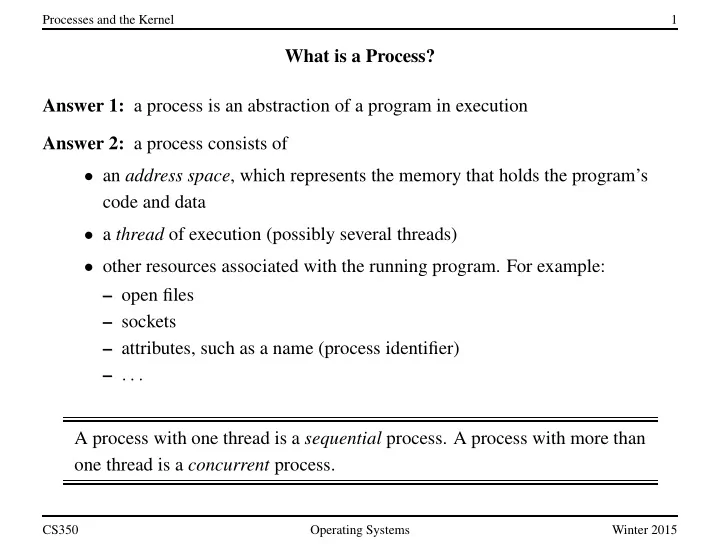
What is a Process? Answer 1: a process is an abstraction of a program in execution Answer 2: a process consists of
- an address space, which represents the memory that holds the program’s
code and data
- a thread of execution (possibly several threads)
- other resources associated with the running program. For example:
– open files – sockets – attributes, such as a name (process identifier) – . . . A process with one thread is a sequential process. A process with more than
- ne thread is a concurrent process.
CS350 Operating Systems Winter 2015
SLIDE 2 Processes and the Kernel 2
Multiprogramming
- multiprogramming means having multiple processes existing at the same time
- most modern, general purpose operating systems support multiprogramming
- all processes share the available hardware resources, with the sharing
coordinated by the operating system: – Each process uses some of the available memory to hold its address space. The OS decides which memory and how much memory each process gets – OS can coordinate shared access to devices (keyboards, disks), since processes use these devices indirectly, by making system calls. – Processes timeshare the processor(s). Again, timesharing is controlled by the operating system.
- OS ensures that processes are isolated from one another. Interprocess
communication should be possible, but only at the explicit request of the processes involved.
CS350 Operating Systems Winter 2015
SLIDE 3 Processes and the Kernel 3
The OS Kernel
- The kernel is a program. It has code and data like any other program.
- Usually kernel code runs in a privileged execution mode, while other programs
do not
CPU registers memory data code data code stack thread library application kernel
CS350 Operating Systems Winter 2015
SLIDE 4 Processes and the Kernel 4
Kernel Privilege, Kernel Protection
- What does it mean to run in privileged mode?
- Kernel uses privilege to
– control hardware – protect and isolate itself from processes
- privileges vary from platform to platform, but may include:
– ability to execute special instructions (like halt) – ability to manipulate processor state (like execution mode) – ability to access memory addresses that can’t be accessed otherwise
- kernel ensures that it is isolated from processes. No process can execute or
change kernel code, or read or write kernel data, except through controlled mechanisms like system calls.
CS350 Operating Systems Winter 2015
SLIDE 5 Processes and the Kernel 5
System Calls
- System calls are an interface between processes and the kernel.
- A process uses system calls to request operating system services.
- Some examples:
Service OS/161 Examples create,destroy,manage processes fork,execv,waitpid,getpid create,destroy,read,write files
- pen,close,remove,read,write
manage file system and directories mkdir,rmdir,link,sync interprocess communication pipe,read,write manage virtual memory sbrk query,manage system reboot, time
CS350 Operating Systems Winter 2015
SLIDE 6 Processes and the Kernel 6
How System Calls Work
- The hardware provides a mechanism that a running program can use to cause a
system call. Often, it is a special instruction, e.g., the MIPS syscall instruction.
- What happens on a system call:
– the processor is switched to system (privileged) execution mode – key parts of the current thread context, such as the program counter, are saved – the program counter is set to a fixed (specified by the hardware) memory address, which is within the kernel’s address space
CS350 Operating Systems Winter 2015
SLIDE 7 Processes and the Kernel 7
System Call Execution and Return
- Once a system call occurs, the calling thread will be executing a system call
handler, which is part of the kernel, in privileged mode.
- The kernel’s handler determines which service the calling process wanted, and
performs that service.
- When the kernel is finished, it returns from the system call. This means:
– restore the key parts of the thread context that were saved when the system call was made – switch the processor back to unprivileged (user) execution mode
- Now the thread is executing the calling process’ program again, picking up
where it left off when it made the system call. A system call causes a thread to stop executing application code and to start executing kernel code in privileged mode. The system call return switches the thread back to executing application code in unprivileged mode.
CS350 Operating Systems Winter 2015
SLIDE 8
Processes and the Kernel 8
System Call Diagram
path Process Kernel time system call return system call thread execution
CS350 Operating Systems Winter 2015
SLIDE 9
Processes and the Kernel 9
System Call Software Stack
code system call convention procedure call convention follows Kernel unprivileged code privileged follows kernel Application Syscall Library system call happens here
CS350 Operating Systems Winter 2015
SLIDE 10
Processes and the Kernel 10
OS/161 close System Call Description Library: standard C library (libc) Synopsis: #include <unistd.h> int close(int fd); Description: The file handle fd is closed. . . . Return Values: On success, close returns 0. On error, -1 is returned and errno is set according to the error encountered. Errors: EBADF: fd is not a valid file handle EIO: A hard I/O error occurred
CS350 Operating Systems Winter 2015
SLIDE 11
Processes and the Kernel 11
An Example System Call: A Tiny OS/161 Application that Uses close /* Program: user/uw-testbin/syscall.c */ #include <unistd.h> #include <errno.h> int main() { int x; x = close(999); if (x < 0) { return errno; } return x; }
CS350 Operating Systems Winter 2015
SLIDE 12
Processes and the Kernel 12
Disassembly listing of user/uw-testbin/syscall 00400050 <main>: 400050: 27bdffe8 addiu sp,sp,-24 400054: afbf0010 sw ra,16(sp) 400058: 0c100077 jal 4001dc <close> 40005c: 240403e7 li a0,999 400060: 04410003 bgez v0,400070 <main+0x20> 400064: 00000000 nop 400068: 3c021000 lui v0,0x1000 40006c: 8c420000 lw v0,0(v0) 400070: 8fbf0010 lw ra,16(sp) 400074: 00000000 nop 400078: 03e00008 jr ra 40007c: 27bd0018 addiu sp,sp,24 MIPS procedure call convention: arguments in a0,a1,. . ., return value in v0. The above can be obtained using cs350-objdump -d.
CS350 Operating Systems Winter 2015
SLIDE 13 Processes and the Kernel 13
OS/161 MIPS System Call Conventions
- When the syscall instruction occurs:
– An integer system call code should be located in register R2 (v0) – Any system call arguments should be located in registers R4 (a0), R5 (a1), R6 (a2), and R7 (a3), much like procedure call arguments.
- When the system call returns
– register R7 (a3) will contain a 0 if the system call succeeded, or a 1 if the system call failed – register R2 (v0) will contain the system call return value if the system call succeeded, or an error number (errno) if the system call failed.
CS350 Operating Systems Winter 2015
SLIDE 14
Processes and the Kernel 14
OS/161 System Call Code Definitions /* Contains a number for every more-or-less standard */ /* Unix system call (you will implement some subset). */ ... #define SYS_close 49 #define SYS_read 50 #define SYS_pread 51 //#define SYS_readv 52 /* won’t be implementing */ //#define SYS_preadv 53 /* won’t be implementing */ #define SYS_getdirentry 54 #define SYS_write 55 ... This comes from kern/include/kern/syscall.h. The files in kern/include/kern define things (like system call codes) that must be known by both the kernel and applications.
CS350 Operating Systems Winter 2015
SLIDE 15
Processes and the Kernel 15
System Call Wrapper Functions from the Standard Library ... 004001dc <close>: 4001dc: 08100030 j 4000c0 <__syscall> 4001e0: 24020031 li v0,49 004001e4 <read>: 4001e4: 08100030 j 4000c0 <__syscall> 4001e8: 24020032 li v0,50 ... The above is disassembled code from the standard C library (libc), which is linked with user/uw-testbin/syscall.o.
CS350 Operating Systems Winter 2015
SLIDE 16
Processes and the Kernel 16
The OS/161 System Call and Return Processing 004000c0 <__syscall>: 4000c0: 0000000c syscall 4000c4: 10e00005 beqz a3,4000dc <__syscall+0x1c> 4000c8: 00000000 nop 4000cc: 3c011000 lui at,0x1000 4000d0: ac220000 sw v0,0(at) 4000d4: 2403ffff li v1,-1 4000d8: 2402ffff li v0,-1 4000dc: 03e00008 jr ra 4000e0: 00000000 nop The system call and return processing, from the standard C library. Like the rest of the library, this is unprivileged, user-level code.
CS350 Operating Systems Winter 2015
SLIDE 17
Processes and the Kernel 17
OS/161 MIPS Exception Handler
common_exception: mfc0 k0, c0_status /* Get status register */ andi k0, k0, CST_KUp /* Check the we-were-in-user-mode bit */ beq k0, $0, 1f /* If clear, from kernel, already have stack */ /* 1f is branch forward to label 1: */ nop /* delay slot */ /* Coming from user mode - find kernel stack */ mfc0 k1, c0_context /* we keep the CPU number here */ srl k1, k1, CTX_PTBASESHIFT /* shift to get the CPU number */ sll k1, k1, 2 /* shift back to make array index */ lui k0, %hi(cpustacks) /* get base address of cpustacks[] */ addu k0, k0, k1 /* index it */ move k1, sp /* Save previous stack pointer */ b 2f /* Skip to common code */ lw sp, %lo(cpustacks)(k0) /* Load kernel sp (in delay slot) */
CS350 Operating Systems Winter 2015
SLIDE 18
Processes and the Kernel 18
OS/161 MIPS Exception Handler
1: /* Coming from kernel mode - just save previous stuff */ move k1, sp /* Save previous stack in k1 (delay slot) */ 2: /* At this point: * Interrupts are off. (The processor did this for us.) * k0 contains the value for curthread, to go into s7. * k1 contains the old stack pointer. * sp points into the kernel stack. * All other registers are untouched. */ When the syscall instruction occurs, the MIPS transfers control to ad- dress 0x80000080. This kernel exception handler lives there. See kern/arch/mips/locore/exception-mips1.S
CS350 Operating Systems Winter 2015
SLIDE 19
Processes and the Kernel 19
OS/161 User and Kernel Thread Stacks
memory CPU registers stack code data code data stack thread library application kernel
Each OS/161 thread has two stacks, one that is used while the thread is ex- ecuting unprivileged application code, and another that is used while the thread is executing privileged kernel code.
CS350 Operating Systems Winter 2015
SLIDE 20 Processes and the Kernel 20
OS/161 MIPS Exception Handler (cont’d) The common exception code then does the following:
- 1. allocates a trap frame on the thread’s kernel stack and saves the user-level
application’s complete processor state (all registers except k0 and k1) into the trap frame.
- 2. calls the mips trap function to continue processing the exception.
- 3. when mips trap returns, restores the application processor state from the trap
frame to the registers
- 4. issues MIPS jr and rfe (restore from exception) instructions to return control
to the application code. The jr instruction takes control back to the location specified by the application program counter when the syscall occurred (i.e., exception PC) and the rfe (which happens in the delay slot of the jr) restores the processor to unprivileged mode
CS350 Operating Systems Winter 2015
SLIDE 21
Processes and the Kernel 21
OS/161 Trap Frame
memory CPU registers data code stack stack data code application state thread library trap frame with saved application kernel
While the kernel handles the system call, the application’s CPU state is saved in a trap frame on the thread’s kernel stack, and the CPU registers are avail- able to hold kernel execution state.
CS350 Operating Systems Winter 2015
SLIDE 22 Processes and the Kernel 22
mips trap: Handling System Calls, Exceptions, and Interrupts
- On the MIPS, the same exception handler is invoked to handle system calls,
exceptions and interrupts
- The hardware sets a code to indicate the reason (system call, exception, or
interrupt) that the exception handler has been invoked
- OS/161 has a handler function corresponding to each of these reasons. The
mips trap function tests the reason code and calls the appropriate function: the system call handler (syscall) in the case of a system call.
- mips trap can be found in kern/arch/mips/locore/trap.c.
Interrupts and exceptions will be presented shortly
CS350 Operating Systems Winter 2015
SLIDE 23
Processes and the Kernel 23
OS/161 System Call Handler
syscall(struct trapframe *tf) { callno = tf->tf_v0; retval = 0; switch (callno) { case SYS_reboot: err = sys_reboot(tf->tf_a0); break; case SYS___time: err = sys___time((userptr_t)tf->tf_a0, (userptr_t)tf->tf_a1); break; /* Add stuff here */ default: kprintf("Unknown syscall %d\n", callno); err = ENOSYS; break; }
syscall checks system call code and invokes a handler for the indicated system call. See kern/arch/mips/syscall/syscall.c
CS350 Operating Systems Winter 2015
SLIDE 24
Processes and the Kernel 24
OS/161 MIPS System Call Return Handling
if (err) { tf->tf_v0 = err; tf->tf_a3 = 1; /* signal an error */ } else { /* Success. */ tf->tf_v0 = retval; tf->tf_a3 = 0; /* signal no error */ } /* Advance the PC, to avoid the syscall again. */ tf->tf_epc += 4; /* Make sure the syscall code didn’t forget to lower spl */ KASSERT(curthread->t_curspl == 0); /* ...or leak any spinlocks */ KASSERT(curthread->t_iplhigh_count == 0); }
syscall must ensure that the kernel adheres to the system call return con- vention.
CS350 Operating Systems Winter 2015
SLIDE 25 Processes and the Kernel 25
Exceptions
- Exceptions are another way that control is transferred from a process to the
kernel.
- Exceptions are conditions that occur during the execution of an instruction by a
- process. For example, arithmetic overflows, illegal instructions, or page faults
(to be discussed later).
- Exceptions are detected by the hardware.
- When an exception is detected, the hardware transfers control to a specific
address.
- Normally, a kernel exception handler is located at that address.
Exception handling is similar to, but not identical to, system call handling. (What is different?)
CS350 Operating Systems Winter 2015
SLIDE 26
Processes and the Kernel 26
MIPS Exceptions EX_IRQ /* Interrupt */ EX_MOD 1 /* TLB Modify (write to read-only page) */ EX_TLBL 2 /* TLB miss on load */ EX_TLBS 3 /* TLB miss on store */ EX_ADEL 4 /* Address error on load */ EX_ADES 5 /* Address error on store */ EX_IBE 6 /* Bus error on instruction fetch */ EX_DBE 7 /* Bus error on data load *or* store */ EX_SYS 8 /* Syscall */ EX_BP 9 /* Breakpoint */ EX_RI 10 /* Reserved (illegal) instruction */ EX_CPU 11 /* Coprocessor unusable */ EX_OVF 12 /* Arithmetic overflow */ In OS/161, mips trap uses these codes to decide whether it has been in- voked because of an interrupt, a system call, or an exception.
CS350 Operating Systems Winter 2015
SLIDE 27 Processes and the Kernel 27
Interrupts (Revisited)
- Interrupts are a third mechanism by which control may be transferred to the
kernel
- Interrupts are similar to exceptions. However, they are caused by hardware
devices, not by the execution of a program. For example: – a network interface may generate an interrupt when a network packet arrives – a disk controller may generate an interrupt to indicate that it has finished writing data to the disk – a timer may generate an interrupt to indicate that time has passed
- Interrupt handling is similar to exception handling - current execution context is
saved, and control is transferred to a kernel interrupt handler at a fixed address.
CS350 Operating Systems Winter 2015
SLIDE 28 Processes and the Kernel 28
Interrupts, Exceptions, and System Calls: Summary
- Interrupts, exceptions and system calls are three mechanisms by which control
is transferred from an application program to the kernel
- When these events occur, the hardware switches the CPU into privileged mode
and transfers control to a predefined location, at which a kernel handler should be located.
- The kernel handler creates a trap frame and uses it to saves the application
thread context so that the handler code can be executed on the CPU.
- Just before the kernel handler finishes executing, it restores the application
thread context from the trap frame, before returning control to the application. In OS/161, trap frames are placed on the kernel stack of the thread performed the system call, or of the thread that was running when the interrupt or ex- ception occurred
CS350 Operating Systems Winter 2015
SLIDE 29
Processes and the Kernel 29
System Calls for Process Management Linux OS/161 Creation fork,execv fork,execv Destruction exit,kill exit Synchronization wait,waitpid,pause,. . . waitpid Attribute Mgmt getpid,getuid,nice,getrusage,. . . getpid
CS350 Operating Systems Winter 2015
SLIDE 30
Processes and the Kernel 30
The fork, exit, getpid and waitpid system calls main() { rc = fork(); /* returns 0 to child, pid to parent */ if (rc == 0) { my_pid = getpid(); x = child_code(); _exit(x); } else { child_pid = rc; parent_code(); child_exit = waitpid(child_pid); parent_pid = getpid(); } }
CS350 Operating Systems Winter 2015
SLIDE 31
Processes and the Kernel 31
Process Creation Example (Part 1)
Kernel Process A Parent process (Process A) requests creation of a new process. fork
CS350 Operating Systems Winter 2015
SLIDE 32
Processes and the Kernel 32
Process Creation Example (Part 2)
fork Kernel Process A Process B B’s thread is ready, not running system call return Kernel creates new process (Process B)
CS350 Operating Systems Winter 2015
SLIDE 33
Processes and the Kernel 33
The execv system call int main() { int rc = 0; char *args[4]; args[0] = (char *) "/testbin/argtest"; args[1] = (char *) "first"; args[2] = (char *) "second"; args[2] = 0; rc = execv("/testbin/argtest", args); printf("If you see this execv failed\n"); printf("rc = %d errno = %d\n", rc, errno); exit(0); }
CS350 Operating Systems Winter 2015
SLIDE 34
Processes and the Kernel 34
Combining fork and execv main() { char *args[4]; /* set args here */ rc = fork(); /* returns 0 to child, pid to parent */ if (rc == 0) { status = execv("/testbin/argtest",args); printf("If you see this execv failed\n"); printf("status = %d errno = %d\n", status, errno); exit(0); } else { child_pid = rc; parent_code(); child_exit = waitpid(child_pid); } }
CS350 Operating Systems Winter 2015
SLIDE 35 Processes and the Kernel 35
Implementation of Processes
- The kernel maintains information about all of the processes in the system in a
data structure often called the process table.
- Per-process information may include:
– process identifier and owner – the address space for the process – threads belonging to the process – lists of resources allocated to the process, such as open files – accounting information
CS350 Operating Systems Winter 2015
SLIDE 36
Processes and the Kernel 36
OS/161 Process /* From kern/include/proc.h */ struct proc { char *p_name; /* Name of this process */ struct spinlock p_lock; /* Lock for this structure */ struct threadarray p_threads; /* Threads in process */ struct addrspace *p_addrspace; /* virtual address space */ struct vnode *p_cwd; /* current working directory */ /* add more material here as needed */ };
CS350 Operating Systems Winter 2015
SLIDE 37
Processes and the Kernel 37
OS/161 Process /* From kern/include/proc.h */ /* Create a fresh process for use by runprogram() */ struct proc *proc_create_runprogram(const char *name); /* Destroy a process */ void proc_destroy(struct proc *proc); /* Attach a thread to a process */ /* Must not already have a process */ int proc_addthread(struct proc *proc, struct thread *t); /* Detach a thread from its process */ void proc_remthread(struct thread *t); ...
CS350 Operating Systems Winter 2015
SLIDE 38 Processes and the Kernel 38
Implementing Timesharing
- whenever a system call, exception, or interrupt occurs, control is transferred
from the running program to the kernel
- at these points, the kernel has the ability to cause a context switch from the
running process’ thread to another process’ thread
- notice that these context switches always occur while a process’ thread is
executing kernel code By switching from one process’s thread to another process’s thread, the ker- nel timeshares the processor among multiple processes.
CS350 Operating Systems Winter 2015
SLIDE 39
Processes and the Kernel 39
Two Processes in OS/161
CPU registers data code code data data code stack stack stack stack trap frame for app #1 thread library saved kernel thread context for thread #1 application #2 kernel application #1
CS350 Operating Systems Winter 2015
SLIDE 40 Processes and the Kernel 40
Timesharing Example (Part 1)
ready, not running Kernel Process A Process B context switch A’s thread is ready, not running system call
Kernel switches execution context to Process B. return B’s thread is
CS350 Operating Systems Winter 2015
SLIDE 41 Processes and the Kernel 41
Timesharing Example (Part 2)
return Kernel Process A Process B Kernel switches execution context back to process A. B’s thread is ready, not running context switch system call
CS350 Operating Systems Winter 2015
SLIDE 42 Processes and the Kernel 42
Implementing Preemption
- the kernel uses interrupts from the system timer to measure the passage of time
and to determine whether the running process’s quantum has expired.
- a timer interrupt (like any other interrupt) transfers control from the running
program to the kernel.
- this gives the kernel the opportunity to preempt the running thread and dispatch
a new one.
CS350 Operating Systems Winter 2015
SLIDE 43
Processes and the Kernel 43
Preemptive Multiprogramming Example
Key: Kernel Process A Process B context switches timer interrupt interrupt return ready thread running thread CS350 Operating Systems Winter 2015