Lecture 6/Chapters 5&6 backward in time, about the past. - - PowerPoint PPT Presentation

lecture 6 chapters 5 6
SMART_READER_LITE
LIVE PREVIEW

Lecture 6/Chapters 5&6 backward in time, about the past. - - PowerPoint PPT Presentation

Definitions Retrospective observational study: researchers record variables values Lecture 6/Chapters 5&6 backward in time, about the past. Observational Studies & Review Prospective observational study: researchers record


slide-1
SLIDE 1

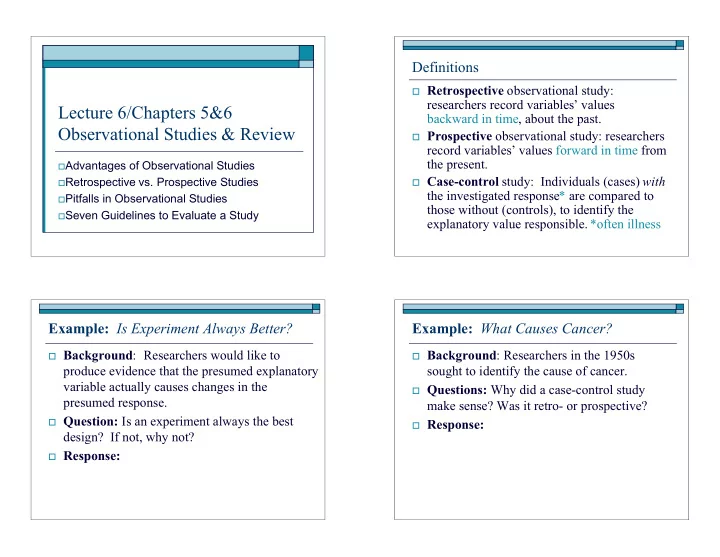
Lecture 6/Chapters 5&6 Observational Studies & Review

Advantages of Observational Studies Retrospective vs. Prospective Studies Pitfalls in Observational Studies Seven Guidelines to Evaluate a Study

Definitions

Retrospective observational study:

researchers record variables’ values backward in time, about the past.

Prospective observational study: researchers

record variables’ values forward in time from the present.

Case-control study: Individuals (cases) with

the investigated response* are compared to those without (controls), to identify the explanatory value responsible. *often illness

Example: Is Experiment Always Better?

Background: Researchers would like to

produce evidence that the presumed explanatory variable actually causes changes in the presumed response.

Question: Is an experiment always the best

design? If not, why not?

Response:

Example: What Causes Cancer?

Background: Researchers in the 1950s

sought to identify the cause of cancer.

Questions: Why did a case-control study

make sense? Was it retro- or prospective?

Response:

slide-2
SLIDE 2

Example: Pros/Cons of Observational Study

Background: Researchers want to produce

evidence that cell phones can cause accidents.

Questions: What are respective drawbacks of

two studies described in article excerpts? Which is more convincing to you?

Response:

1st (obs) 2nd (exp) ____ seems more convincing…

Example: Relative Scope of Studies

Background: There may be a subtle effect of

asbestos in drinking water on lung cancer: if asbestos level is multiplied by 100, 21 out of 20,000 would have lung cancer instead of 20.

Question: Besides being unethical, why

would an experiment be inappropriate?

Response:

Example: Retrospective vs. Prospective

Background: Does watching TV make kids

fat? Weigh a random sample of children, find

  • ut from them (or parents) how much TV they

watched over the past few years.

Questions: Is the design retrospective or

prospective? Any flaws?

Response:

  • (see hotdog study p. 517)

Example: Retrospective vs. Prospective

Background: Does watching TV make kids

fat? Weigh a random sample of kids at start & end of several-year period, during which time TV times are recorded in journals.

Questions: Is the design retrospective or

prospective? Any flaws?

Response:

slide-3
SLIDE 3

Outside variables (Review)

Confounding variable: one that clouds the

issue of causation because its values are tied in with those of the so-called explanatory variable, and also play a role in the so-called response variable's values Confounding variables are especially problematic in observational studies.

Common Problems w. Observational Studies

Confounding variables (should always be

considered first)

Extending the results inappropriately (sample

doesn’t truly represent population of interest)

Using the past as a source of data (time enters

in as confounding variable)

Example: Confounding Variables

Background: Discussed various studies today Question/Response: What is a possible

confounding variable in each relationship?

Smoking/cancer: Cell phones/accidents: Asbestos/lung cancer:

Example: Extending Results Inappropriately

Background: A study at Cornell found that

students gain an average of 4 pounds their freshman year.

Question: Can we conclude that, for all

schools, the so-called “Freshman Fifteen” would be better named the “Freshman Four”?

Response:

slide-4
SLIDE 4

Example: Data from the Past

Background: Recently at Papworth Hospital

in England, mortality rate of heart transplant patients increased from 7% to 35%.

Question: Can we conclude that malpractice

  • r a decline in proper care of patients is

responsible?

Response:

Seven Guidelines for Systematic Evaluation

Step 1: Determine if study was sample survey, experiment, obs study, census, or anecdotes. Step 2: Consider 7 Critical Components (details). Step 3: Check for “Difficulties and Disasters” (sampling p. 69, exp. p. 90, obs. studies p. 96) Step 4: Is info complete? If not, find original? Step 5: Do results make sense? Step 6: Are alternative explanations possible? Step 7: Do results affect your attitude/lifestyle?

1.

Source of research and funding

2.

Researchers who had contact w. participants

3.

Individuals studied, how they were selected

4.

Variables studied [measurements, questions]

5.

Setting (time, place)

6.

Confounding variables [differences besides factor of interest] if causal relationship is claimed

7.

Extent or size of claimed effects/differences

Prepare for step-by-step discussion of how 7 Guidelines apply to jet lag & breastfeeding studies; note 7 Critical Components for step 2: JET LAG? JUST LIGHT UP YOUR KNEE In an experiment from the strange but possibly true category, scientists have shone a bright light on the backs of human knees and, in some mysterious way, reset the master biological clock in the human brain. Those treated with the light had their biological clocks advanced

  • r delayed up to three hours, enough to overcome the fatigue

associated with familiar forms of jet lag or insomnia. Why shining light on the knee would have this effect is a mystery. The finding is so surprising that many experts said they were withholding judgment until the experiment was repeated. But those who heard the study described at a meeting last summer said it was carefully done. ``We were all flabbergasted,'' said Dr. Michael Menaker, a biologist at the University of Virginia in Charlottesville. ``For three days we tried to find flaws in the experiment and we couldn't.''

slide-5
SLIDE 5

(continued) Dr. Al Lewy, an expert on circadian rhythms at the University of Oregon Health Sciences University in Portland, said: ``We've taken it as received wisdom that such effects would have to be mediated through the eyes. I am very

  • surprised. It is so revolutionary.''
  • Dr. Thomas Wehr, chief of the clinical psychobiology branch at

the National Institute of Mental Health in Bethesda, Md., said: ``There are more biological mechanisms underlying the human response to light than was dreamt of in our original hypothesis. Still, until others repeat the experiment, the findings have to be regarded as preliminary.'' If the finding does hold up, the experts said, it will have profound implications for basic biology, overturning conventional ideas of how biological clocks are set. It may also lead to new treatments for seasonal depression, sleep disorders and jet lag. Airline passengers could wear a knee brace with a light source that would reset their biological clocks as they slept during the flight. (continued) The study, which was published Friday in the journal Science, was done by Dr. Scott Campbell and Dr. Patricia Murphy of the Laboratory of Human Chronobiology at Cornell University Medical College in White Plains, N.Y. When life began, primitive creatures needed to have a way of keeping time and of knowing when it is light or dark, Campbell

  • said. And so they evolved a variety of internal biological clocks -

cells or clumps of cells that oscillate every 24 hours, sending

  • ut signals that control a host of behaviors such as when to

wake up, go to sleep, eat, mate, hibernate and the like. Some creatures have light sensitive cells on various parts of their bodies that help regulate the master clock. Horseshoe crabs have clock sensors on their tails, swallows have them just inside their skulls and, according to a recent finding, fruit flies have time-keeping genes active in their legs, wings and hair bristles, suggesting that the entire body helps keep track of

  • time. Because day length changes through the seasons, every

animal has to reset its clocks every day. (continued) Humans are thought to possess a single master clock in the brain that ``gives temporal organization to everything that we do,'' Campbell said, ``but no one ever imagined we had light sensitive cells on any part of our bodies'' outside of the eye. Even the eye presents a mystery, he said. It contains special cells that gather light and enable vision. But these cells, called rods and cones, have nothing to do with resetting biological

  • clocks. Many blind people experience jet lag, suggesting that
  • ther as yet undiscovered light sensitive cells in the eyes are

sending important information about day length to the brain. Despite years of looking, no one has ever found such cells in the eye. ``We thought we should look on the skin,'' Campbell said. An experiment done a decade earlier by Wehr had found that a couple of people with winter depression got better when light was administered to their face, arms, legs and not to the eyes, he

  • said. ``Dr. Wehr said it was so interesting that someone should

someday repeat the experiment,'' Campbell said. ``So we did.'' (continued) Fifteen volunteers came to the laboratory for four days and nights. On the first night, researchers determined each person's biological rhythm using two standard measures: body core temperature and the rise in a hormone called melatonin. ``Your body temperature rises throughout the day and begins to decline around 7 or 8 o'clock at night,'' Campbell said. It falls to its lowest point about 5 or half past 5 in the morning and slowly starts to go up again. In a similar vein, melatonin begins to increase around 10 p.m. and makes people feel sleepy. It falls off again during the day.On the second night, the subjects stayed awake in a dimly lighted room, reclining in a chair with a table

  • ver their laps. A thick black material was draped over their legs

and fastened to their waists. Underneath this skirt, a knee pad with a fiber optic tube was attached to the back of their knees and a bright light was delivered through the tube for three hours. Previous experiments with bright light delivered to the eyes showed that it is possible to advance or delay the body clock depending on when the light is given, Campbell said.

slide-6
SLIDE 6

(continued) In the new experiment, subjects received light behind the knees at various times between midnight and noon, Campbell said. For example, one man got the light treatment between 1 and 4 a.m. and another between 6 and 9 a.m. Other subjects were put under the same dark skirt, kept awake the same amount of time and given the same instructions. But researchers did not turn on the light source. Neither group knew if it was getting the light treatment or not. On the third and fourth nights, all subjects were told to stay in bed from midnight to noon and were allowed to sleep as their biological rhythms were measured. In similar experiments done with light to the eyes, body clocks are unstable on the third day and this was also the case with light to the knees. The fourth day was a surprise. For those treated with light, the timing of their minimum body temperature shifted by up to three hours. Those getting the sham treatment experienced small but statistically insignificant changes in their bodily rhythms, Campbell said. BREAST MILK BENEFIT Feeding breast milk to very low birth- weight babies cut the infants’ rate of infection by nearly half, according to a study published yesterday in the journal Pediatrics, another indication of the advantages of breast milk

  • ver formula.

Previous studies have shown that breast-feeding boosts the immune systems of full-term babies, and the study of very low birth weight, prematurely born infants bore out that trait, researchers from Georgetown University Medical Center and Johns Hopkins School of Hygiene and Public Health wrote. In a review of 212 premature births from 1992 and 1993, the researchers found that 29 percent of the infants fed human milk acquired infections versus 478 percent of the babies fed formula. Infections of the blood or meningitis occurred in 19.5 percent of the human milk-fed infants compared to 33 percent of the formula-fed babies.