Lecture 5 Logistics Winter 2015 Richard Anderson 1/28/2015 - - PowerPoint PPT Presentation

lecture 5 logistics winter 2015
SMART_READER_LITE
LIVE PREVIEW

Lecture 5 Logistics Winter 2015 Richard Anderson 1/28/2015 - - PowerPoint PPT Presentation

Computing and Global Health Lecture 5 Logistics Winter 2015 Richard Anderson 1/28/2015 University of Washington, Winter 2015 1 Todays topics Ron Pankiewicz, Village Reach GAVI Supply Chain Strategy Logistics requirements

slide-1
SLIDE 1

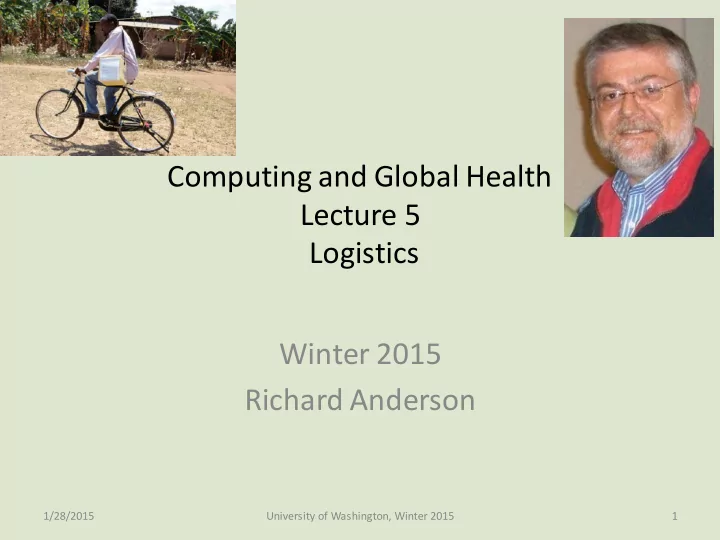
Computing and Global Health Lecture 5 Logistics Winter 2015 Richard Anderson

1/28/2015 University of Washington, Winter 2015 1

slide-2
SLIDE 2

Today’s topics

  • Ron Pankiewicz, Village Reach
  • GAVI Supply Chain Strategy
  • Logistics requirements
  • Logistics processes

– Forecasting – Delivery – Ensuring product quality

1/28/2015 University of Washington, Winter 2015 2

slide-3
SLIDE 3

Readings and Assignments

  • Logistimo
  • SMS For Life (to

assigned)

  • Assignment 5: Design a

data collection system for a Visibility & Analytics Network

  • Assignment 6: Develop

a syntax for an SMS reporting system

1/28/2015 University of Washington, Winter 2015 3

slide-4
SLIDE 4

GAVI Supply Chain Slides

1/28/2015 University of Washington, Winter 2015 4

slide-5
SLIDE 5

1/28/2015 University of Washington, Winter 2015 5

slide-6
SLIDE 6

1/28/2015 University of Washington, Winter 2015 6

slide-7
SLIDE 7

1/28/2015 University of Washington, Winter 2015 7

slide-8
SLIDE 8

1/28/2015 University of Washington, Winter 2015 8

slide-9
SLIDE 9

Supply Chain and Logistics

  • Supply chain 101

– Push process – Pull process

1/28/2015 University of Washington, Winter 2015 9

slide-10
SLIDE 10

Global health logistics

  • Large scale public sector

– National scale distribution – Usually externally sourced products – Commercial or non-commercial goods – Multiple financing models

  • Local logistics

– Regional or NGO distribution of goods

1/28/2015 University of Washington, Winter 2015 10

slide-11
SLIDE 11

Private sector

  • We will ignore the private sector, but . . .
  • Some LMIC engage private sector in logistics
  • Some goods are available both in public

system and in the markets

– Parallel public and private networks

1/28/2015 University of Washington, Winter 2015 11

slide-12
SLIDE 12

Basic logistics models

  • Multiple levels

– National – Regional – Facility

1/28/2015 University of Washington, Winter 2015 12

slide-13
SLIDE 13

Logistics Requirements

  • Requirement derived

from country workshops and visits

  • Country independent

requirements

– What is common across countries

1/28/2015 University of Washington, Winter 2015 13

slide-14
SLIDE 14

Business processes

1/28/2015 University of Washington, Winter 2015 14

slide-15
SLIDE 15

Business Processes

1/28/2015 University of Washington, Winter 2015 15

slide-16
SLIDE 16

Computing and logistics

  • Tracking
  • Visibility of Inventory
  • Management of Transactions
  • Warehouse management
  • Forecasting
  • Alerts
  • Supply chain optimization

1/28/2015 University of Washington, Winter 2015 16

slide-17
SLIDE 17

Global health logistics vs. corporate

Proctor and Gamble

  • Daily deliveries
  • Centralized control
  • Thousands of products
  • End to end visibility

Tanzania EPI

  • Quarterly or monthly

deliveries

  • Decentralized system
  • Small number of products
  • Single level visibility

1/28/2015 University of Washington, Winter 2015 17

slide-18
SLIDE 18

Logistics challenges

  • Service delivery – stocks not available
  • Other issues

– Overstock – Delivery timing – Lost stock and spoilage – Transportation costs

1/28/2015 University of Washington, Winter 2015 18

slide-19
SLIDE 19

Causes of stock outs

  • Insufficient overall supply
  • Misallocation
  • Lack of funds
  • Lack of transport
  • Demand variation
  • Delay in transport
  • Improper ordering
  • Spoilage
  • Leakage

1/28/2015 University of Washington, Winter 2015 19

slide-20
SLIDE 20

Visibility and analysis

  • Goals
  • Components

– Planning – Delivery – Quality of product – Quality of supply chain

1/28/2015 University of Washington, Winter 2015 20

slide-21
SLIDE 21

Planning

  • How do you know how much stuff to order

1/28/2015 University of Washington, Winter 2015 21

slide-22
SLIDE 22

EPI Forecasting

1/28/2015 University of Washington, Winter 2015 22

Vaccine demand = Doses * Population * Coverage * Supply Period / (52 * (1 – Wastage)) Min Stock = Doses * Population * Coverage * Reserve Period / (52 * (1 – Wastage)) Max Stock = Vaccine demand + Min Stock

slide-23
SLIDE 23

Delivery

  • Receive order
  • Approve order
  • Arrange transport
  • Pack order
  • Send shipment
  • Receive shipment
  • Verify / record shipment
  • Unpack shipment
  • Store shipment

1/28/2015 University of Washington, Winter 2015 23

slide-24
SLIDE 24

DVDMT Reporting

1/28/2015 University of Washington, Winter 2015 24

slide-25
SLIDE 25

Bar coding

1/28/2015 University of Washington, Winter 2015 25

slide-26
SLIDE 26

Stock data reporting

  • Regular reports of stock levels to SMS sent to a

server

  • SMS for Life

– Reporting project supported by Novartis – Weekly reports of supplies of Malaria medication – Pilot studies show significant drop in stock outs – Scales quickly (reach 5000 health facilities 7 months) – Reported costs: “operational cost of less than 80 USD per health facility”

1/28/2015 University of Washington, Winter 2015 26

slide-27
SLIDE 27

SMS for Life

1/28/2015 University of Washington, Winter 2015 27

The mobile phone credit was an incentive to motivate health workers to send the message on time and also to recognize the additional tasks they had to perform for the pilot above their normal workload.

slide-28
SLIDE 28

Product quality

  • Product spoilage
  • Product expiration

1/28/2015 University of Washington, Winter 2015 28

slide-29
SLIDE 29

Supply chain quality

  • How good is the supply chain infrastructure

1/28/2015 University of Washington, Winter 2015 29

slide-30
SLIDE 30

Cold chain equipment inventory

  • 1. Health facility data
  • 2. Refrigerators, freezers, cold room, cold box data
  • 3. Vaccine and equipment reference data

2/4/2015 Page 30

slide-31
SLIDE 31

Cold chain capacity analysis

  • Maximum volume of storage necessary

to store all vaccines

– VFIC: Volume per fully immunized child – POP * VFIC / Supply Interval

1/28/2015 University of Washington, Winter 2015 31

slide-32
SLIDE 32

Temperature monitoring

1/28/2015 University of Washington, Winter 2015 32

slide-33
SLIDE 33

Supply chain optimization

1/28/2015 University of Washington, Winter 2015 33

slide-34
SLIDE 34

US Vaccine Supply Chain

  • 1994: 64 distribution networks, 430 depots
  • 2008: single distribution network, 4 depots

1/28/2015 University of Washington, Winter 2015 34

slide-35
SLIDE 35

Supply chain modeling

1/28/2015 University of Washington, Winter 2015 35

slide-36
SLIDE 36

Next week

  • Patient Support

1/28/2015 University of Washington, Winter 2015 36