
SLIDE 1
Computing & Information Sciences Kansas State University CIS 536/636 Introduction to Computer Graphics Lecture 28 of 41
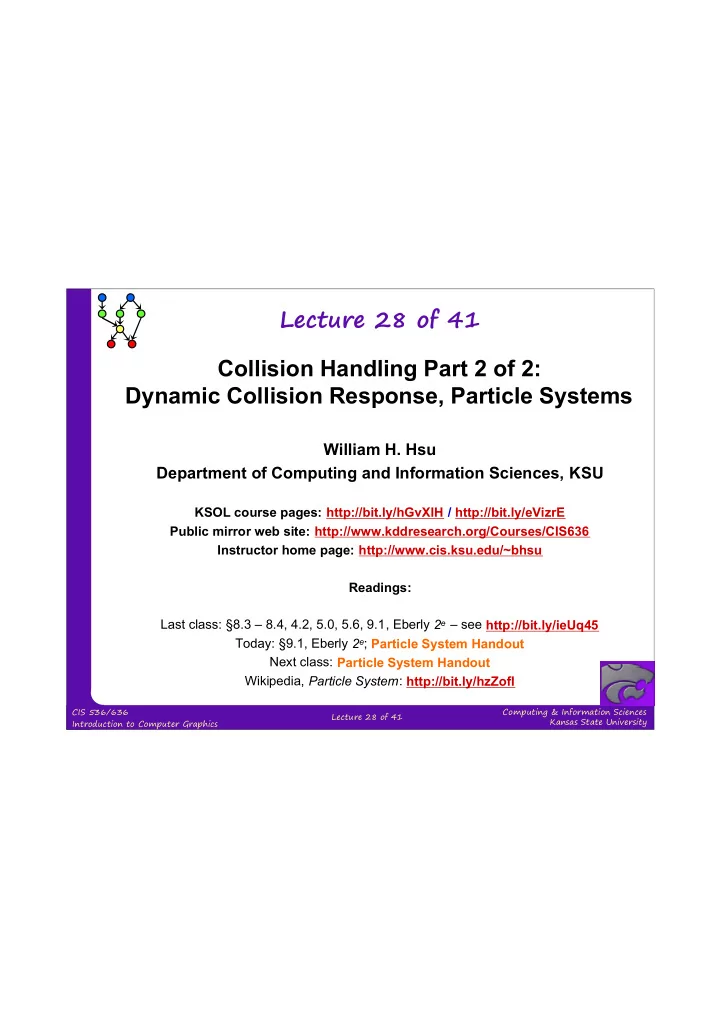
Lecture 28 of 41 Collision Handling Part 2 of 2: Dynamic Collision - - PDF document
Lecture 28 of 41 Collision Handling Part 2 of 2: Dynamic Collision Response, Particle Systems William H. Hsu Department of Computing and Information Sciences, KSU KSOL course pages: http://bit.ly/hGvXlH / http://bit.ly/eVizrE Public mirror web
Computing & Information Sciences Kansas State University CIS 536/636 Introduction to Computer Graphics Lecture 28 of 41
Computing & Information Sciences Kansas State University 2 CIS 536/636 Introduction to Computer Graphics Lecture 28 of 41
Computing & Information Sciences Kansas State University 3 CIS 536/636 Introduction to Computer Graphics Lecture 28 of 41
Computing & Information Sciences Kansas State University 4 CIS 536/636 Introduction to Computer Graphics Lecture 28 of 41
Postdoctoral Researcher Advanced Science Institute RIKEN (理研) http://hubertshum.com/info/
Associate Professor Department of Computer Science Cornell University http://www.cs.cornell.edu/~francois/
Visiting Lecturer Graphics Lab University of California – San Diego CEO/Chief Scientist, PixelActive http://graphics.ucsd.edu
Computing & Information Sciences Kansas State University 5 CIS 536/636 Introduction to Computer Graphics Lecture 28 of 41
Adapted from Wikipedia, Human-Computer Interaction http://bit.ly/bqrQTg
Computing & Information Sciences Kansas State University 6 CIS 536/636 Introduction to Computer Graphics Lecture 28 of 41
Adapted from slide 2004 F. Guimbretire, Cornell University Stanford CS448B: Visualization, Fall 2004, http://bit.ly/h0hRzU
Computing & Information Sciences Kansas State University 7 CIS 536/636 Introduction to Computer Graphics Lecture 28 of 41
Adapted from material 2008 Wikimedia Foundation (from Wickens et al., 2004) Human-Computer Interaction, http://bit.ly/bqrQTg
Computing & Information Sciences Kansas State University 8 CIS 536/636 Introduction to Computer Graphics Lecture 28 of 41
Adapted from material 2008 Wikimedia Foundation (from Wickens et al., 2004) Human-Computer Interaction, http://bit.ly/bqrQTg
Computing & Information Sciences Kansas State University 9 CIS 536/636 Introduction to Computer Graphics Lecture 28 of 41
Adapted from slide 2008 H. P. H. Shum, RIKEN (理研) Computer Animation, http://bit.ly/ig6KTK
Computing & Information Sciences Kansas State University 10 CIS 536/636 Introduction to Computer Graphics Lecture 28 of 41
Adapted from slide 2008 H. P. H. Shum, RIKEN (理研) Computer Animation, http://bit.ly/ig6KTK
Computing & Information Sciences Kansas State University 11 CIS 536/636 Introduction to Computer Graphics Lecture 28 of 41
Adapted from slide 2008 H. P. H. Shum, RIKEN (理研) Computer Animation, http://bit.ly/ig6KTK
Computing & Information Sciences Kansas State University 12 CIS 536/636 Introduction to Computer Graphics Lecture 28 of 41
Computing & Information Sciences Kansas State University 13 CIS 536/636 Introduction to Computer Graphics Lecture 28 of 41
Adapted from slides 2004 – 2005 S. Rotenberg, UCSD CSE169: Computer Animation, Winter 2005, http://bit.ly/f0ViAN
Computing & Information Sciences Kansas State University 14 CIS 536/636 Introduction to Computer Graphics Lecture 28 of 41
Computing & Information Sciences Kansas State University 15 CIS 536/636 Introduction to Computer Graphics Lecture 28 of 41
Adapted from slides 2004 – 2005 S. Rotenberg, UCSD CSE169: Computer Animation, Winter 2005, http://bit.ly/f0ViAN
Computing & Information Sciences Kansas State University 16 CIS 536/636 Introduction to Computer Graphics Lecture 28 of 41
Adapted from slides 2004 – 2005 S. Rotenberg, UCSD CSE169: Computer Animation, Winter 2005, http://bit.ly/f0ViAN
Computing & Information Sciences Kansas State University 17 CIS 536/636 Introduction to Computer Graphics Lecture 28 of 41
Adapted from slides 2004 – 2005 S. Rotenberg, UCSD CSE169: Computer Animation, Winter 2005, http://bit.ly/f0ViAN
Computing & Information Sciences Kansas State University 18 CIS 536/636 Introduction to Computer Graphics Lecture 28 of 41
Adapted from slides 2004 – 2005 S. Rotenberg, UCSD CSE169: Computer Animation, Winter 2005, http://bit.ly/f0ViAN
Computing & Information Sciences Kansas State University 19 CIS 536/636 Introduction to Computer Graphics Lecture 28 of 41
Adapted from slides 2004 – 2005 S. Rotenberg, UCSD CSE169: Computer Animation, Winter 2005, http://bit.ly/f0ViAN
Computing & Information Sciences Kansas State University 20 CIS 536/636 Introduction to Computer Graphics Lecture 28 of 41
Adapted from slides 2004 – 2005 S. Rotenberg, UCSD CSE169: Computer Animation, Winter 2005, http://bit.ly/f0ViAN
Computing & Information Sciences Kansas State University 21 CIS 536/636 Introduction to Computer Graphics Lecture 28 of 41
Adapted from slides 2004 – 2005 S. Rotenberg, UCSD CSE169: Computer Animation, Winter 2005, http://bit.ly/f0ViAN
Computing & Information Sciences Kansas State University 22 CIS 536/636 Introduction to Computer Graphics Lecture 28 of 41
Adapted from slides 2004 – 2005 S. Rotenberg, UCSD CSE169: Computer Animation, Winter 2005, http://bit.ly/f0ViAN
Computing & Information Sciences Kansas State University 23 CIS 536/636 Introduction to Computer Graphics Lecture 28 of 41
Adapted from slides 2004 – 2005 S. Rotenberg, UCSD CSE169: Computer Animation, Winter 2005, http://bit.ly/f0ViAN
Computing & Information Sciences Kansas State University 24 CIS 536/636 Introduction to Computer Graphics Lecture 28 of 41
Adapted from slides 2004 – 2005 S. Rotenberg, UCSD CSE169: Computer Animation, Winter 2005, http://bit.ly/f0ViAN
Computing & Information Sciences Kansas State University 25 CIS 536/636 Introduction to Computer Graphics Lecture 28 of 41
Adapted from slides 2004 – 2005 S. Rotenberg, UCSD CSE169: Computer Animation, Winter 2005, http://bit.ly/f0ViAN
Computing & Information Sciences Kansas State University 26 CIS 536/636 Introduction to Computer Graphics Lecture 28 of 41
Adapted from slides 2004 – 2005 S. Rotenberg, UCSD CSE169: Computer Animation, Winter 2005, http://bit.ly/f0ViAN
Computing & Information Sciences Kansas State University 27 CIS 536/636 Introduction to Computer Graphics Lecture 28 of 41
Adapted from slides 2004 – 2005 S. Rotenberg, UCSD CSE169: Computer Animation, Winter 2005, http://bit.ly/f0ViAN
Computing & Information Sciences Kansas State University 28 CIS 536/636 Introduction to Computer Graphics Lecture 28 of 41
Adapted from slides 2004 – 2005 S. Rotenberg, UCSD CSE169: Computer Animation, Winter 2005, http://bit.ly/f0ViAN
Computing & Information Sciences Kansas State University 29 CIS 536/636 Introduction to Computer Graphics Lecture 28 of 41
Adapted from slides 2004 – 2005 S. Rotenberg, UCSD CSE169: Computer Animation, Winter 2005, http://bit.ly/f0ViAN
Computing & Information Sciences Kansas State University 30 CIS 536/636 Introduction to Computer Graphics Lecture 28 of 41
Adapted from slides 2004 – 2005 S. Rotenberg, UCSD CSE169: Computer Animation, Winter 2005, http://bit.ly/f0ViAN
Computing & Information Sciences Kansas State University 31 CIS 536/636 Introduction to Computer Graphics Lecture 28 of 41
Adapted from slides 2004 – 2005 S. Rotenberg, UCSD CSE169: Computer Animation, Winter 2005, http://bit.ly/f0ViAN
Computing & Information Sciences Kansas State University 32 CIS 536/636 Introduction to Computer Graphics Lecture 28 of 41
Adapted from slides 2004 – 2005 S. Rotenberg, UCSD CSE169: Computer Animation, Winter 2005, http://bit.ly/f0ViAN
Computing & Information Sciences Kansas State University 33 CIS 536/636 Introduction to Computer Graphics Lecture 28 of 41
Adapted from slides 2004 – 2005 S. Rotenberg, UCSD CSE169: Computer Animation, Winter 2005, http://bit.ly/f0ViAN
Computing & Information Sciences Kansas State University 34 CIS 536/636 Introduction to Computer Graphics Lecture 28 of 41
Adapted from slides 2004 – 2005 S. Rotenberg, UCSD CSE169: Computer Animation, Winter 2005, http://bit.ly/f0ViAN
Computing & Information Sciences Kansas State University 35 CIS 536/636 Introduction to Computer Graphics Lecture 28 of 41
Adapted from slides 2004 – 2005 S. Rotenberg, UCSD CSE169: Computer Animation, Winter 2005, http://bit.ly/f0ViAN
Computing & Information Sciences Kansas State University 36 CIS 536/636 Introduction to Computer Graphics Lecture 28 of 41
Adapted from slides 2004 – 2005 S. Rotenberg, UCSD CSE169: Computer Animation, Winter 2005, http://bit.ly/f0ViAN
Computing & Information Sciences Kansas State University 37 CIS 536/636 Introduction to Computer Graphics Lecture 28 of 41
Adapted from slides 2004 – 2005 S. Rotenberg, UCSD CSE169: Computer Animation, Winter 2005, http://bit.ly/f0ViAN
Computing & Information Sciences Kansas State University 38 CIS 536/636 Introduction to Computer Graphics Lecture 28 of 41
Adapted from slides 2004 – 2005 S. Rotenberg, UCSD CSE169: Computer Animation, Winter 2005, http://bit.ly/f0ViAN
Computing & Information Sciences Kansas State University 39 CIS 536/636 Introduction to Computer Graphics Lecture 28 of 41
Adapted from slides 2004 – 2005 S. Rotenberg, UCSD CSE169: Computer Animation, Winter 2005, http://bit.ly/f0ViAN
Computing & Information Sciences Kansas State University 40 CIS 536/636 Introduction to Computer Graphics Lecture 28 of 41
Adapted from slides 2004 – 2005 S. Rotenberg, UCSD CSE169: Computer Animation, Winter 2005, http://bit.ly/f0ViAN
Computing & Information Sciences Kansas State University 41 CIS 536/636 Introduction to Computer Graphics Lecture 28 of 41
Computing & Information Sciences Kansas State University 42 CIS 536/636 Introduction to Computer Graphics Lecture 28 of 41