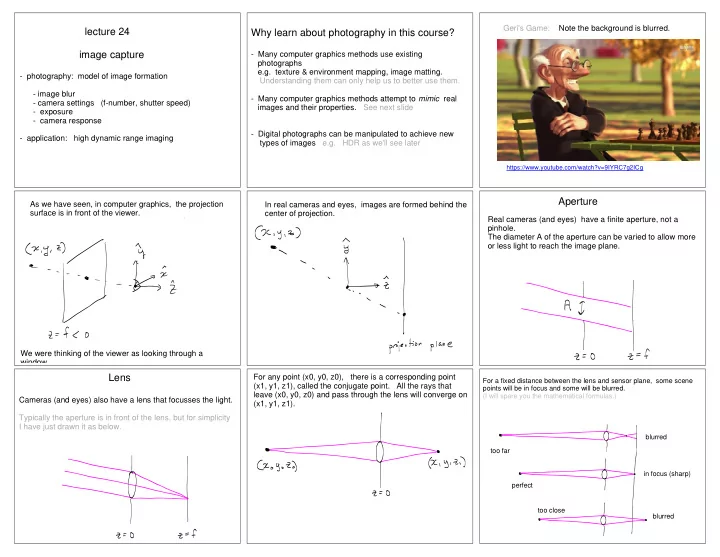

SLIDE 1
lecture 24 image capture
- photography: model of image formation
- image blur
- camera settings (f-number, shutter speed)
- exposure
- camera response
- application: high dynamic range imaging
Why learn about photography in this course?
- Many computer graphics methods use existing
photographs e.g. texture & environment mapping, image matting. Understanding them can only help us to better use them.
- Many computer graphics methods attempt to mimic real
images and their properties. See next slide
- Digital photographs can be manipulated to achieve new
types of images e.g. HDR as we'll see later Geri's Game: Note the background is blurred.
https://www.youtube.com/watch?v=9IYRC7g2ICg
As we have seen, in computer graphics, the projection surface is in front of the viewer. We were thinking of the viewer as looking through a window. In real cameras and eyes, images are formed behind the center of projection.
Aperture
Real cameras (and eyes) have a finite aperture, not a pinhole. The diameter A of the aperture can be varied to allow more
- r less light to reach the image plane.