Learning from Each Other: A Peer Observation Process to Evaluate - - PDF document

learning from each other a peer observation process to
SMART_READER_LITE
LIVE PREVIEW

Learning from Each Other: A Peer Observation Process to Evaluate - - PDF document

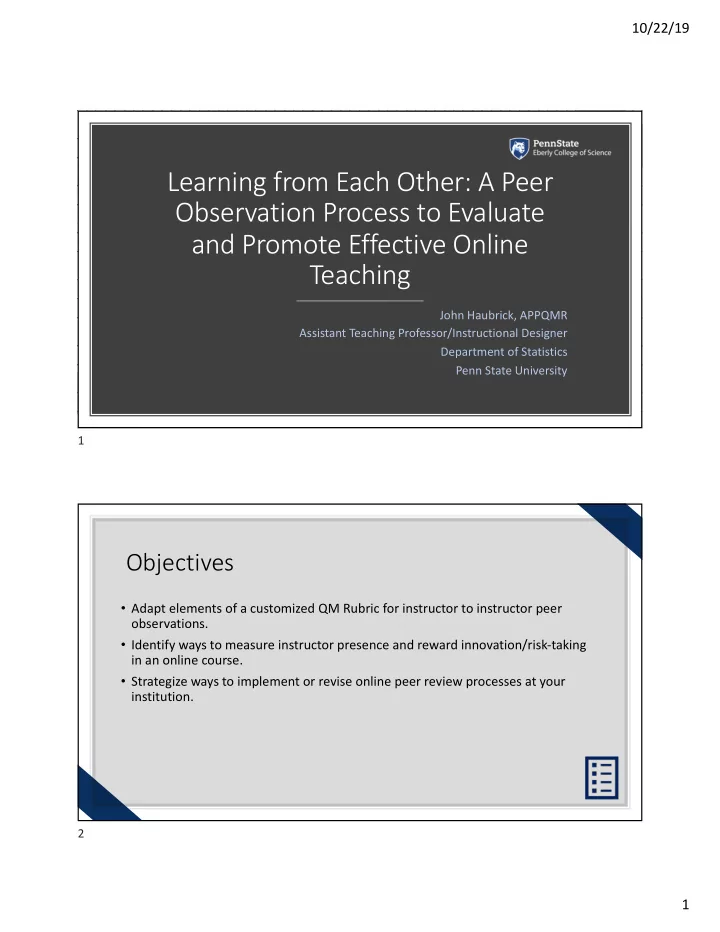
10/22/19 Learning from Each Other: A Peer Observation Process to Evaluate and Promote Effective Online Teaching John Haubrick, APPQMR Assistant Teaching Professor/Instructional Designer Department of Statistics Penn State University 1


slide-1
SLIDE 1

10/22/19 1

Learning from Each Other: A Peer Observation Process to Evaluate and Promote Effective Online Teaching

John Haubrick, APPQMR Assistant Teaching Professor/Instructional Designer Department of Statistics Penn State University 1

Objectives

  • Adapt elements of a customized QM Rubric for instructor to instructor peer
  • bservations.
  • Identify ways to measure instructor presence and reward innovation/risk-taking

in an online course.

  • Strategize ways to implement or revise online peer review processes at your

institution.

2

slide-2
SLIDE 2

10/22/19 2

Background on our program

  • Master’s level and two undergraduate GE courses in Statistics
  • Same offerings in resident
  • ~15 years online
  • Peer Reviews
  • Open online course notes
  • 100% Online courses
  • Mix of tenured, teaching and adjunct faculty
  • Uses master courses
  • A lot of instructor flexibility

3

Defining “Peer Review”

PSU Policy… “In addition to student evaluation of teaching, there shall also be evaluation of a candidate’s teaching by peers from the candidate’s unit and campus.”

4

slide-3
SLIDE 3

10/22/19 3

The process

Instructor Tasks Observer Tasks

Add observer to Canvas course Complete Instructor Input Form Review the Instructor Input Form Complete the Rubric Upload Completed Rubric

5

The process - tools

6

slide-4
SLIDE 4

10/22/19 4

STAT Online Peer Observation Guide

Using the rubric

7

Beyond the rubric

  • How do we

assess/encourage/reward innovation and risk-taking?

  • How do we

assess/encourage/reward instructor presence?

8

slide-5
SLIDE 5

10/22/19 5

Informative Encouraging Rewarding Constructive

Goals of the process

9

Audience discussion questions

10

slide-6
SLIDE 6

10/22/19 6

Beyond the rubric- Instructor Presence

Di Discu cussion: : Instruct ctor Presence ce

One way to think about ‘presence’ online is through the Community of Inquiry framework (Garrison, Anderson, & Archer, 2000). The framework is built upon three dimensions: 1) Teaching Presence, 2) Social Presence, and 3) Cognitive Presence. Discussion: Share with your peer how you establish these three types of presence in your course. Notes: How does your peer establish these three types of presence in their course?

11

Beyond the rubric- Innovation/ Risk-taking

Di Discussion: : Innovation & Risk Taking

Discussion: Share with your peer if you are trying anything new this semester (or year)? If yes, share your innovation or change you’ve made this semester (or year).

  • Has the innovation or change been successful?
  • What challenges have you had to work through?
  • How could others benefit from what you’ve learned?
  • What advice would you share with a colleague who is

interested in trying this or something similar? Notes: What has your peer done this semester (or year) that is innovative or new for them?

12