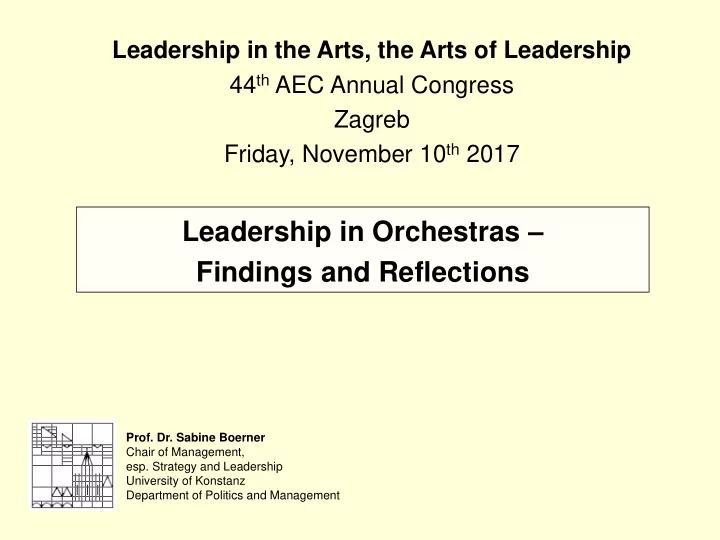
Leadership in Orchestras Findings and Reflections Prof. Dr. Sabine - - PowerPoint PPT Presentation

leadership in orchestras
SMART_READER_LITE
LIVE PREVIEW

Leadership in Orchestras Findings and Reflections Prof. Dr. Sabine - - PowerPoint PPT Presentation

Leadership in the Arts, the Arts of Leadership 44 th AEC Annual Congress Zagreb Friday, November 10 th 2017 Leadership in Orchestras Findings and Reflections Prof. Dr. Sabine Boerner Chair of Management, esp. Strategy and Leadership


slide-1
SLIDE 1

Leadership in the Arts, the Arts of Leadership 44th AEC Annual Congress Zagreb Friday, November 10th 2017

  • Prof. Dr. Sabine Boerner

Chair of Management,

  • esp. Strategy and Leadership

University of Konstanz Department of Politics and Management

Leadership in Orchestras – Findings and Reflections

slide-2
SLIDE 2

1. Findings from symphony orchestras: Directive leadership

  • 2. Findings from a chamber orchestra:

Shared leadership

  • 3. The Orpheus Chamber Orchestra: Democratic

leadership

  • 4. Reflections on leadership in higher music

education: directive, shared or democratic?

Outline

  • 10. November 2017 - 1

Leadership in orchestras

  • Prof. Dr. Sabine Boerner
slide-3
SLIDE 3

“There is no more obvious expression of power than the function of a conductor“

(Elias Canetti, 1998, p. 394)

  • 10. November 2017 - 2

Leadership in orchestras

  • Prof. Dr. Sabine Boerner
  • 1. Findings from symphony orchestras:

Directive leadership

slide-4
SLIDE 4

Source: Schultz, S. Die Macht der Maestros. Spiegel online. 8.6. 2009

Conductors’ voices

  • 10. November 2017 - 3

Leadership in orchestras

  • Prof. Dr. Sabine Boerner

“As a conductor, in this moment you feel the temptation of power. I can almost imagine that it is me creating the symphony, the musicians being my instruments and the score coming from my assistant, Ludwig van Beethoven.”

slide-5
SLIDE 5

Source: Boerner 2002

“... And if they feel that the conductor is rather informal, very friendly and doesn‘t give much about discipline, musicians very quickly become beastlike.“ “... because, when you have 117 musicians in an

  • rchestra, you have, like I

said, 118 opinions or more. And, basically, musicians are nothing else but children, adult children. Some are more mature, others are less mature.“ “They have to dance to my stick, otherwise it‘s not working.“

Conductors’ voices

  • 10. November 2017 - 4

Leadership in orchestras

  • Prof. Dr. Sabine Boerner
slide-6
SLIDE 6

Source: Boerner 2002

“ (...) The fact that, throughout your whole life, you‘ll always be treated like a student. So, it‘s

  • awful. The conductor says: practice, practice!

That‘s what I say to my students. And this is awful, this is nasty. So eventually (…) some are approaching their 60s and still there‘s someone standing there, and maybe he‘s even 20 years younger (…) it cannot be like that, this is awful. Which profession is like that? “ Musicians’ voices

  • 10. November 2017 - 5

Leadership in orchestras

  • Prof. Dr. Sabine Boerner
slide-7
SLIDE 7

Source: Boerner 2002

“I think it‘s wrong, and a cooperative relationship would be better. But I have rarely experienced that, practically never. And I think there are reasons for this, because they are not stupid, these conductors.” “But for example Celibidache is known for the fact that everyone was terrified of him and he must have been, frankly speaking, a real

  • bastard. But nevertheless the

artistic quality in the evening was amazing. So, it‘s a phenomenon I‘m thinking a lot about, but I still wasn‘t really able to find an explanation.“

Explanations from musicians

  • 10. November 2017 -6

Leadership in orchestras

  • Prof. Dr. Sabine Boerner
slide-8
SLIDE 8

Explanations from research:

  • a. What is special about the task?
  • 10. November 2017- 7

Leadership in orchestras

  • Prof. Dr. Sabine Boerner

Large ensemble High levels of task interdependence

slide-9
SLIDE 9
  • 10. November 2017 - 8

Leadership in orchestras

  • Prof. Dr. Sabine Boerner
  • b. What is special about leadership?

Marin Alsop Music director Baltimore Symphony Orchestra and Sao Paolo Symphony Orchestra. “But if you are doing a great job, meaning that you are totally committed and totally convinced and that you have worked terribly hard, the way you are structuring and motivating a piece sweeps up even those who disagree with you. There is no conflict.“

Source: Pollack 1996

slide-10
SLIDE 10

Transformational leadership Transformational leaders… … are charismatic personalities, … are able to illustrate attractive visions of the future, … think outside the box , … enhance intrinsic motivation in employees …„move followers to performance beyond expectations“ (Bass 1985, p.9)

  • b. What is special about leadership?
  • 10. November 2017 - 9

Leadership in orchestras

  • Prof. Dr. Sabine Boerner
slide-11
SLIDE 11

Diversity with respect to ■ instrument (-group) ■ position (Soloists vs. rank-and-file members) ■ age ■ nationality Need for strong team spirit, i.e., ■ … the musicians value one another. ■ … there are not too many conflicts inside the group.

  • 10. November 2017 - 10

Leadership in orchestras

  • Prof. Dr. Sabine Boerner
  • c. What is special about the team?
slide-12
SLIDE 12
  • The more transformational

leadership, the better the artistic quality.

  • But: there has to be a strong

team spirit among the musicians.

  • 10. November 2017 - 11

Leadership in orchestras

  • Prof. Dr. Sabine Boerner

Empirical study

“The conductor’s transformational leadership style only increases the artistic quality of the orchestral performance if there is a strong team spirit at the same time.”

Source: Boerner & v. Streit 2006

slide-13
SLIDE 13
  • 2. Findings from a Chamber Orchestra: Shared leadership
  • 10. November 2017 - 12

Leadership in orchestras

  • Prof. Dr. Sabine Boerner
  • “Camerata Harmony”
  • founded in 2007 as a string chamber music ensemble in

Germany

  • 13 permanent members
  • graduated from different academies of music in Germany and

Eastern Europe

  • performing both with and without guest conductors
slide-14
SLIDE 14

Classic leadership vs. shared leadership

  • 10. November 2017 - 13

Leadership in orchestras

  • Prof. Dr. Sabine Boerner

“A dynamic, interactive influence process among individuals in groups for which the

  • bjective is to lead
  • ne another to the

achievement of group

  • r organizational

goals“

Pearce & Conger, 2003

D F B A E C D F B A E C Classic Leadership Shared Leadership

slide-15
SLIDE 15

Shared leadership “Camerata Harmony”: Incoming leadership nominations

  • 10. November 2017 - 14

Leadership in orchestras

  • Prof. Dr. Sabine Boerner

How much do you rely on this person for leadership when performing?

slide-16
SLIDE 16
  • 3. The Orpheus Chamber Orchestra: Democratic leadership
  • 10. November 2017 - 15

Leadership in orchestras

  • Prof. Dr. Sabine Boerner

■ founded 1972 as a chamber music ensemble in New York, today: 28 permanent members ■ starting point: frustration of orchestral musicians (“Tuttischweine“ (rank-and-file members) ) ■ bad experiences with grassroots democracy: “In critical moments, chairs were flying.“

Source: Firlus 2001; Seifter & Economy 2001

slide-17
SLIDE 17

“The 2013-2014 season marks Orpheus Chamber

Orchestra’s 41st year of making internationally acclaimed music while reinventing the way the world thinks about collaboration, outreach, and democratic leadership.”

Source: www.orpheusnyc.org. 23.September 2013

  • 10. November 2017 - 16

Leadership in orchestras

  • Prof. Dr. Sabine Boerner

Democratic leadership

slide-18
SLIDE 18

The principle of the ”core group“ - shared leadership responsibility ■

  • ne member per section

■ developing an artistic concept, rehearsal and budget plan ■ afterwards presenting and discussing the concept with all musicians The principle of “rotating leadership“ - temporary leadership responsibility ■ new core group gets selected for every piece ■

  • ver time every musician can be at some point part of the core

group

The Orpheus Process

  • 10. November 2017 - 17

Leadership in orchestras

  • Prof. Dr. Sabine Boerner

Source: Firlus 2001; Seifter & Economy 2001

slide-19
SLIDE 19

The eight Orpheus rules

  • 1. empower those who are doing the work
  • 2. encourage people to take responsibility
  • 3. define roles clearly
  • 4. establish shared and temporary leadership responsibilities
  • 5. foster cooperation at different levels
  • 6. learn to listen and to talk
  • 7. seek consensus (and establish a creative environment which fosters

consensus)

  • 8. passionate dedication to the work
  • 10. November 2017 - 18

Leadership in orchestras

  • Prof. Dr. Sabine Boerner

The Orpheus Process

Source: Seifter & Economy (2001)

slide-20
SLIDE 20

“The Orpheus Process, an original method that places democracy at the center of artistic execution, has been the focus of studies at Harvard and Stanford, and of leadership seminars at Morgan Stanley and Memorial Sloan-Kettering Hospitals, among others.” “The Orpheus Institute offers musicians, university students, and business leaders experiental training in collective leadership through the Orpheus Process. “

The Orpheus Process – A model for democratic leadership?

Source: www.orpheusnyc.org. 23.September 2013

  • 10. November 2017 - 19

Leadership in orchestras

  • Prof. Dr. Sabine Boerner
slide-21
SLIDE 21
  • 4. Reflections: “From Orchestra to Higher Music

Education”

  • 10. November 2017- 20

Leadership in orchestras

  • Prof. Dr. Sabine Boerner

Ensemble Focus on Leadership Findings Features Symphony

  • rchestra

Formal Directive transformational + team spirit Large ensemble „Camerata Harmony“ Formal & informal Shared leadership Very small ensemble (13) Orpheus Chamber Orchestra Formal Democratic (shared & rotating) Small ensemble (27) Academy of Music Formal & informal

???

Large

  • rganization
slide-22
SLIDE 22
  • 10. November 2017 - 21

Leadership in orchestras

  • Prof. Dr. Sabine Boerner

zero-sum game ? positive-sum game!

  • ften ill-defined tasks and

roles clearly defined tasks and roles (score)

  • verlapping subtasks

independent subtasks (compositions) moderate need for coordination extremely high need for coordination moderate task interdependence extremely high task interdependence

differences:

  • bjective: “positive synergy”

highly professional members

Academy of Music Orchestra

Commonalities and Differences

slide-23
SLIDE 23
  • Clear sense of direction/strategic vision
  • Being considerate
  • Treating academic staff fairly and with integrity
  • Allowing the opportunity to participate in key decisions/ encouraging
  • pen communication
  • Communicating well about the direction the department is going

Source: Bryman 2007

Findings on leadership effectiveness in higher education (department level)

  • 10. November 2017 - 22

Leadership in orchestras

  • Prof. Dr. Sabine Boerner
slide-24
SLIDE 24
  • Acting as a role model/having credibility
  • Creating a positive/collegial work atmosphere in the department
  • Advancing the department’s cause with respect to constituencies

internal and external to the university and being proactive in doing so

  • Providing feedback on performance
  • Making academic appointments that enhance department’s

reputation

Findings on leadership effectiveness in higher education (department level)

  • 10. November 2017 - 23

Leadership in orchestras

  • Prof. Dr. Sabine Boerner
slide-25
SLIDE 25
  • 10. November 2017 - 24

Leadership in orchestras

  • Prof. Dr. Sabine Boerner

Conclusion

■ In orchestras, different forms and styles of leadership can be found, depending on their size and type. ■ Comparing orchestras with academies of music, there are similarities (e.g., high degrees of professionality) and differences (e.g., (different levels of task interdepence) ■ Considerations on leadership in music academies should include both formal and informal leadership roles and different leadership styles.

slide-26
SLIDE 26

The End

  • 10. November 2017 - 26

Leadership in orchestras

  • Prof. Dr. Sabine Boerner
slide-27
SLIDE 27

Bass, B. (1985). Leadership and Performance Beyond Expectations. New York: Free Press. Boerner, S. (2002). Führungsverhalten und Führungserfolg – Beitrag zu einer Theorie der Führung am Beispiel des Musiktheaters. Wiesbaden: Gabler. Boerner, S. (2002). Kein Dirigent, aber viele Führende. Das Orpheus Chamber Orchestra – ein Modell für Unternehmen? Organisationsentwicklung, 3, p. 52-57. Boerner, S. & v. Streit, C. (2006). Gruppenstimmung (group mood) als Erfolgsbedingung transformationaler Führung – Ergebnisse einer empirischen Untersuchung. Zeitschrift für Arbeits- und Organisationspsychologie, 1, 3–8. Boerner, S. & v. Streit, C. (2007). Promoting orchestral performance: The interplay between the musicians´ mood and a conductor´s leadership style. Psychology of Music, 35(1), 135–146. Bryman, A. (2007). Effective leadership in higher education. A literature review. Studies in Higher Education, 32(6), 693-710. Canetti, E. (1998). Masse und Macht. Frankfurt: Fischer. Firlus, T. (2001). Führung: Demokratie in Dur. Das Orpheus Chamber Orchestra trifft alle Entscheidungen

  • hne Dirigent. Manager wundern sich, wie das geht. Wirtschaftswoche, 3.8.2001.

Pearce, C. L., & Conger, J. A. (2003). All those years ago. In C. L. Pearce & J. A. Conger (Eds.), Shared

  • leadership. Reframing the hows and whys of leadership . Thousand Oaks, Calif: Sage Publications.

Pollack, B. (1996). Interview with a Music Director: Marin Alsop. Harmony, 2, 44-49.

References

  • 10. November 2017 - 25

Leadership in orchestras

  • Prof. Dr. Sabine Boerner
slide-28
SLIDE 28

Pollack, B. (1996). Interview with a Music Director: Marin Alsop. Harmony, 2, 44-49. Seifter, H. & Economy, P. (2001). Das virtuose Unternehmen. Frankfurt: Campus. Vredenburgh, D. & He, I.Y. (2003). Leadership lessons from a conductorless orchestra. Business Horizons, September/October, 19-24.

References

  • 10. November 2017 - 26

Leadership in orchestras

  • Prof. Dr. Sabine Boerner
slide-29
SLIDE 29
  • 30. September 2013 - 24

Leadership in orchestras

  • Prof. Dr. Sabine Boerner

Backup

slide-30
SLIDE 30

Written survey (orchestra based questionnaire) to measure… ■ transformational leadership of the conductor ■ team spirit in the orchestra ■ artistic quality of the orchestral performance Sample ■ 208 musicians from 22 German symphonic orchestras (A/B) ■ average age: 40 years ■ average work experience: 15 years

Empirical study: method

  • 30. September 2013 - 14

Leadership in orchestras

  • Prof. Dr. Sabine Boerner
slide-31
SLIDE 31

Empirical study-

  • perationalization of transformational leadership

Charisma ■ “The conductor has charisma“ ■ “We are proud to work with him“ Inspiring motivation ■ “The conductor illustrates his visions with the help of symbols and gestures.“ ■ “He makes clear, what he is expecting from us.“ Intellectual stimulation ■ “He makes completely new, convincing proposals on the interpretation.“ ■ “He enables us to look at known pieces in a different light.”

  • 30. September 2013 - 25

Leadership in orchestras

  • Prof. Dr. Sabine Boerner
slide-32
SLIDE 32

8 Items to identify the mutual assessment of orchestral participants and the level of conflict ■ “likeable“ ■ “incompetent“ ■ “get along well“ ■ “friendly“ ■ “lazy“ ■ “existing tensions in professional procedures“ ■ “individual groups within the orchestra stick together“ ■ “not able to assess“

Empirical study-

  • perationalization of cooperative group climate
  • 30. September 2013 - 26

Leadership in orchestras

  • Prof. Dr. Sabine Boerner
slide-33
SLIDE 33

3 Items to measure orchestral quality ■ “The audience assesses the quality as …“ ■ “Soloist who are playing with us, assess us as …” ■ “In comparison with other orchestras of the same quality we’ve been assessed as …”

Empirical study-

  • perationalization of orchestral quality
  • 30. September 2013 - 27

Leadership in orchestras

  • Prof. Dr. Sabine Boerner
slide-34
SLIDE 34

■ complicated decision- making processes ■ increased time requirements ■ limited repertoire ■decentralized self- determination by the musicians instead of heteronomy by the conductor ■increased motivation and satisfaction of musicians ■increased commitment of the whole orchestra

Conclusion: effects in the orchestra

  • 30. September 2013 - 20

Leadership in orchestras

  • Prof. Dr. Sabine Boerner

 

slide-35
SLIDE 35

“This is the last monarchy in this world, aside from convents (…) theatre is an authoritarian business, and there have been attempts to democratize, (…) you surely know that, those orchestras without conductor, it didn‘t work out. … If everyone takes part and wants to have a say, in most cases it turns out to be terrible (…). (…) in my opinion those common concepts of democracy just don‘t work.“ (choirmaster)

Conclusion

Source: Boerner 2002

  • 30. September 2013 - 16

Leadership in orchestras

  • Prof. Dr. Sabine Boerner
slide-36
SLIDE 36

Musiknetzwerk Outgoing

slide-37
SLIDE 37

Orga Incoming

slide-38
SLIDE 38

Orga Outgoing

slide-39
SLIDE 39

Liking Incoming

slide-40
SLIDE 40

Liking Outgoing