LCCMR ID: 197-F Project Title: Northern Minnesota Site-Based - - PDF document

lccmr id 197 f
SMART_READER_LITE
LIVE PREVIEW

LCCMR ID: 197-F Project Title: Northern Minnesota Site-Based - - PDF document

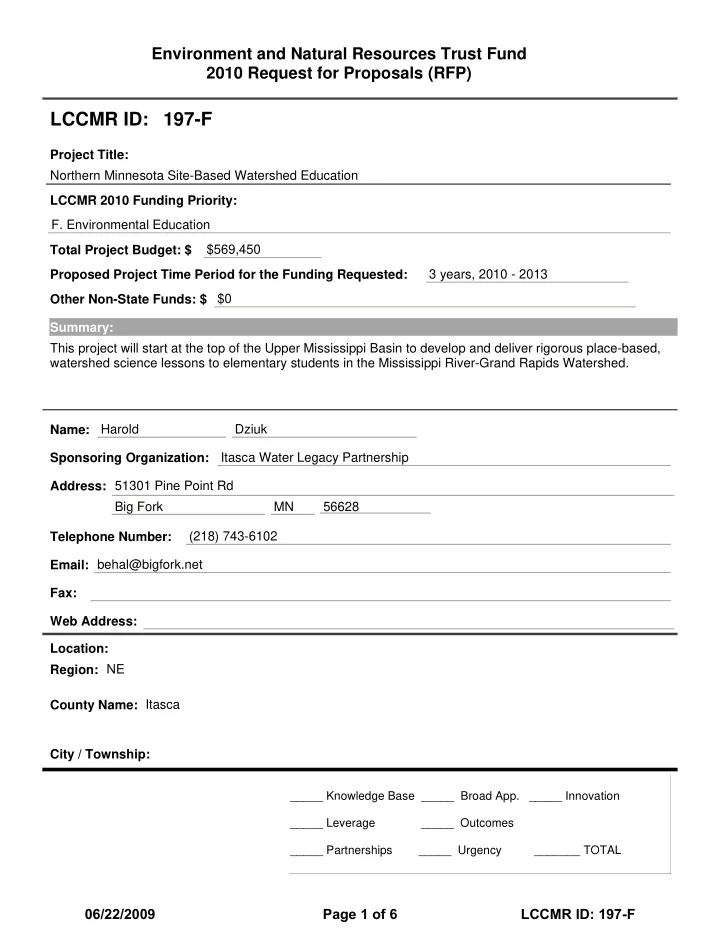
Environment and Natural Resources Trust Fund 2010 Request for Proposals (RFP) LCCMR ID: 197-F Project Title: Northern Minnesota Site-Based Watershed Education LCCMR 2010 Funding Priority: F. Environmental Education Total Project Budget: $


slide-1
SLIDE 1

Environment and Natural Resources Trust Fund 2010 Request for Proposals (RFP)

Northern Minnesota Site-Based Watershed Education $569,450 3 years, 2010 - 2013 $0 Harold Dziuk Itasca Water Legacy Partnership 51301 Pine Point Rd Big Fork MN 56628 (218) 743-6102 behal@bigfork.net Itasca This project will start at the top of the Upper Mississippi Basin to develop and deliver rigorous place-based, watershed science lessons to elementary students in the Mississippi River-Grand Rapids Watershed. Project Title: Total Project Budget: $ Proposed Project Time Period for the Funding Requested: Other Non-State Funds: $ Name: Sponsoring Organization: Address: Telephone Number: Email: Fax: Web Address: County Name: City / Township: Region: Summary: NE

LCCMR ID: 197-F

LCCMR 2010 Funding Priority:

  • F. Environmental Education

Location:

_____ Knowledge Base _____ Broad App. _____ Innovation _____ Leverage _____ Outcomes _____ Partnerships _____ Urgency _______ TOTAL

06/22/2009 Page 1 of 6 LCCMR ID: 197-F

slide-2
SLIDE 2

MAIN PROPOSAL

PROJECT TITLE: NORTHERN MINNESOTA SITE-BASED WATERSHED EDUCATION

  • I. PROJECT STATEMENT

Minnesota school children are less connected with the natural world than ever. As our state faces a future where nearly 40 percent of its water could be listed as impaired, it is these young Minnesota citizens who need to be prepared to deal with the consequences. If taught young, they can also be an active part of the solution. This project proposes to start at the top of the Upper Mississippi Basin to develop and deliver rigorous place-based, watershed science lessons to elementary students in the Mississippi River-Grand Rapids watershed. Itasca County has witnessed an increase in citizen interest in water quality issues as a result of the Itasca Water Legacy Partnership’s (IWLP) surface water assessment program, which is in the process of monitoring nearly 200 lakes in the Mississippi River-Grand Rapids and adjacent

  • watersheds. This project would build on this local enthusiasm and engage the basin’s young

people in these water quality protection efforts by providing funding: 1) To train and coach teachers on how to incorporate Minnesota standards-based watershed science lessons into their classrooms; 2) To provide science supplies for students, which will help them explore their place in the watershed and how their actions impact the waters within it; 3) To provide rigorous, science-based outdoor field experiences to synthesize and apply what they have learned. The chief goal is to create informed, engaged citizens with an appreciation for how individual and community actions impact water and related natural resources. The project achieves this goal by providing much-needed financial assistance for outstate districts to implement an innovative, site-based watershed science curriculum. Lessons will borrow from the best of existing natural resources curricula like Minnesota’s Project WET (Water Education for Teachers) and MinnAqua (fishing education). Many areas identified in the 2010 Trust Fund RFP—including non-native and invasive species; surface and ground-water management and stewardship; pollution and contaminant sources; and aquatic habitat protection—will be addressed as well. A key component will be student-initiated service learning projects (e.g., shoreland restoration or

  • ther community projects) to encourage the active engagement of youth in real-world solutions

to local water issues. As the Project WET state coordinator said, “If kids don't know about water quality, they won't care. If they don't care, then they won't take action.” By clearly incorporating Minnesota science standards into this curriculum, elementary students and teachers will apply the core concepts of observation and scientific inquiry as they begin to grasp their own formative role in the health and resilience of the Mississippi River watershed.

  • II. DESCRIPTION OF PROJECT RESULTS

Result 1: Curriculum Development Budget: $ 161,000 Develop a site-specific curriculum for watershed science in northern Minnesota’s Mississippi- Grand Rapids watershed that can be adapted to other northern Minnesota watersheds. Deliverables Completion Date

  • 1. Watershed science curriculum guide (Grade 4)

June 2011

  • 2. Adaptations designed for 5th and 3rd

June 2012, June 2013 grades

  • 3. Coordination of curriculum implementation

June 2013 Result 2: Science Supplies for Students Budget: $ 90,000 Thirty classrooms each year are provided with $1,000 of watershed science equipment and

  • supplies. Coordinated purchase of supplies reduces costs for all districts involved.

Deliverables Completion Date

  • 1. 30 classroom sets of science supplies each year

June 2011, 2012, 2013

06/22/2009 Page 2 of 6 LCCMR ID: 197-F

slide-3
SLIDE 3

Result 3: Teacher Workshops Budget: $ 17,700 Thirty teachers are trained in Project WET and MinnAqua each year. Budget includes full costs

  • f workshops, including materials, and $25 teacher stipends for each training session attended.

Deliverables Completion Date

  • 1. 30 teachers trained in MinnAqua & Project WET each year

June 2011, 2012, 2013 Result 4: Teacher Coaching & Coaches Budget: $ 268,500 Watershed teaching specialists come into classrooms to show teachers how to conduct lessons. Deliverables Completion Date

  • 1. $1,000 stipends for lead teachers in each school

June 2013

  • 2. 5-15 demonstration lessons each year/classroom

June 2013

  • 3. Ongoing consultation/coaching from curriculum specialists

June 2013 Result 5: Student Field Experiences Budget: $ 32,250 Students participate in outdoor-classroom observations and experiments and a science- intensive field day to synthesize the year-long focus on their watershed. Budget includes busing, local experts’ stipends, water sampling boat rental, and field-science supplies. Deliverables Completion Date

  • 1. Field experiences at a local lake/river in the watershed

June 2011, 2012, 2013

  • III. PROJECT STRATEGY
  • A. Project Team/Partners

IWLP supports the development and implementation of educational programs, projects and policies that ensure the quality, protection, and improvement of all Itasca County waters. For this project, IWLP will partner with elementary teachers in the independent school districts within the Mississippi-Grand Rapids watershed and with the Itasca Area Schools Collaborative (IASC) to develop and deliver a site-based, watershed science curriculum for grades 3-5. IWLP will administer funds through its fiscal agent, the Grand Rapids Community Foundation. The districts will designate teachers to work with three watershed teaching specialists (licensed teachers) to incorporate watershed lessons into their school science curriculum.

  • B. Timeline Requirements

This will be a three-stage project beginning in July 2010 and ending in June 2013. The first year will focus on developing and testing the 4th grade curriculum, training 4th grade teachers to carry

  • ut the lessons in the classroom, and supplying those classrooms with watershed science

equipment and supplies. The second and third years will adapt and deepen the curriculum to include 5th and 3rd grade students and will train and supply those teachers and classrooms. Developing the program by this strategy will balance grade-level curriculum development with widespread student exposure.

  • C. Long-Term Strategy

Materials developed through this project will be shared openly through the Minnesota SEEK (Sharing Environmental Education Knowledge) website for other watersheds in Minnesota and

  • ther glacial lakes states where the lessons can be adapted for other local contexts. As funding

for elementary schools diminishes, continued investment from outside sources is absolutely essential to adequately fund student access to science education on natural resources. Northern Minnesota Site-Based Watershed Education will help students achieve greater success in the science component of the Minnesota Comprehensive Assessments and prepare them to be more informed stewards of our natural resources.

06/22/2009 Page 3 of 6 LCCMR ID: 197-F

slide-4
SLIDE 4

BUDGET ITEM 1-Curriculum Coordinator/Lead Teacher Trainer (Year 1, 1.0 FTE; Years 2-3, 0.75 FTE) 2-Teacher Trainers (0.5 FTE per teacher, Years 1-3) 14-Annual Lead Teacher Stipends (one teacher per elementary school per year at $1,000 each) Contracts with curriculum trainers to deliver workshops and materials for MinnAqua and Project WET teacher workshops (one of each kind of workshop per year/$2,200 wksp) Computer, printer and office supplies for coordinator Classroom demonstration materials for teacher trainers Classroom science supplies for students at $1,000/classroom/year Field supplies for students Travel for teacher trainers to schools for demonstration lessons ($2000/trainer/yr) Busing for field days Boat rentals/fuel for water monitoring & experiments on field days 75 (25 each year)-$150/day stipends for local field day experts for student science exploration 180 (60 each year)-$25 stipends for teachers to attend local Project WET and MinnAqua training sessions TOTAL PROJECT BUDGET REQUEST TO LCCMR SOURCE OF FUNDS AMOUNT In-kind Services During Project Period: Time, travel and expertise provided by watershed experts, curriculum specialists, and teachers (2,820 hrs @ $40/hr) 112,800 $ 4,500 $ Additional Budget Items: 36,000 $ 12,000 $ 6,000 $ 11,000 $ 10,500 $ 42,000 $ Contracts: 90,000 $ 3,000 $ Travel: Equipment/Tools/Supplies:

  • V. OTHER FUNDS

Project Budget

  • IV. TOTAL PROJECT REQUEST BUDGET (3 years)

AMOUNT 180,000 $ 569,450 $ Personnel: 150,000 $ 13,200 $ 11,250 $

06/22/2009 Page 4 of 6 LCCMR ID: 197-F

slide-5
SLIDE 5

NORTHERN MINNESOTA SITE-BASED WATERSHED EDUCATION

Big Fork River Miss R-Headwaters Miss R-Grand Rapids Koochiching St. Louis Beltrami Itasca Cass Hubbard Aitkin Crow Wing Carlton 1 2 4 118 316 317 318 319 698

150 300 75 Miles

50 100 25 Miles

Locator Map

Major Watersheds Aitkin - SD 1 Deer River - SD 317 Floodwood - SD 698 Grand Rapids - SD 318 Greenway - SD 316 Hill City - SD 2 McGregor - SD 4 Nashwauk-Keewatin - SD 319 Northland Community - SD 118 MN Counties

06/22/2009 Page 5 of 6 LCCMR ID: 197-F

slide-6
SLIDE 6

NORTHERN MI NNESOTA SI TE-BASED WATERSHED EDUCATI ON

Project Manager Qualifications & Organization Description

Harold E. Dziuk (218) 743-6102 Project Manager 51301 Pine Point Road beha1@bigfork.net Bigfork, MN 56628-4229 Harold Dziuk is a founding member of the Itasca Water Legacy Partnership (IWLP), a current member of its governing board, and Science/Assessment Committee member. As a long-time water quality advocate, Dziuk has served in several leadership positions in the following water/shoreland organizations during his retirement: Big Sandy Lake Association, Big Sandy Area Lakes Watershed Management Project (Chair, Steering Committee), Minnesota Lakes Association (Board of Directors), Aitkin County Lakes Association, Itasca Coalition of Lake Associations (Board of Directors), Turtle Lake Area Citizens Watershed Association, and the Turtle Lake Association (President/Past President). In his role as project manager for the proposed “Northern Minnesota Site-Based Watershed Education” program, Dziuk will oversee IWLP’s fiduciary role in managing grant monies and ensuring quality deliverables for the program. In this role, Dziuk will: 1) provide financial oversight, via the Grand Rapids Community Foundation (GRCF), for distribution of grant monies; 2) provide biannual accounting reports to the GRCF; 3) oversee submission of bi-annual reports to LCCMR; and 4) oversee the hiring and annual review of a curriculum coordinator in partnership with the Itasca Area School Collaborative (IASC). Dziuk’s professional resume includes the following highlights: Education: Bachelor of Science ‘51, Doctor of Veterinary Medicine ‘54, Master of Science ‘55, Doctor of Philosophy ‘60 Fields of research interest: Veterinary medicine, animal physiology; physiopathology of inhaled air pollutants; digestive diseases of domestic animals and birds; physiological responses of newborn calves to cold environments. Military experience: US Army Veterinary Corps (1955 – 56), Biological Warfare Laboratories, Fort Detrick, MD Employment: Associate Scientist, General Electric Co., Hanford Atomic Products Operation, Richland, WA; Associate Professor, College of Veterinary Medicine, Iowa State University, Ames, IA; Professor, College of Veterinary Medicine, University of Minnesota, St. Paul, MN; Professor Emeritus, College of Veterinary Medicine, University of Minnesota; Lecturer, College of Veterinary Medicine, Tuskegee University, Tuskegee, AL; Science Advisor, Minnesota Public Utilities Commission, St. Paul, MN The mission of the Itasca Water Legacy Partnership (IWLP) is to support the development and implementation

  • f educational programs, projects and policies that ensure the quality, protection and improvement of all Itasca County
  • waters. The mission is guided by the following values and principles: 1) to work collaboratively and 2) to promote a

strong and sustainable economy. The group realized several important accomplishments in 2008, including Organizational Description: I tasca Water Legacy Partnership

  • Awards of more than a half-million dollars in grants to complete a baseline water quality assessment and to promote

better shoreland practices in Itasca County

  • Implementation of a two-year water quality testing program in partnership with Itasca Community College (ICC) and

the Itasca County Soil and Water Conservation District

  • Establishment of a revolving loan fund with the Itasca County Office of Environmental Services for upgrades to

failing individual septic treatment systems

  • Adoption of a mission statement, governing structure, bylaws and strategic plan focused on three areas: 1) building

local capacity for water assessment, 2) encouraging personal practices that sustain high-quality waters (“Team Up for Clean Waters” initiative), and 3) assessing the full economic value of clean water Recognizing the importance of engaging the next generation in the protection of clean waters throughout northern Minnesota, the 2009 Public Awareness Subcommittee Work Plan includes engagement in several K-12 watershed education initiatives, including developing connections with local school districts and youth organizations and supporting K-12 and post-secondary science curricula that emphasizes watershed education, hydrology, natural resource management and outdoor education.

06/22/2009 Page 6 of 6 LCCMR ID: 197-F