LCCMR ID: 153-E2 Project Title: Climate Change Adaptation Plans for - - PDF document

lccmr id 153 e2
SMART_READER_LITE
LIVE PREVIEW

LCCMR ID: 153-E2 Project Title: Climate Change Adaptation Plans for - - PDF document

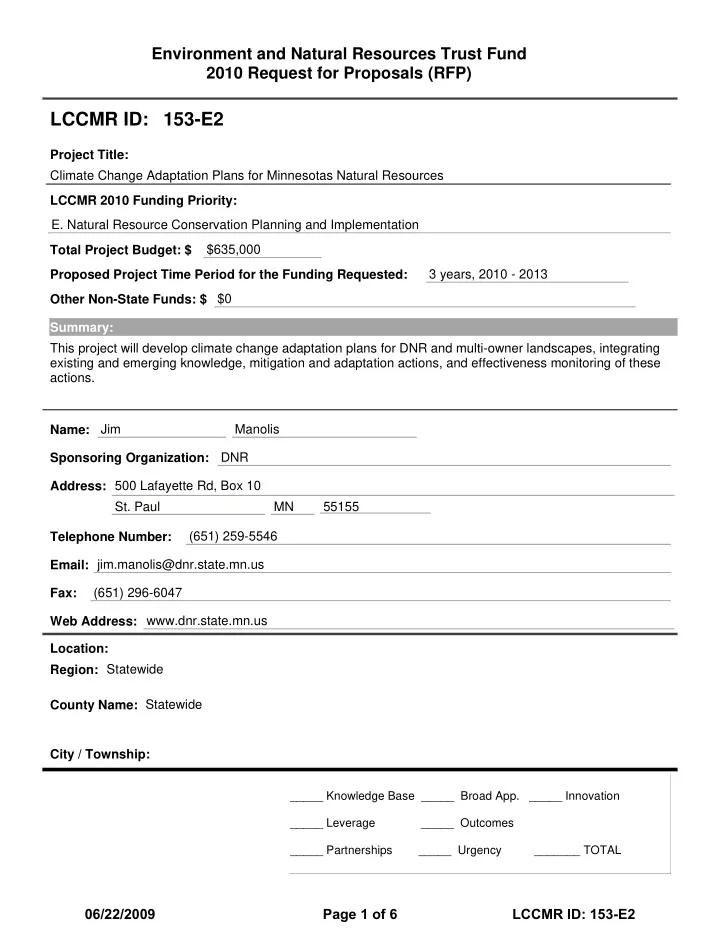
Environment and Natural Resources Trust Fund 2010 Request for Proposals (RFP) LCCMR ID: 153-E2 Project Title: Climate Change Adaptation Plans for Minnesotas Natural Resources LCCMR 2010 Funding Priority: E. Natural Resource Conservation


slide-1
SLIDE 1

Environment and Natural Resources Trust Fund 2010 Request for Proposals (RFP)

Climate Change Adaptation Plans for Minnesotas Natural Resources $635,000 3 years, 2010 - 2013 $0 Jim Manolis DNR 500 Lafayette Rd, Box 10

  • St. Paul

MN 55155 (651) 259-5546 (651) 296-6047 jim.manolis@dnr.state.mn.us www.dnr.state.mn.us Statewide This project will develop climate change adaptation plans for DNR and multi-owner landscapes, integrating existing and emerging knowledge, mitigation and adaptation actions, and effectiveness monitoring of these actions. Project Title: Total Project Budget: $ Proposed Project Time Period for the Funding Requested: Other Non-State Funds: $ Name: Sponsoring Organization: Address: Telephone Number: Email: Fax: Web Address: County Name: City / Township: Region: Summary: Statewide

LCCMR ID: 153-E2

LCCMR 2010 Funding Priority:

  • E. Natural Resource Conservation Planning and Implementation

Location:

_____ Knowledge Base _____ Broad App. _____ Innovation _____ Leverage _____ Outcomes _____ Partnerships _____ Urgency _______ TOTAL

06/22/2009 Page 1 of 6 LCCMR ID: 153-E2

slide-2
SLIDE 2

MAIN PROPOSAL

PROJECT TITLE: Climate Change Adaptation Plans for Minnesota's Natural Resources

  • I. PROJECT STATEMENT

Climate change is projected to impact the health and productivity of Minnesota’s lands and waters and the animals and plants that depend on them, and exacerbate detrimental effects of habitat loss and invasive

  • species. Climate change also threatens to diminish the services natural lands provide us—from clean

water and forest products to outdoor recreation. The 2008 “Minnesota Statewide Conservation and Preservation Plan” calls for reducing the impact of climate change on natural resources, and efforts to reduce greenhouse gas emissions and adapt to changing conditions are proliferating. However, natural resource managers and decision makers lack a comprehensive framework for integrating climate change assessment results into planning and management guidelines for Minnesota lands and waters at statewide, regional, and local scales. The Department of Natural Resources seeks to implement and test an adaptive climate change response

  • framework. This framework will integrate existing and emerging research and assessment results,

mitigation and adaptation actions, and effectiveness monitoring of these actions (Fig. 1). Key aspects of this work include interdisciplinary and multi-agency collaboration and communication. The project will serve as a catalyst for regional collaboration among federal, state, and private entities in effective management planning in the face of climate change. Two positions will coordinate efforts to 1) conduct a rapid assessment of status needs for climate change adaptation and mitigation efforts, 2) develop an integrative climate change response framework and adaptation plan for DNR, and 3) implement the planning framework in several pilot landscapes and test a process for modifying management plans to effectively incorporate climate adaptation and mitigation components.

  • II. DESCRIPTION OF PROJECT RESULTS

Result 1: Rapid Assessment of Status and Needs Budget: $ 70,000 DNR will convene internal and multi-organizational teams to assess and summarize the status of agency adaptive capacity, evaluate social aspects of climate change impacts, identify barriers to adaptation and mitigation activities, and prioritize goals for adaptation and mitigation planning. This effort will draw heavily on existing ad-hoc or formal initiatives engaged in these topics (e.g., interagency and U of MN climate adaptation forums and projects). Deliverable Completion Date

  • 1. Inter-organizational planning workshop, status and needs assessment
  • Sept. 2010
  • 2. Evaluation of social impacts of climate change on natural resources/recreation
  • Jun. 2011
  • 2. Interactive website for maintaining project communications and results
  • Dec. 2010
  • 3. Status and needs assessment final report
  • Dec. 2010

Result 2: Climate Change Response Framework and DNR Adaptation Plan Budget: $ 280,000 The project will develop an integrative climate change response framework including assessment, mitigation, adaptation, and monitoring. Project components will summarize the best available science on potential climate change impacts on Minnesota natural resources, conduct opportunity analyses on the highest-leverage adaptation and natural resource-based mitigation activities, draw on vulnerability and connectivity analyses developed by other projects, and identify priorities for additional vulnerability

06/22/2009 Page 2 of 6 LCCMR ID: 153-E2

slide-3
SLIDE 3

assessments and monitoring. A DNR climate change response plan will recommend operational orders, policies, and guidelines for developing more specific Division and unit plans. Deliverable Completion Date

  • 1. Draft Adaptation-Mitigation Framework
  • Sept. 2010
  • 2. Brief summary of best available science on potential climate change impacts in

Minnesota

  • Mar. 2011
  • 3. Opportunity Analysis—Adaptation: identify key opportunities for improving

adaptation capacity in Minnesota

  • Sept. 2011
  • 4. Opportunity Analysis—Mitigation: estimate potential for increases in carbon

sequestration through quantitative modeling

  • Sept. 2011
  • 5. Recommendations for vulnerability assessments and monitoring activities
  • Oct. 2011
  • 6. DNR climate adaptation plan including recommendations for new DNR policies,
  • perational orders, and strategies to address adaptation and mitigation needs
  • Dec. 2011

Result 3: Piloting Adaptive Landscape Plans Budget: $ 285,000 To be effective, the planning framework described above must be readily applicable to strategic and

  • perational management planning at relevant geographic scales. This result will implement the

framework in several pilot landscapes and test a process for modifying management plans to incorporate climate adaptation and mitigation components. Workshops involving scientists and managers will prototype a plan revision process for forest, wetland, grassland, and aquatic/watershed system plans. Two

  • f these plans will be selected for a more detailed examination resulting in comprehensive

recommendations for incorporating climate adaptation and mitigation components. Deliverable Completion Date

  • 1. Workshops prototyping plan revision process
  • Jan. 2012-Oct.

2013

  • 2. Detailed recommendations for revising two landscape plans
  • Jun. 2013
  • 3. Report on lessons learned, recommendations for broader-scale implementation
  • f climate change planning at strategic and operational levels
  • Jun. 2013
  • III. PROJECT STRATEGY
  • A. Project Team/Partners

This project will be managed by Jim Manolis, Ph.D., Andy Holdsworth, Ph.D., and Keith Wendt of the Policy, Research, and Planning unit in DNR’s Office of Management and Budget Services. The project will partner with numerous other organizations including DNR Divisions, the US Forest Service (Mary Shedd), the Minnesota Forest Resources Council (Clarence Turner), The Nature Conservancy (Meredith Cornett, Mark White), and the University of Minnesota (Peter Reich, Lucinda Johnson, others).

  • B. Timeline Requirements

The timeline for this project will be 36 months.

  • C. Long-Term Strategy

Building capacity for effective climate change adaptation and mitigation will be a long-term effort. This project will lay a foundation for such long-term change, and will help integrate knowledge gained from several other funded and proposed projects. DNR and partner organizations will need to utilize a variety

  • f funding sources to build such long-term capacity over time.

06/22/2009 Page 3 of 6 LCCMR ID: 153-E2

slide-4
SLIDE 4

BUDGET ITEM Personnel: Project Coordinator and Project Scientist (2 FTE), including salary and fringe Contracts: Carbon Sequestration Opprotunity Analysis (quantitative modeling exercise) Summary of potential climate impacts on natural resources Visiting scientists for workshops Social Impact analysis Project website development/maintainence Equipment/Tools/Supplies: Computer, office, phone expenses Printing/copying Travel: In state Out state TOTAL PROJECT BUDGET REQUEST TO LCCMR SOURCE OF FUNDS AMOUNT Status In-kind Services During Project Period: Project management services including supervision of project coordinator, oversight of project contracts, and voluntary services provided by project task force members. 150,000 $ Funding History: No Previous funding History

  • $

50,000 $

  • V. OTHER FUNDS

Project Budget

  • IV. TOTAL PROJECT REQUEST BUDGET (3 years)

AMOUNT 635,000 $ 480,000 $ 5,000 $ 5,000 $ 5,000 $ 30,000 $ 5,000 $ 20,000 $ 20,000 $ 15,000 $

  • $

06/22/2009 Page 4 of 6 LCCMR ID: 153-E2

slide-5
SLIDE 5
  • Fig. 1. An Adaptive Framework for Managing Land and Water in the Face of Climate Change

Assessment

Synthesizing knowledge on:

  • Climate change causes, impacts, and

trends;

  • potential future changes; and
  • mitigation and adaptation options.

Monitoring

Data collection and reporting on trends and impacts of climate change and effectiveness of management.

Mitigation

Land and water management actions that reduce causes of climate change (e.g., sequestration).

Adaptation

Actions that help natural and human systems adjust to unavoidable climate change (e.g., maintaining or restoring habitat corridors).

06/22/2009 Page 5 of 6 LCCMR ID: 153-E2

slide-6
SLIDE 6

Project Manager Qualifications and Organization Description Project Manager: Jim Manolis is a Science Policy Consultant with the Minnesota Department

  • f Natural Resources Policy, Planning and Research Section, Office of Management and

Budget Services. Over the past 14 years he has focused on integrated resource management and linking science with natural resource policy and management. He currently leads projects that focus on integrating biodiversity and forest management, implementing forest certification standards, and advising DNR leaders on carbon science and policy. Jim was a David H. Smith Conservation Research Fellow from 2003-2005 http://www.conbio.org/SmithFellows, where he focused on landscape modeling in the 100,000-acre Manitou landscape in northeastern

  • Minnesota. His research assisted an ongoing partnership of major landowners working to

integrate biodiversity and forest management in the landscape. He continues to participate in this work as chair of the collaborative http://manitoucollab.googlepages.com/home. Previous positions involved implementing DNR’s old-growth forest policy, managing a multi-stakeholder assessment of forest spatial patterns for the Minnesota Forest Resources Council, and strategic natural resource planning. Jim has Ph.D. and M.S. degrees in Conservation Biology from the University of Minnesota (1999, 1996). Lead Team Member: Andrew Holdsworth is Science Policy Coordinator in the Policy, Research, and Planning Section within DNR’s Office of Management and Budget Services. Andrew Holdsworth works to advance conservation planning, performance measurement, and integrated resource management at DNR. He received a PhD in Conservation Biology from the University of Minnesota where he was advised by Peter Reich and Lee Frelich. His research expertise is in forest ecology, invasive species, fire ecology, sustainable forest management, and natural resource assessment. Prior to his graduate and agency work in Minnesota, he conducted cross-border biodiversity, water resource, and climate change vulnerability assessments in the southwestern U.S. and forest fire management research in the Brazilian Amazon. Lead Team Member: Keith Wendt has been with the Minnesota Department of Natural Resources since 1981. He now manages the Policy, Research, and Planning Section within DNR’s Office of Management and Budget Services. Wendt’s team of resource scientists and policy planners work to advance integrated resource management, conservation performance measurement, research, and strategic planning. He has been building integrated policy frameworks to address complex forest issues for over a decade. Wendt previously served as DNR Plant Ecologist and Research Supervisor for the Natural Heritage Program. Prior to DNR, Wendt was an academic staff member at the University of Wisconsin Arboretum, where he co- founded the journal “Restoration and Management Notes” - a journal of the Society for Ecological Restoration. He did MS degree work in Vegetation Ecology and Environmental Planning at the University of Wisconsin, Madison. Organizational Description: The Minnesota Department of Natural Resources works with citizens to conserve and manage the state's natural resources, to provide outdoor recreation

  • pportunities, and provide for commercial uses of natural resources in a way that creates a

sustainable quality of life. This mission requires sharing stewardship with citizens and partners, working together to address often-competing interests.

06/22/2009 Page 6 of 6 LCCMR ID: 153-E2