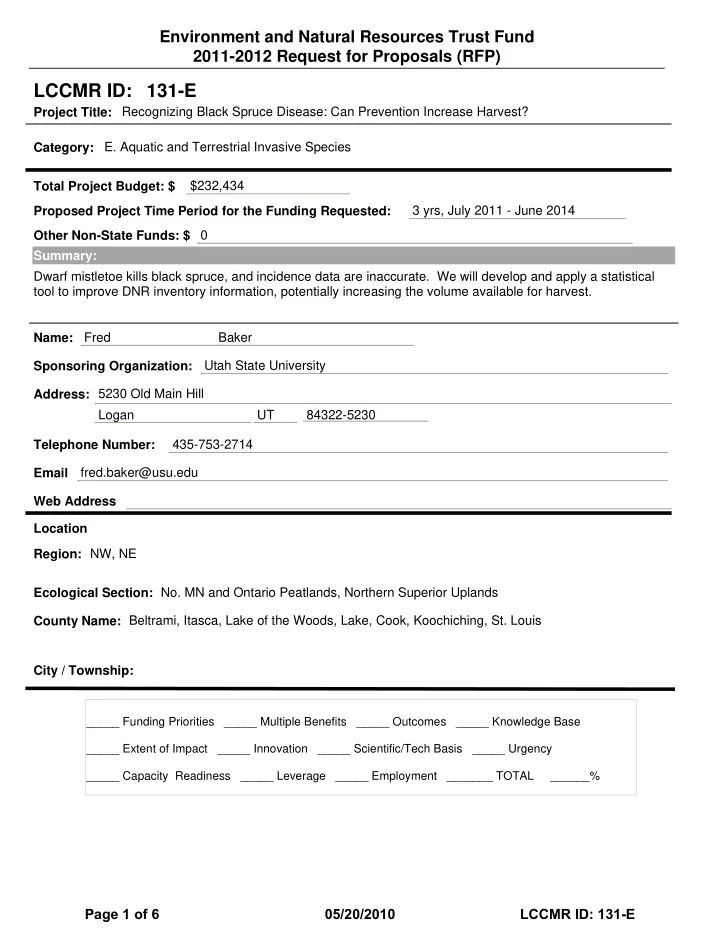
LCCMR ID: 131-E Project Title: Recognizing Black Spruce Disease: - - PDF document

lccmr id 131 e
SMART_READER_LITE
LIVE PREVIEW

LCCMR ID: 131-E Project Title: Recognizing Black Spruce Disease: - - PDF document

Environment and Natural Resources Trust Fund 2011-2012 Request for Proposals (RFP) LCCMR ID: 131-E Project Title: Recognizing Black Spruce Disease: Can Prevention Increase Harvest? Category: E. Aquatic and Terrestrial Invasive Species Total


slide-1
SLIDE 1

Environment and Natural Resources Trust Fund 2011-2012 Request for Proposals (RFP)

Recognizing Black Spruce Disease: Can Prevention Increase Harvest? $232,434 3 yrs, July 2011 - June 2014 Fred Baker Utah State University 5230 Old Main Hill Logan UT 84322-5230 435-753-2714 fred.baker@usu.edu Beltrami, Itasca, Lake of the Woods, Lake, Cook, Koochiching, St. Louis Dwarf mistletoe kills black spruce, and incidence data are inaccurate. We will develop and apply a statistical tool to improve DNR inventory information, potentially increasing the volume available for harvest. Project Title: Total Project Budget: $ Proposed Project Time Period for the Funding Requested: Other Non-State Funds: $ Name: Sponsoring Organization: Address: Telephone Number: Email Web Address County Name: City / Township: Region: Summary: NW, NE Location Ecological Section: No. MN and Ontario Peatlands, Northern Superior Uplands

_____ Funding Priorities _____ Multiple Benefits _____ Outcomes _____ Knowledge Base _____ Extent of Impact _____ Innovation _____ Scientific/Tech Basis _____ Urgency _____ Capacity Readiness _____ Leverage _____ Employment _______ TOTAL ______%

Category:

  • E. Aquatic and Terrestrial Invasive Species

LCCMR ID: 131-E

Page 1 of 6 05/20/2010 LCCMR ID: 131-E

slide-2
SLIDE 2

2011-2012 MAIN PROPOSAL

PROJECT TITLE: Recognizing Black Spruce Disease: Can Prevention Increase Harvest?

  • I. PROJECT STATEMENT

Black spruce is the second most valuable pulpwood species in Minnesota, bringing in more than $2.3 million to the state and counties in 2008, and providing jobs in mills and in the logging

  • industry. This species grows on more than 1.5 million acres of land in northern MN, on wet

sites where few other species can grow. Black spruce is used for high quality, “recession - proof” paper by mills such as those in International Falls and Grand Rapids. Harvesting black spruce is currently at its maximum sustainable level. Pest impacts will reduce the volume available for future harvest. Put another way, minimizing pest impacts can increase the allowable harvest, further stimulating the timber industry and rural economies. Dwarf mistletoe is a parasitic seed plant that grows on black spruce. It spreads by forcibly shooting its seeds up to 55 feet. The parasite causes the trees to form witches’ brooms, and usually kills them within 15 years. Broomed trees are difficult to delimb and loggers usually avoid them. Dead trees quickly decay and fall over. When enough trees are dead or broomed, the entire stand loses its value for timber, and for species that require a closed forest canopy. A 25-year old black spruce stand with 17% infection at age 25 will lose 64% of its timber – and value – within 75 years. Disease loss can be viewed as a threat to the timber resource, or as an opportunity to increase sustainable harvest if the loss can be reduced. The MN DNR forest inventory estimates that 10% of black spruce stands are infested with dwarf mistletoe. Recent findings suggest that mistletoe may infest at least 35% of MN black spruce stands, and perhaps as many as 59%. . We propose to survey a sample of stands to improve a statistical tool (Bayesian Heirarchical Model) to improve the accuracy of information on dwarf mistletoe incidence in the MN DNR

  • inventory. Our previous survey showed MN DNR inventory was 50% accurate in determining

dwarf mistletoe presence in a stand. Using the statistical tool with a very limited data set increased the accuracy to 75%. We will then use the improved statistical tool to identify potential increases in sustainable harvest levels. This novel tool can be applied to other data as well, increasing the accuracy and reducing the extreme cost for MN DNR to obtain accurate ecological information. Thus, we will provide more accurate information (and the technique to improve the accuracy of other information) to allow foresters to better manage black spruce to retain value, not just for timber but also for habitat integrity. Our project brings together a unique team to address this issue. Baker has worked for 35 years

  • n assessing impact of dwarf mistletoes, including black spruce dwarf mistletoe in Minnesota;

Hooten is a leader in the field of applied statistics in ecology. Shelstad is an instructor at Vermilion Community College in Ely, and, in addition to training forest technicians, he has served as field coordinator for past dwarf mistletoe surveys. Aunan (with the MN DNR) is a forest inventory specialist and will work with a timber supply modeler (MN DNR, vacant position.) Mielke is a liaison for a similar project examining the much coarser scale US Forest Service Forest Inventory and Analysis. We will hire field crews from among December graduates of the Forest Technician program at Vermilion and Itasca Community Colleges. This will provide jobs for these graduates during the winter when few forestry jobs are available. 1

Page 2 of 6 05/20/2010 LCCMR ID: 131-E

slide-3
SLIDE 3
  • II. DESCRIPTION OF PROJECT ACTIVITIES

Field Survey. Because black spruce grow on wet sites with limited access during the summer, we will do the surveys in winter when snowmobiles provide easier (and much cheaper!) access to the stands. This activity will provide a spatially explicit data set of dwarf mistletoe location in at least 320 black spruce stands. Budget: $192,483. Developing and Testing the Statistical Tool. At the end of the first field season, we will compare predicted presence/absence of dwarf mistletoe (from the tool) with observed values. Field survey data will then be used to improve the tool to select stands for next year’s sampling in

  • rder to maximize the knowledge gained. Data collected in the second year will be used to test

the improved statistical tool, and to further refine it. Budget: $23,833 Disease Impact Projection. At the same time the tool is being improved, we will use the survey data to project the impacts of dwarf mistletoe in each stand using a custom tool in ArcGIS. This will provide an estimate of the value losses in each sampled stand and the values which might be saved if losses can be prevented. If, as we expect, significant impacts are found, we will explore the best way to implement these spatially explicit results into the MN DNR forest inventory and GIS. Budget: $10,170 Timber Supply Impact Modeling. We will use the results of dwarf mistletoe impact simulation for both years of data combined with the statistical tool, to examine the effects of dwarf mistletoe on timber supply in all the black spruce stands in the DNR inventory. This will provide an understanding of current and projected value losses, and of the opportunity to increase allowable harvest in black spruce stands. Budget: $5,948

  • III. PROJECT STRATEGY
  • A. Project Team/Partners.

Receiving Trust Fund Money: F.A. Baker, Utah State University, Logan, UT; D. Shelstad, Vermilion Community College, Ely, MN;; M. Hooten, Utah State University; Not Receiving Trust Fund Money: Timothy Aunan, MN Department of Natural Resources, Grand Rapids, MN. Timber Supply Modeler MN DNR (position currently vacant); M. Mielke, USDA Forest Service St. Paul, MN

  • B. Timeline Requirements

Project will begin in July of 2011, with field activities occurring in December - March 2011 and

  • 2012. Handoff of all data and reports to MN DNR will be completed by December 2013.
  • C. Long-Term Strategy and Future Funding Needs

This project will provide accurate information and the tools to improve other inventory information that will allow foresters to better manage black spruce and other forest resources in

  • Minnesota. If our project identifies a substantial threat – or an opportunity to increase black

spruce sustainable harvest, forest managers will have the information they need to examine management options and justify decisions. 2

Page 3 of 6 05/20/2010 LCCMR ID: 131-E

slide-4
SLIDE 4

Salaries and Wages Baker (project coordinator), 1 month summer salary for 2yrs, 43.75% benefit, to do data management and disease impact projection, crew taining 20,346 $ Shelstad (1 month summer salary for 2 yrs, 8.3% benefits), field crew supervisor 17,588 $ Hooten, 1 month summer salary for 2 yrs, 43.75% benefits to design sampling strategy, evaluate and develop statistical tool 23,833 $ Survey crew, 4 people, $15.00/hr, 8.3% benefits, 14 wks/yr; December graduates

  • f VCC or Itasca CC Forest Technician programs

74,458 $ Timber Supply Modeling, 1 person $15.00/hr, 8.3% benefits,8 wks, yr 2 5,198 $ Contracts: Snowmobile rental (with trailer), 4 machines, 14 weeks/yr, 2 trailers. Easiest and most cost effective way to access black spruce stands is during winter when the ground is frozen 24,000 $ Equipment/Tools/Supplies Snowshoes (6 pair) (they break!) 900 $ GPS units (5@ $275) 1,375 $ Two-way radios (5 @ $100) 500 $ Supplies, sucha as rechargeable batteries and chargers, snowshoe bindings 2,000 $ Software Licenses, ArcGis 3@$150/yr; SPSS @ $100 1,000 $ Travel: Be specific. Only in-state travel essential to completing project activities can be included. Crew food and lodging 40,294 $ Crew mileage 13,202 $ Shelstad (food, lodging and mileage) 3,600 $ Baker (in state, food, lodging and mileage) 3,390 $ Timber Supply Modeler (food and lodging ) 750 $ TOTAL ENVIRONMENT & NATURAL RESOURCES TRUST FUND $ REQUEST SOURCE OF FUNDS AMOUNT Status Other Non-State $ Being Applied to Project During Project Period: USDA Forest Service and USU 136,530 $ Pending In-kind Services During Project Period: Although not formally accounted for here, Baker's travel to Minnesota at least twice each year, and an additional 4 weeks of research effort each year will be allocated to this project. 25,000 $

  • V. OTHER FUNDS

232,434 $

  • $

2011-2012 Detailed Project Budget

  • IV. TOTAL TRUST FUND REQUEST BUDGET 2 years

AMOUNT

  • $

C:\Documents and Settings\Fred Baker\Desktop\blk_spruce.xls

Page 4 of 6 05/20/2010 LCCMR ID: 131-E

slide-5
SLIDE 5

Figure 1. Black spruce stands in Minnesota, where the study will be done. Souce: MN DNR GIS. Figure 2. Male flowers of the dwarf mistletoe Figure 2. Witches’ brooms divert nutrients plant. From the tree and usually kills it within 15 yr. Figure 3. A 60-year old black spruce stand - Figure 4. Moderate mistletoe infestation in many live trees.

  • lder stand - much lower density and value.

Page 5 of 6 05/20/2010 LCCMR ID: 131-E

slide-6
SLIDE 6

Project Manager Qualifications and Organization Description Fred Baker is an associate professor at Utah State University. I earned a Ph.D. at the University of Minnesota in Plant Pathology, and a B. S. degree from the U in Forest

  • Science. I have worked with dwarf mistletoes more than 35 years. My research in forest

pathology has focused on improving the quality of information used in pest management decision making. I design hazard rating systems, better survey methods, impact simulation, economic analyses, and quantify pest impacts on non-timber resources, for dwarf mistletoes and other pest systems. I have written several textbooks and published many papers, both scientific and applied, on dwarf mistletoes and other forest

  • diseases. The first two papers listed below are the foundation for this proposal.

Although my home base is at Utah State University, I spend several weeks each year doing research in Minnesota on diseases of black spruce and other tree species. All of the field work will be done in Minnesota. Much of my effort in this project will be done in

  • Minnesota. I may do the disease impact projection in Utah only to focus my time in

Minnesota on field work. Hooten is an expert statistician, and will work in Utah to take advantage of the computing power and software in his lab. The expenses for both myself and Hooten will provide summer salary, as we are on 9 month contracts, and amounts to less than 20% of the project budget. The bulk of our budget is allocated to field survey data collection, which is costly for anyone. Through this project, we will develop statistical tools which will greatly increase the accuracy of existing data for minimal cost. Baker, F.A., Hansen, M. Shaw, J.D., Mielke, M., Shelstad, D.N., Hooten, M., and Hanks,

  • E. 2009. Effectiveness of operational inventories in detecting dwarf mistletoe in

black spruce stands. Northern Journal of Applied Forestry, in review. Hanks, E.M., Hooten, M.B., and Baker, F.A. 2010. Improving accuracy of large- scale prediction of forest disease incidence through Bayesian data reconciliation. Ecological Modelling, in review. Baker, F.A., and Guyon, J.G. 2010. Distribution of Three Dwarf mistletoe species within their host tree crowns. Western Journal Of Applied Forestry, In press. Tainter, F.H., and F.A. Baker. 1996. Principles of Forest Pathology. John Wiley and Sons, Inc., 803 pp. Baker, F.A. and Knowles, K. 2005. Case study: 36 years of dwarf mistletoe in a regenerating black spruce stand. North. J. Appl.For. 21:150-153. Baker, F.A., M. Slivitsky, and K. Knowles. 1992. Impact of dwarf mistletoe on Manitoba jack pine forests. Plant Disease 76:1256-1259. Baker, F.A. and D.W. French. 1991. Radial enlargement of mortality centers caused by Arceuthobium pusillum Peck in black spruce stands. Forest Science 37:364-367. Page 6 of 6 05/20/2010 LCCMR ID: 131-E