LCCMR ID: 128-E Project Title: Controlling Terrestrial Invasive - - PDF document

lccmr id 128 e
SMART_READER_LITE
LIVE PREVIEW

LCCMR ID: 128-E Project Title: Controlling Terrestrial Invasive - - PDF document

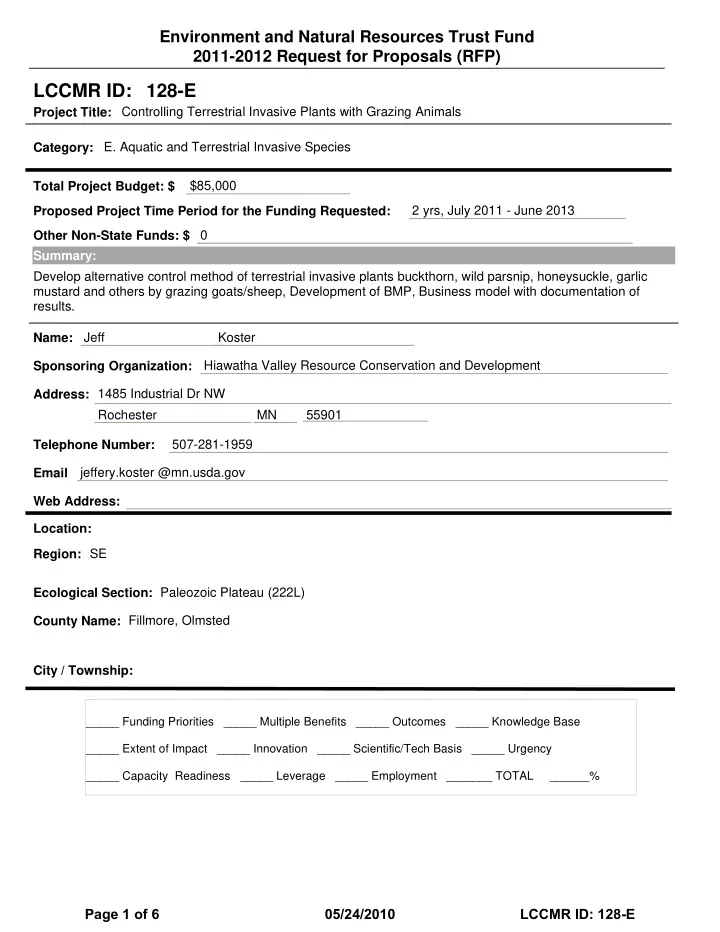
Environment and Natural Resources Trust Fund 2011-2012 Request for Proposals (RFP) LCCMR ID: 128-E Project Title: Controlling Terrestrial Invasive Plants with Grazing Animals Category: E. Aquatic and Terrestrial Invasive Species Total Project


slide-1
SLIDE 1

Environment and Natural Resources Trust Fund 2011-2012 Request for Proposals (RFP)

Controlling Terrestrial Invasive Plants with Grazing Animals $85,000 2 yrs, July 2011 - June 2013 Jeff Koster Hiawatha Valley Resource Conservation and Development 1485 Industrial Dr NW Rochester MN 55901 507-281-1959 jeffery.koster @mn.usda.gov Fillmore, Olmsted Develop alternative control method of terrestrial invasive plants buckthorn, wild parsnip, honeysuckle, garlic mustard and others by grazing goats/sheep, Development of BMP, Business model with documentation of results. Project Title: Total Project Budget: $ Proposed Project Time Period for the Funding Requested: Other Non-State Funds: $ Name: Sponsoring Organization: Address: Telephone Number: Email Web Address: County Name: City / Township: Region: Summary: SE Location: Ecological Section: Paleozoic Plateau (222L)

_____ Funding Priorities _____ Multiple Benefits _____ Outcomes _____ Knowledge Base _____ Extent of Impact _____ Innovation _____ Scientific/Tech Basis _____ Urgency _____ Capacity Readiness _____ Leverage _____ Employment _______ TOTAL ______%

Category:

  • E. Aquatic and Terrestrial Invasive Species

LCCMR ID: 128-E

Page 1 of 6 05/24/2010 LCCMR ID: 128-E

slide-2
SLIDE 2

1 PROJECT TITLE: Controlling Terrestrial Invasive Plants with Grazing Animals

  • I. PROJECT STATEMENT

Terrestrial invasive plants of buckthorn, wild parsnip, honeysuckle, garlic mustard and others are becoming dominate species in many ecological sites in SE Minnesota. Present control methods (chemical and mechanical) are costly, effective only in the short term or have other negative side effects. Goats have been used in many parts of the western US to provide weed control in various ecological sites (city parks, green space, rangeland and suburban/woodland interfaces. The goals of the project are to:1) Develop a cost effective and environmentally friendly alternative to chemical and mechanical control methods for these species, 2) Demonstrate that goats/ sheep can be used effectively to control invasive and 3) Develop a business and business model along with Best Management Practices for using goats/sheep for invasive weed control in SE Minnesota and the Driftless Area of the upper Mississippi River Valley region. Two sites with the targeted species will be grazed using goats/sheep. Grazing duration, intensity, frequency and timing will be evaluated to determine the most successful method for control of the targeted species.

  • II. DESCRIPTION OF PROJECT ACTIVITIES

Activity 1: Inventory, Monitoring, Evaluation, and Documentation Budget: $ 30,000 Collection of initial site conditions/composition with establishment of clipping transects and photo points. Monitor, evaluate and document activities to determine effectiveness and utilization of target and non-target species by grazing animals. Outcome Completion Date

  • 1. Baseline data, site composition, Transects, photo points

9/2011

  • 2. Document utilization of targeted and non-targeted Species

6/2013

  • 3. Inventory, Evaluate & Document control and sites receiving mechanical

and herbicide treatments 6/2013

  • 4. Provide final report documenting results and recommendations,

6/2013 Activity 2: Grazing of targeted species (buckthorn, wild parsnip, etc.) Budget: $ 50,000 Implement grazing plan to control targeted terrestrial species of Buckthorn, Honeysuckle, Wild parsnip, and Garlic Mustard. Outcome Completion Date

  • 1. Develop site specific grazing plans (annually)

5/2010-2015

  • 2. Establish and maintain temporary enclosures and enclosures with water 5/2010-2015
  • 3. Adjust stocking rates and duration to provide control of target species

5/2010-2015 Activity 3: Outreach, Education, Business model and Reporting Budget: $ 5,000 Field days and tours to educate the public and land use professionals on project activities. Completion of reports, business model and Best management practices. Outcome Completion Date

  • 1. Field days 2/yr

7/2011-2015

  • 2. Required reports semi-annual final /2011,6/2012,12/2012 & 6/2013

6/2013

  • 3. Business plan

6/2013

Page 2 of 6 05/24/2010 LCCMR ID: 128-E

slide-3
SLIDE 3

2

  • III. PROJECT STRATEGIES
  • A. Project Team/Partners
  • Project Manager: Jeff Koster, Coordinator Hiawatha Valley RC&D
  • Grazing Specialist: John Zinn, State Grazing Specialist, NRCS-USDA

Technical Committee:

  • Skip Langer, District Technician, Olmsted Soil and Water Conservation District
  • Kurt Hinz, Forester, MN DNR
  • George Poch, Soil Scientist (Private), Vice-Chairman, Hiawatha Valley RC&D
  • Steve Carlin, Ranager, Gamehaven Scout Ranch
  • Jerome Deden, Executive Director, Eagle Bluff Environmental Learning Center
  • Nicole Lehman – Environmental Specialist McGhie & Betts
  • Katie Dudley, Forest Stewardship plan writer, MN DNR
  • Dave Copeland, District Conservationist, NRCS-USDA

Partner Organizations:

  • Boy Scouts of America Gamehaven Scout Ranch (site)
  • Eagle Bluff Environmental Learning Center (site)
  • Driftless Area Initiative (Financial Assistance)
  • USDA-Natural Resource Conservation Service (Technical Services)
  • Hiawatha Valley RC&D (Financial Assistance and ENRTF recipient
  • MN-DNR (Technical Services - planning)
  • Olmsted Co. SWCD (Technical Services- Planning)and Possible contractor
  • B. Timeline Requirements

2010 (Year 0) Initial inventory of sites, establishment of transects and photo points, development and evaluation of grazing strategies and protocols. Driftless Area Initiative Funds 2011 (Year 1) July 1 start date, LCCMR Funding, Driftless Area Initiative Funds Activity 1: Inventory, Monitoring Documentation and Evaluation Activity 2: Outreach and Education Activity 3: Grazing of Targeted invasive species at two or more sites in SE Minnesota 2012 (Year 2) LCCMR Funds, Driftless Area Initiative Funds Activities 1, 2 and 3 continue 2013 (Year 3) LCCMR Funding and Funding TBD Activities 1, 2, and 3 continue, Final Reports and Deliverables for LCCMR funded activities completed and delivered. After June 30, 2013 Activities continue with outside funding 2014 (Year 4) Funding TBD and income from Fees for Service Activities 1, 2, and 3 continue with outside funding BMPs updated 2015 Project is operated as private business

  • C. Long-Term Strategy and Future Funding Needs

The two years of the LCCMR funding will cover part of three growing seasons. This project will cover six growing seasons. Grazing unlike other forms of invasive control does not provide dramatic changes in the landscape in a short period of time and it is estimated that it will take multiple years per site to bring the targeted species under control. Grazing provides for a more sustainable gradual change to the site. The initial year starts the project. Year 1 allows the project to become fully implemented. Years 2 and 3 fine tune the operations, Year 4 continue with the reduction of the invasive and provide for transition to private business. Follow on funding will be from grants and fees for service for grazing of weeds on new sites

Page 3 of 6 05/24/2010 LCCMR ID: 128-E

slide-4
SLIDE 4

C:\Documents and Settings\dgriffit\My Documents\ML2011\RFP\Proposals Final Submissions\Koster-0410-2-340-Budget

BUDGET ITEM (See list of Eligible & Non-Eligible Costs, p. 13) Contracts: Grazing contractor-Kelly O'neil & TBD, Provides animals, equipment, tools, daily care of animals, moves animals to, from and within site, Set up temporary grazing enclosures/exclosures on each site $12,500/site/yr 2 sites/yr Contracts: I M &E Contract(s); Inventory, monitoring and evaluation of each study site; Contractor TBD (University, Evironmental engineering firm, Non profit, or Soil and Water Conservation District) Establish baseline condition, through transects and photo points, Provides Documentation with photos, analysissand written reports $15,000/year Equipment/Tools/supplies- Provided by contractor Acquisition: Not Applicable Travel: Not Applicable Additional Budget Items:Development, Publication and Distibution of Results and Best Management Practices; Semi-annual Reports and Final Report TOTAL ENVIRONMENT & NATURAL RESOURCES TRUST FUND $ REQUEST SOURCE OF FUNDS AMOUNT Status Other Non-State $ Being Applied to Project During Project Period: Driftless Aarea Initiative Watershed project 15,000 $ Secured Other State $ Being Applied to Project During Project Period: None none In-kind Services During Project Period: Grazing plans and monitoring NRCS State Grazing specialist (John Zinn) 150hrs/yr @ $80/hour 24,000 $ In-kind Services During Project Period: Project Management Hiawatha Valley RC&D Coordinator (Jeff Koster)150hrs/yr @ $80/hour 24,000 $ In-kind Services During Project Period: Grazing land (Value of pasture rental)100 acres per site $90 acre/6 months period Gamehaven Scout Ranch, Eagle Bluff Learning Center (2 sites per year) 36,000 $ Remaining $ from Current ENRTF Appropriation: Not Applicable N/A Funding History: Inventory, Monitoring and Evaluation for Project year 2010, Hiawatha Valley RC&D and Driftless Area Initiative 7,500 $ N/A 5,000 $ 30,000 $

  • V. OTHER FUNDS

50,000 $ 85,000 $ N/A N/A

2011-2012 Detailed Project Budget

INSTRUCTIONS AND TEMPLATE (1 PAGE LIMIT) (1-page limit, single-sided, 10 pt. font minimum. Retain bold text and DELETE all instructions typed in italics. ADD OR DELETE ROWS AS NECESSARY . If a category is not applicable write “N/A” , leave it blank, or delete the row.)

  • IV. TOTAL TRUST FUND REQUEST BUDGET [Insert # of years for project] years

Attach budget, in MS-EXCEL format, to your “2011-2012 LCCMR Proposal Submit Form”. AMOUNT

Page 4 of 6 05/24/2010 LCCMR ID: 128-E

slide-5
SLIDE 5

PROJECT TITLE: Controlling Terrestrial Invasive Plants with Grazing Animals The Hiawatha Valley Resource Conservation and Development Council is a 501c 3 non-profit

  • rganization that links concerned citizens with the resources needed to solve local problems.

The Resource Conservation and Development is a unique program that helps people care for and protect their natural resources in a way that will improve the area’s economy, environment, and living standards. RC&D brings together people’s needs, concerns,

  • pportunities, and solutions. The Hiawatha RC&D is sponsored locally by the Board of

County Commissioners and Soil & Water Conservation Districts (SWCDs) in each of the eleven Counties in SE Minnesota. Each county has 3 representatives; a county commissioner, a SWCD member, and a jointly appointed member at large. The Hiawatha Valley RC&D Council has been a leader in resource development projects since its establishment in 1976. The Council has assisted local people and others to successfully completed more than 300 projects since their establishment. Most projects focus

  • n issues including: Natural Resources, (Forestry, and Renewable energy) Economic

Development, Community Development, Environmental Management and Information and Education. Project Manager Qualifications: Jeff Koster RC&D Coordinator January 2001 to Present (Colorado and Minnesota) American Society of Agronomy Certified Crop Advisor 1998-2009 Restricted Used Pesticide License, NV, 1992-1996 USDA - Natural Resource Conservation Service

  • Certified Conservation Planner,
  • Nutrient Planner
  • Pest Management Planner

A 26 year employee of Natural Resource Conservation Service with contract experience dealing with federal, state and local cost share program and long term contracts. Design and implementation of complex conservation management plan and associated conservation practices. Responsible for the Development, funding and implementation of RC&D projects in two states with program budgets exceeding $300,000. Page 5 of 6 05/24/2010 LCCMR ID: 128-E

slide-6
SLIDE 6

Page 6 of 6 05/21/2010 LCCMR ID: 099-C3+4 Page 6 of 6 05/24/2010 LCCMR ID: 128-E