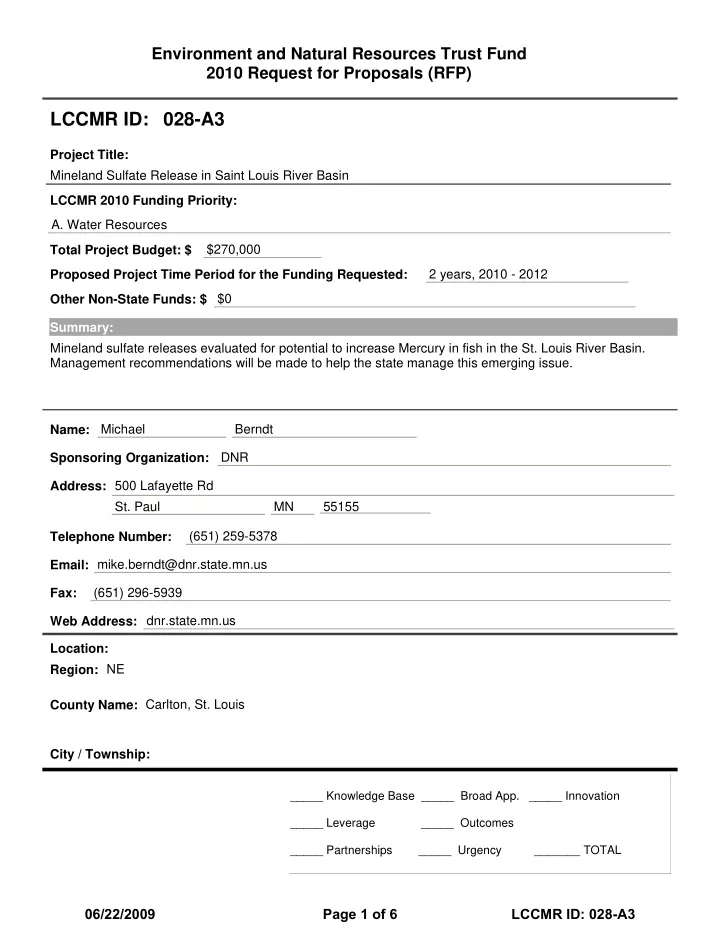
SLIDE 2 PROJECT TITLE: Mineland Sulfate Releases in St. Louis River Basin
The St. Louis River Basin serves multiple purposes ranging from recreational fishing and boating to agriculture, forestry, and hydroelectric power generation. The basin is probably most well known for hosting the Mesabi Iron Range, a world class ore deposit that has supplied iron for the United States continuously since the late 1880’s. Less well known are the nearby undeveloped copper-nickel / precious metal deposits that are likely to be an important future U.S. resource for these metals. Mining features including waste rock piles, open pits, and tailings basins on the Iron Range are the dominant source of sulfate (SO4) to the St. Louis River. Left unabated, SO4 releases are likely to increase over the next century as active mines are deepened, new mines are opened, and more waste rock and tailings are generated. Although no water quality standards have been established for SO4, the Minnesota Pollution Control Agency has developed temporary guidelines focused on avoiding high SO4 discharges to waters where the potential exists to increase methylmercury (MeHg) and fish mercury (Hg) concentrations anywhere downstream. High fish-Hg can, in turn, adversely affect the health of fish consumers including eagles, osprey, loons, otters, and human beings. Department of Natural Resources collaborative studies have revealed that SO4 concentrations fluctuate widely in the St. Louis River, reaching highest levels near the mining district during dry periods and lowest levels downstream, particularly during wet periods. While the general release mechanisms and SO4 treatment schemes are understood, treatment costs are very high while the level
- f protection each level of treatment affords to the environment is largely unknown. As of yet, no
clear strategy has been developed in Minnesota to balance the economic needs of the state or the national appetite for metals against the environmental consequences of increasing SO4 discharges to the St. Louis River. The proposed study will advance along three fronts: (1) mapping of current sulfate sources (waste rock piles, tailings basins, water-filled pits), (2) providing an objective assessment of treatment
- ptions, including heretofore untried (in Minnesota) in-pit SO4 reduction, and (3) evaluation of the
likely impacts of seasonally controlled SO4 releases from Cloquet to the St. Louis River Estuary (on- going DNR research has focused on the river north of Cloquet). The result of this research will be a consistent and comprehensive series of recommendations and supporting documents that state agencies, decision makers, and other stake holders can rely on to manage SO4 releases to the St. Louis River as mining companies continue to bring forward plans for expansion and development in the foreseeable future.
- II. DESCRIPTION OF PROJECT RESULTS
Result: A series recommendations and supporting documents that state agencies, decision makers, and
- ther stake holders can rely on to help manage SO4
releases to the St. Louis River. Budget: $270,000 Deliverables Completion Date
- 1. A preliminary report detailing current MeHg and SO4
June 2011 levels in the St. Louis River and the St. Louis River Estuary.
- 2. A final report detailing MeHg and SO4
June 2012 relationships in the St. Louis River and the St. Louis River estuary.
- 3. A final report that documents current SO4
June 2012 sources and their concentrations.
06/22/2009 Page 2 of 6 LCCMR ID: 028-A3