LCCMR ID: 012-A1 Project Title: Paddlefish and Sturgeon Monitoring - - PDF document

lccmr id 012 a1
SMART_READER_LITE
LIVE PREVIEW

LCCMR ID: 012-A1 Project Title: Paddlefish and Sturgeon Monitoring - - PDF document

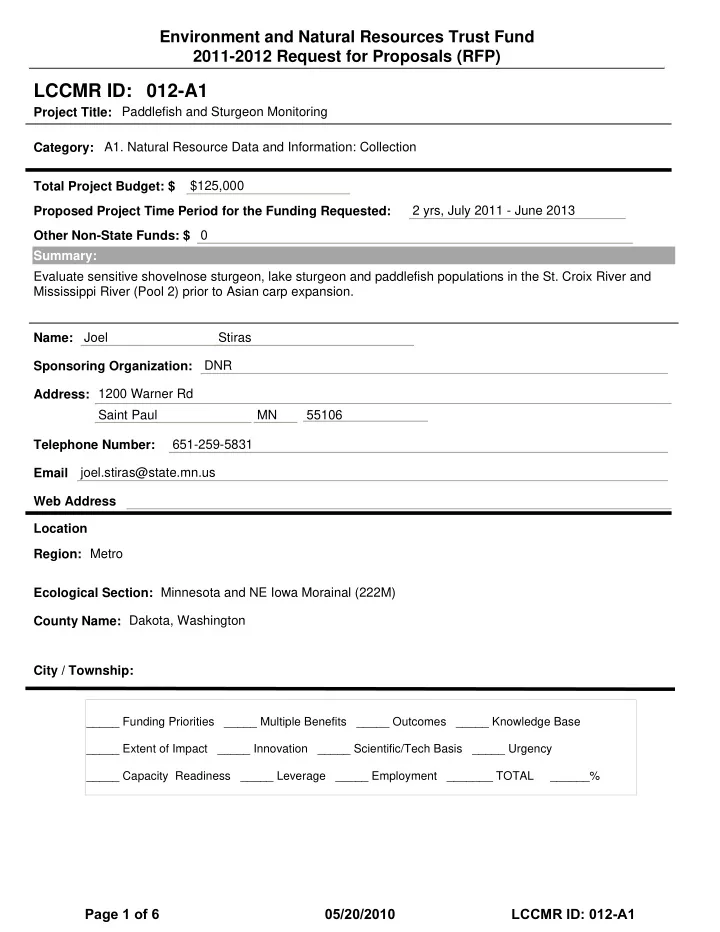
Environment and Natural Resources Trust Fund 2011-2012 Request for Proposals (RFP) LCCMR ID: 012-A1 Project Title: Paddlefish and Sturgeon Monitoring Category: A1. Natural Resource Data and Information: Collection Total Project Budget: $


slide-1
SLIDE 1

Environment and Natural Resources Trust Fund 2011-2012 Request for Proposals (RFP)

Paddlefish and Sturgeon Monitoring $125,000 2 yrs, July 2011 - June 2013 Joel Stiras DNR 1200 Warner Rd Saint Paul MN 55106 651-259-5831 joel.stiras@state.mn.us Dakota, Washington Evaluate sensitive shovelnose sturgeon, lake sturgeon and paddlefish populations in the St. Croix River and Mississippi River (Pool 2) prior to Asian carp expansion. Project Title: Total Project Budget: $ Proposed Project Time Period for the Funding Requested: Other Non-State Funds: $ Name: Sponsoring Organization: Address: Telephone Number: Email Web Address County Name: City / Township: Region: Summary: Metro Location Ecological Section: Minnesota and NE Iowa Morainal (222M)

_____ Funding Priorities _____ Multiple Benefits _____ Outcomes _____ Knowledge Base _____ Extent of Impact _____ Innovation _____ Scientific/Tech Basis _____ Urgency _____ Capacity Readiness _____ Leverage _____ Employment _______ TOTAL ______%

Category:

  • A1. Natural Resource Data and Information: Collection

LCCMR ID: 012-A1

Page 1 of 6 05/20/2010 LCCMR ID: 012-A1

slide-2
SLIDE 2

2011-2012 MAIN PROPOSAL

PROJECT TITLE: Paddlefish and sturgeon monitoring in Mississippi (Pool 2) and St Croix Rivers.

  • I. PROJECT STATEMENT

Little is known about the paddlefish population in the uppermost extent of its range in the Mississippi River Basin. Paddlefish are an ancient species and are the only species currently

  • n the Minnesota’s State Threatened List and more information must be gathered to assess the

population, especially before Asian carp expand into the area. Paddlefish and Asian carp are expected to be direct competitors as they both filter feed on plankton. In addition, lake sturgeon and shovelnose sturgeon are an ancient species with relatively unknown populations. Lake sturgeon have a restrictive angling and harvest season on the St Croix border waters and a lake sturgeon tagging project has been in operation on the St Croix River since 2003. Harvest of shovelnose sturgeon is prohibited except in MN/WI border waters of the Mississippi River downstream of the Red Wing Dam. All three of these species have commercial value to the caviar industry as worldwide sturgeon populations have been collapsing. States further south may become more restrictive due to increasing commercial pressures and Asian carp

  • expansion. Minnesota could have increased pressure to exploit (both legally and illegally) what

is thought to be recovering populations of lake sturgeon and unknown populations of shovelnose sturgeon and paddlefish. Goals of the project are to determine population size and structure and locate key habitat areas

  • f these three species, particularly spawning areas as these are the most crucial areas in need
  • f protection. In addition, contaminant testing is needed and accidental mortalities would be

tested as well as eggs from any ripe females sampled during assessments. Multiple specialized sampling methods (netting, trawling, snagging, electrofishing, trotlines, angling) would be employed to sample these species. Fish would be tagged to obtain population estimates, aged when possible, and a small number would be fitted with radio transmitters and tracked to determine migrations, movements, and key habitat areas.

  • II. DESCRIPTION OF PROJECT ACTIVITIES

Activity 1: _Determine population size of paddlefish and sturgeon and contaminants in meat and eggs_____ Budget: $ _75,000__ Outcome Completion Date

  • 1. Sample and tag paddlefish and sturgeon to determine population size

June 2012

  • 2. Collect samples for contaminant testing as opportunities allow

June 2012

  • 3. Compile information to determine if more extensive work is needed

June 2013 Activity 2: _Determine movements, migrations, and spawning areas___ Budget: $ _50,000__ Outcome Completion Date

  • 1. Collect and radio tag a subsample of paddlefish and sturgeon

June 2011

  • 2. Monitor radio tagged fish to identify key habitats

June 2013

Page 2 of 6 05/20/2010 LCCMR ID: 012-A1

slide-3
SLIDE 3
  • III. PROJECT STRATEGY
  • A. Project Team/Partners

DNR Fisheries – design sampling protocols, sample and tag fish, collect samples to be submitted to Minnesota Pollution Control Agency (MPCA) for contaminant testing, contract with the University of Minnesota for a graduate student to conduct the radio telemetry tracking of fish. MPCA – submit egg and fish samples for contaminant testing, including but not limited to testing for heavy metals, PCB’s, and PFOS. University of Minnesota – hire a graduate student to track and report radio tagged fish.

  • B. Timeline Requirements

Summer 2011: purchased needed equipment to begin sampling; coordinate with the University

  • f Minnesota to hire a graduate student to track radio tagged fish.

Fall 2011: begin sampling efforts; if graduate student in place, priority would be to get fish radio tagged to aid in sampling as fish likely congregate during cold water periods and during spawning. Fall 2011-2013: once graduate student in place, track radio tagged fish to determine movements, migrations, and key habitats. Fall 2011-2012: sample and tag as many sturgeon and paddlefish as possible, submit contaminant samples for testing as they become available, analyze data, prepare reports, determine which sampling methods are most efficient and if efforts need to be expanded.

  • C. Long-Term Strategy and Future Funding Needs

This proposal may require additional funding in the future for continued radio tracking of tagged fish as paddlefish and sturgeon likely do not spawn every year. Determination of spawning areas is of particular importance as these areas need to be protected. Some equipment, such as gill nets and trammel nets, may need to be replaced to continue further sampling. Future monitoring could continue without further funding, however it is not known how difficult it will be to sample these three species in sufficient numbers to determine their respective population

  • sizes. The limitations to sampling and recapturing enough fish to make these determinations

are dependent on limited time and personnel to sample fish populations that are believed to be low in abundance.

Page 3 of 6 05/20/2010 LCCMR ID: 012-A1

slide-4
SLIDE 4

BUDGET ITEM (See list of Eligible & Non-Eligible Costs, p. 13) Personnel: Student Intern, 1,200 hrs @ $15.00/hr for 2 years Contracts: University of Minnesota: hire a graduate student to track and report radio tagged fish Equipment/Tools/Supplies: Radio transmitters, tansmitter receiver, exterior tags, tag readers, surgical supplies, custom made sampling gear. TOTAL ENVIRONMENT & NATURAL RESOURCES TRUST FUND $ REQUEST SOURCE OF FUNDS AMOUNT Status Other State $ Being Applied to Project During Project Period: Fleet charges 2,460 $ Game and Fish Funds Other State $ Being Applied to Project During Project Period: Fisheries Specialist (2) Salary, $37.50 x 1000 hrs 37,500 $ Game and Fish Funds AMOUNT

2011-2012 Detailed Project Budget

INSTRUCTIONS AND TEMPLATE (1 PAGE LIMIT) (1-page limit, single-sided, 10 pt. font minimum. Retain bold text and DELETE all instructions typed in italics. ADD OR DELETE ROWS AS NECESSARY . If a category is not applicable write “N/A” , leave it blank, or delete the row.)

  • IV. TOTAL TRUST FUND REQUEST BUDGET [Insert # of years for project] years

Attach budget, in MS-EXCEL format, to your “2011-2012 LCCMR Proposal Submit Form”. 70,000 $

  • V. OTHER FUNDS

36,000 $ 125,000 $ 19,000 $

Page 4 of 6 05/20/2010 LCCMR ID: 012-A1

slide-5
SLIDE 5

Page 5 of 6 05/20/2010 LCCMR ID: 012-A1

slide-6
SLIDE 6

Joel Stiras, Fisheries Specialist Joel grew up in Brooklyn Park and obtained a degree from Bemidji State University. While in college, Joel worked as an intern at the fisheries office in Walker, MN. After graduation, Joel gained fisheries management experience in Florida, Indiana and North Carolina before returning to Minnesota as a member of the Central Region Aquatic Plant Management staff. Joel is currently responsible for monitoring the fish populations

  • f the area's major rivers and assisting in operation of the cool water hatchery.

DNR mission statement: Our mission is to work with citizens to conserve and manage the state's natural resources, to provide outdoor recreation opportunities, and to provide for commercial uses of natural resources in a way that creates a sustainable quality of

  • life. The Minnesota Department of Natural Resources works to integrate and sustain the

interdependent values of a healthy environment, a sustainable economy, and livable

  • communities. DNR’s integrated resource management strategy shares stewardship

responsibility with citizens and partners to manage for multiple interests.

ORGANIZATIONAL DESCRIPTION

Page 6 of 6 05/20/2010 LCCMR ID: 012-A1