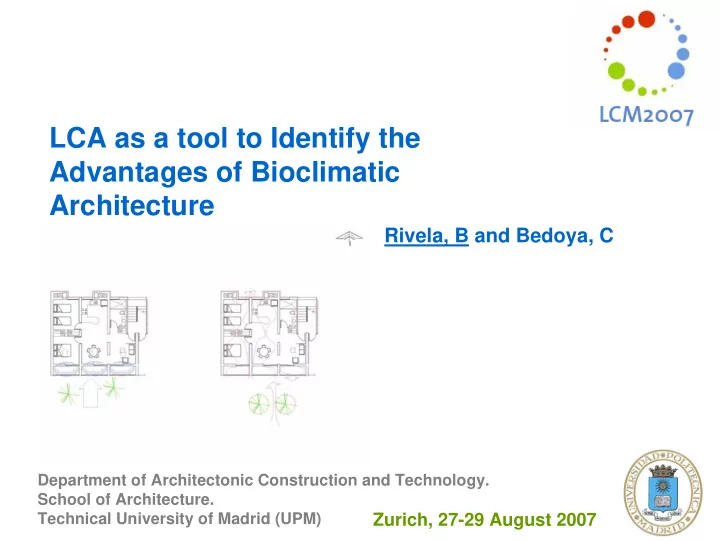
SLIDE 1
LCA as a tool to Identify the Advantages of Bioclimatic Architecture
Department of Architectonic Construction and Technology. School of Architecture. Technical University of Madrid (UPM)
Zurich, 27-29 August 2007
Rivela, B and Bedoya, C
SLIDE 2
Structure
02 Goal and scope 03 Life Cycle Inventory 04 Impact Assessment 01 Short Introduction
Zurich, 27-29 August 2007
05 Conclusions
SLIDE 4 Introduction (I)
40% of all energy end use
(similar percentage of greenhouse gas emissions)
40-50% of waste 50% of all materials extracted from the earth’s crust
Why Construction?
28.1% of industrial employment
(7.5% of total employment)
Zurich, 27-29 August 2007
SLIDE 5
Introduction (II) Tradition vs. Technology Vernacular architecture Technological imperative Sustainable Sustainable Construction? Ecological Organic Green
Zurich, 27-29 August 2007
SLIDE 6
Introduction (III)
01 Bioclimatic architecture
…working with natural forces around the building rather than against them. climate energy
Zurich, 27-29 August 2007
SLIDE 8 Goal & Scope (I)
01 Objective
Assess the importance of bioclimatic design related to the environmental impact of the entire life cycle of building
02 Functional unit
Zurich, 27-29 august
01.1 Relative contribution of different materials
including the production and manufacturing of construction materials involved as well as the process of the envelope construction
Environmental Impact E nve lope A
Ma te ria ls (A) + x kWh
E nve lope B
Ma te ria ls (B) + y kWh
150 m2
01.2 Comparative analysis of construction vs. use phase
SLIDE 9 Goal & Scope (II)
03 Scenarios under study
Zurich, 27-29 august
3.1 Envelope A 3.2 Envelope B
Exterior rendering (2 cm) Wood-fibre insulation (6 cm) Brick (24 cm) Plastering (1.5 cm)
Outdoor
Indoor Polyurethane Insulation (4 cm)
Outdoor
Exterior rendering (2 cm) Brick (12 cm) Rendering (1 cm) Brick (5 cm) Plastering (1.5 cm) Indoor
SLIDE 10
ife Cyc le Inve ntor y
SLIDE 11 Inventory
02 Energy use 01 Construction materials
Zurich, 27-29 august
6 m 12 m 6 m
Operations phase activities considered include heating, cooling and ventilating the building. Lighting, water supply and water heating were leaved out
Winter (kWh) Summer (kWh) Envelope San Sebastian Madrid Seville San Sebastian Madrid Seville A 239,805 226,665 200,385 42,705 45,990 49,275 B 640,575 558,450 440,190 279,225 374,490 436,905
SLIDE 13
Impact Assessment (I)
02 Relative importance of construction vs. use phase 01 Relative importance of materials
Zurich, 27-29 august
03 Comparative assessment of envelopes
SLIDE 14
Impact Assessment (II)
01 Relative importance of materials: envelope A
C RO RI CC R OL E A/E LU M FF
Zurich, 27-29 august
Exterior rendering Plastering Brick Wood-fibre insulation
100%
SLIDE 15
Impact Assessment (III)
01 Relative importance of materials: envelope B
C RO RI CC R OL E A/E LU M FF
Zurich, 27-29 august
Polyurethane Rendering Brick (5 cm) Exterior redering Plastering Brick (12 cm)
SLIDE 16
Impact Assessment (IV)
C RO RI CC R OL E A/E LU M
02 Relative importance of construction vs. use phase
FF Use phase Construction
Zurich, 27-29 August 2007
SLIDE 17 Impact Assessment (V)
C RI CC E A/E FF
Envelope B Envelope A
Zurich, 27-29 August 2007
03 Comparative assessment of envelopes
10 20 30 40 50
10 20 30 40 50
HH EQ R
SLIDE 19
Zurich, 27-29 August 2007
02 The use phase is of major importance in the scenarios
analysed
03 Further research must be done… 01 Bioclimatic strategies are ease of application with minimum
additional investments, and provide a large reduction of the environmental impacts Conclusions
SLIDE 20
www.larevolucioninvisible.com