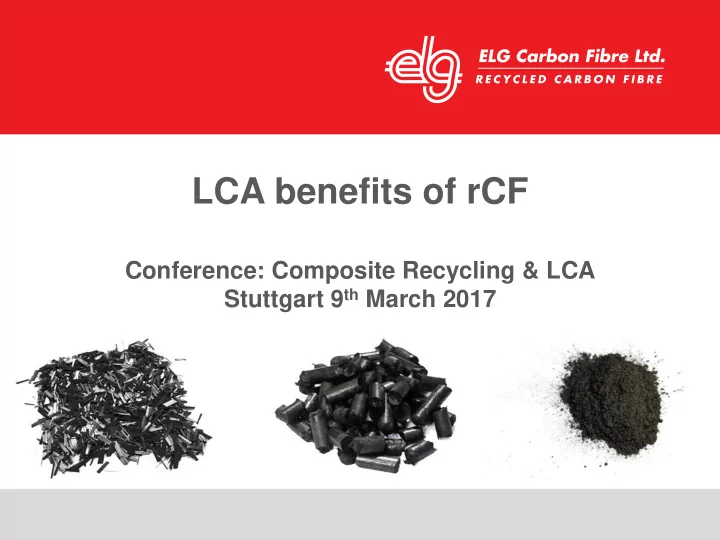
LCA benefits of rCF Conference: Composite Recycling & LCA - - PowerPoint PPT Presentation
LCA benefits of rCF Conference: Composite Recycling & LCA Stuttgart 9 th March 2017 Outline ELG Carbon Fibre Carbon fibre reclaiming & conversion Rational of use of CF composites LCA for carbon fibre (virgin vs. recycled)
1
Outline
- ELG Carbon Fibre
- Carbon fibre reclaiming & conversion
- Rational of use of CF composites
- LCA for carbon fibre (virgin vs. recycled)
- Summary
1
2
Introduction to ELG Haniel Group
- Recycling of High Performance Materials
- 3 business units with the core market segment in stainless steel
- Global market leading company with 45 operational yards worldwide
Ferrochrome, Carbon Fibre Carbon Scrap, Long Products
Europe
485 Employees*
Overseas
(incl. US, AUS, Asia) 270 Employees*
Stainless Steel Scrap
Recycling alloyed scrap
Other Materials
Other Materials ELG Haniel GmbH (Holding Company)
23 Employees*
* Total Employees = Ø 1055 Headcount
ELG Superalloys
Superalloys Scrap
Recycling High-Ni Alloys, Titanium 110 Employees* 165 Employees*
Carbon fibre Reclamation
3
The CF reclamation is the HEART of our process, but only one challenge to ‘close the loop‘!
Carbon fibre Conversion
4
Carbiso™ MF
STAPLE CARBON FIBRE
Carbiso™ MB Carbiso™ M
Compounding Industry Composites Industry
Carbiso™ TM
Masterbatch Q4/2017 Market launch
5
20 40 60 80 100 120 140 2016 2020
Annual Supply & Demand Tonnes ('000)
Carbon Fibre Supply and Demand
Production Capacity Demand
Why Recycle?
- Cost: recycled carbon fibre products
can reduce the cost of lightweight structures and components.
- Legislation: increasing onerous
legislation regarding the disposal of composite manufacturing and end-
- flife waste.
- Supply chain security: mitigates
against shortages in virgin carbon fibre supply.
5
Recycling of manufacturing waste can help fill the forecast gap between carbon fibre supply and demand
Waste
What about the environmental impacts of virgin vs. recycled carbon fibre?
Regulatory Framework
6
- EU regulation by 2021: fleet average of all new cars 95g/km; penalty: €95/g of exceedance onwards
- This means a fuel consumption of around 4.1 l/100 km of petrol or 3.6 l/100 km of diesel.
- Worldwide harmonized Light vehicles Test Procedure (WLTP); introduced in the EU in Sep 2017
Two fold challenge for carmakers: CO2 limits are globally becoming stricter and testing procedures are getting closer to reality.
Source: ICCT Source: PA Consulting
CO2 fleet averages per carmaker
7
Ranking of carmakers:
- Only four of the 12 are forecast to meet the 2021 targets of 95g CO2/km.
- Penalties for those falling short on those targets could be significant, ranging from €350
million for BMW, above €600 million for Fiat Chrysler and up to €1 billion for VW
Source: PA Consulting Group Study examines manufacturers’ performance against the
- verall EU target of 95g
CO₂/ km as well as the specific targets set for each carmaker’s business.
Motivation to use CFRP
8
Opportunities exist for emissions reductions through:
- Increasing power train efficiency
- Alternative fuel approaches (fuel cell, hybrid etc)
- Lowering vehicle mass
Greatest opportunities for mass reduction offer besides High strength steels, Aluminium, Magnesium and in particular CFRP
Source: The Phoenix Group and WorldAutoSteel
Mass Reduction Potential of Materials with regard to Tensile Stress
9
Source: (Song et al., 2009).
100 200 300 400
Carbon Fiber Magnesium Aluminium Glass Fiber Steel
Embodied Energy in MJ/kg Materials
Embodied energy of different materials
- Carbon Fibre raw material production requires up to 280 MJ/kg (5-6 times of steel); only
less than magnesium and more than aluminium
- Functional units also need to be compared as1kg of steel is not equal to 1kg of another
material on a component level delivering the same performance
- For a final part the picture turns around between aluminium and carbon fibre due to the
mass savings (estimated part weight: 67kg for AL vs. 45kg for CF)
- Carbon fibre still shows a significantly negative environmental impact
Functional units Material production GHG emissions comparison for a typical automotive part
Source: Worldsteel Association
LCA of different vehicle concepts
10
Source: Audi
- Life-cycle tradeoffs related to a switch to composites
- Negative impact in production and end of life (if not recycled)
- Mainly in use phase lower weights lead to fuel savings
- Breakeven point in automotive can vary between 132,000 – 180,000 km for
CFRP versus steel depending on the application
- In aerospace the breakeven point can already realised after 70,000 km due
to the significant weight reduction for CFRP vs aluminium
Results LCA for rCF
11
- Production of recycled carbon fibres contributes to 99 % of total GHG
emissions of the recycling process chain:
- Total GHG emissions: 29.45 t (primary CF) vs. 4.65 t (secondary CF)
- Recycled carbon fibres have significantly less environmental impact.
Results LCA for rCF
12
Further reduction in energy consumption per kg (>30%) achieved in last two years
13
Results LCA for rCF
LCA Benefits of rCF
14
- The majority of energy consumption occurs during the virgin carbon fiber
production.
- Recycling requires only 1/10 of this energy
- Great motivation for recycling carbon fiber with positive impact on LCA
The embodied energy for carbon fiber can be significantly reduced by recycling required carbon fibers.
Kategorie 1 Kategorie 2 Cumulative GHG emissions
Virgin CF Recycled CF
Use phase emissions Vehicle production emissions Total driven distance End of vehicle life
Putting LCA benefits of rCF into Practice
15
- Reduction of track wear and hence
infrastructure maintenance costs by reducing vertical and transverse loads on the rails
- Improved reliability and operational
availability through the use of an embedded health monitoring system
- Reduction in energy consumption
and global warming footprint
Project: Bogie Frame Project: eQ1 Project: Closed Loop
- Development of rCF
parts for the eQ1 electrical vehicle
- Reduce the weight of
both, new energy and conventional vehicles in
- rder to meet
environmental and performance targets
- Introduction of a circular
economy through development and implementation of new rCF intermediate products from the existing waste stream for manufacturing of next generation aircraft parts
Sources: Airbus, Chery, Alstom.
16
- iPanels based on recycled carbon fibre cost approximately €30 each, compared
to €300 each for panels made from conventional woven fabric prepreg.
- iStream concept goes into small scale production for TVR in Q4 2017
- Volume adaptation followed by Yamaha electric city car in 2018/19
* iStream photos and information courtesy of Gordon Murray Design Ltd.
iStream* Carbon
Putting LCA benefits of rCF into Practice
17
Summary
- Virgin Carbon Fibre has more environmental impacts on
production and disposal than more conventional materials
- In many cases, these are offset by benefits in use due to the
lower weight / improved performance of composites
- Recycled carbon fibre facilitates the environmental
competiveness to other lightweighting materials already in the production stage
- Recycled carbon fibre demonstrates significant LCA benefits
for material selection processes and empowers eco-friendly lightweighting strategies in the transportation sector
17
Thank You!
18
Marco Gehr COO ELG Carbon Fibre Ltd. Office: +44 (0) 1902 406010 Email: mgehr@elg.de Web: www.elgcf.com