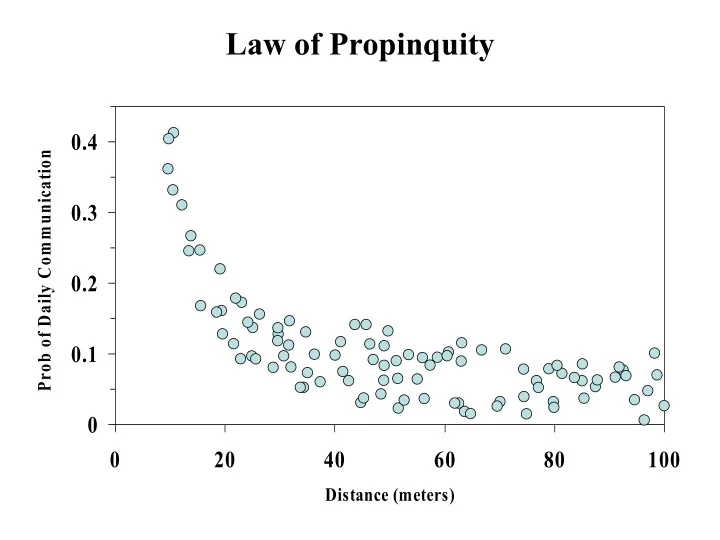
Law of Propinquity 0.4 Prob of Daily Communication 0.3 0.2 0.1 - - PowerPoint PPT Presentation

law of propinquity
SMART_READER_LITE
LIVE PREVIEW

Law of Propinquity 0.4 Prob of Daily Communication 0.3 0.2 0.1 - - PowerPoint PPT Presentation

Law of Propinquity 0.4 Prob of Daily Communication 0.3 0.2 0.1 0 0 20 40 60 80 100 Distance (meters) Gender Sharing Confidential Matters: Male Female Male 1245 748 Female 970 1515 Race Race White Black Hispanic Other


slide-1
SLIDE 1

Law of Propinquity

0.1 0.2 0.3 0.4 20 40 60 80 100

Distance (meters) Prob of Daily Communication
slide-2
SLIDE 2

Gender

Sharing Confidential Matters:

1515 970 Female 748 1245 Male Female Male

slide-3
SLIDE 3

Race

34 3 5 21 Other 1 120 6 66 Hispanic 3 4 283 40 Black 20 30 29 3806 White Other Hispanic Black White Race

slide-4
SLIDE 4

Religion

37 4 1 11 27 Other 14 131 12 66 92 None 1 5 68 7 13 Jewish 13 41 24 790 241 Catholic 30 83 22 305 2129 Protestant Other None Jewish Catholic Protestant Religion

slide-5
SLIDE 5

Age

387 212 138 127 34 60 + 108 210 121 100 84 50 - 59 70 84 246 170 88 40 - 49 106 128 171 501 191 30 - 39 56 155 183 186 567 < 30 60 + 50 - 59 40 - 49 30 - 39 < 30 Age

slide-6
SLIDE 6

Kinds of Homophily

  • Choice-based

– Preference for one’s own kind

  • Opportunistic

– Can only interact with those that are available for interaction – Demography – relative population sizes – Organizational & Event Foci

slide-7
SLIDE 7

SocioDemographic Space

slide-8
SLIDE 8

Organizations in Socio-Demographic Space

slide-9
SLIDE 9

Some Propositions

  • Rate of joining new groups increases with the

size of individual’s ego network

  • Network ties to members increase duration of

membership

– Ties to non-members decrease duration of membership

  • Similarity increases strength of tie

– Dissimilar members more likely to leave – Majority will often experience minorities as unstable

slide-10
SLIDE 10

Ties Between Groups

slide-11
SLIDE 11

Simple Answers

Who you ask for answers to straightforward questions.

Recent acquisition Older acquisitions Original company

HR Dept

  • f Large

Health Care Organization Data drawn from Cross, Borgatti & Parker 2001.

slide-12
SLIDE 12

Problem Reformulation

Who you see to help you think through issues

Recent acquisition Older acquisitions Original company

Data drawn from Cross, Borgatti & Parker 2001.

slide-13
SLIDE 13

The Natural Organization

slide-14
SLIDE 14

The Optimal Organization

slide-15
SLIDE 15

The Experiment - Setup

  • Weekend class exercise
  • Class divided into two independent organizations

– Each subdivided into 4 departments, with some interdependencies

  • A measure of overall performance which included

financial performance, efficiency, and some human resource metrics

  • Staffing was controlled by the experimentor

– “natural org” placed friends together within departments – “optimal org” separated friends as much as possible (high E-I value)

  • As they went along, the experimenter introduced
  • rganizational crises, such as imposing layoffs
slide-16
SLIDE 16

Experimental Results

‘Natural’ ‘Optimal’

140 120 100 80 60 40 20

6 trials at 3 universities. Results shown for most dramatic trial only.

slide-17
SLIDE 17

Why?

  • In crisis, the organization needs to pull together*

across departments

  • But when you have few close ties across

departments

– The tendency is opposite – start retrenching, pointing fingers

  • When you have lots a friends across

departments,

– you trust them not to screw you, and – you are more inquiring and willing to share needed information than blaming and hoarding