Latest EU policy developments - in particular the EPBD recast - - PDF document

latest eu policy developments in particular the epbd
SMART_READER_LITE
LIVE PREVIEW

Latest EU policy developments - in particular the EPBD recast - - PDF document

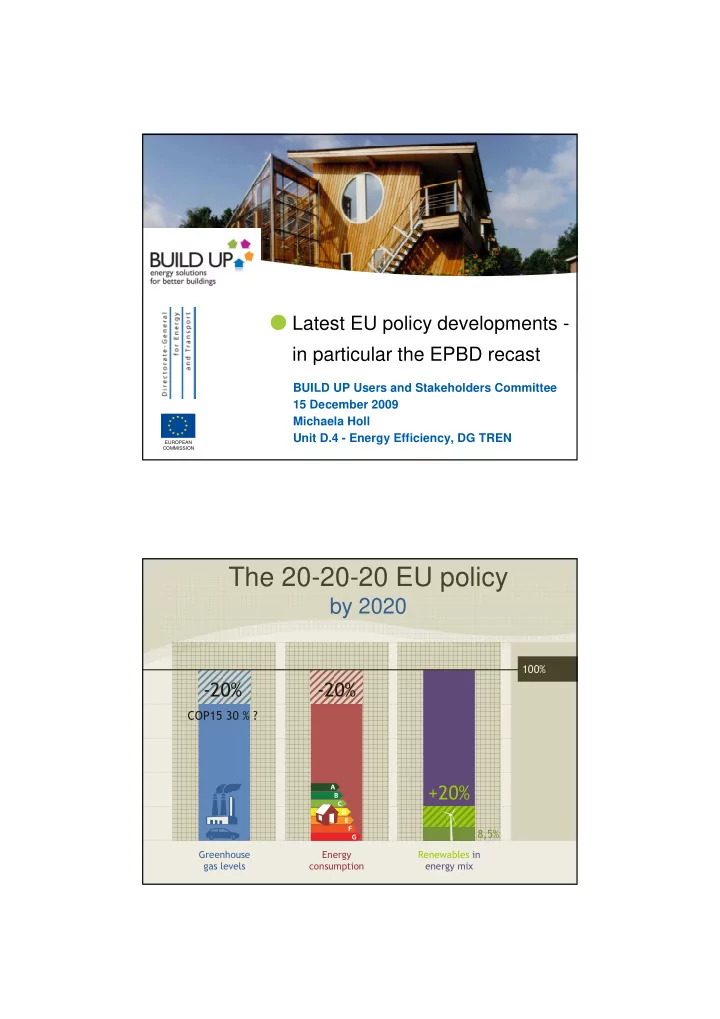
Latest EU policy developments - in particular the EPBD recast BUILD UP Users and Stakeholders Committee 15 December 2009 Michaela Holl Unit D.4 - Energy Efficiency, DG TREN EUROPEAN 1 COMMISSION The 20-20-20 EU policy by 2020


slide-1
SLIDE 1

1

BUILD UP Users and Stakeholders Committee 15 December 2009 Michaela Holl Unit D.4 - Energy Efficiency, DG TREN

  • EUROPEAN

COMMISSION

Latest EU policy developments - in particular the EPBD recast

The 20-20-20 EU policy

by 2020

  • !"#
  • $

%&!

slide-2
SLIDE 2

3

Recent developments at EU level

  • May 09: IPEEC (International Partnership for Energy

Efficiency Cooperation) established Oct 09: Communication on financing of low energy technologies (including the Smart Cities Initiative) Nov 09: Political agreements on EPBD recast, energy labelling, and labelling of tyres under SE Presidency Nov 09: Covenant of Mayors has 1000 participating cities Dec 09: Lisbon Treaty entered into force, new Commissioner for Energy nominated

4

Energy Performance of Buildings Directive (EPBD)

  • The original 2002/91/EC Directive offers holistic approach

towards more energy efficient buildings

  • Member States are in charge of:

A methodology to calculate and rate the energy performance of buildings Set Minimum energy performance levels for new and existing buildings (useful floor area > 1000 m²) that undergo major renovation Energy performance certificates Regular inspections of heating and air-conditioning systems

slide-3
SLIDE 3

5

EPBD developments up to now – timeline

  • 16 Dec 2002: Publication of the EPBD

13 Dec 2008: Com adopts the proposal for EPBD recast 17 Nov 2009: Trialogue agreement on EPBD recast 1 Dec 2009: Entry into force of Lisbon Treaty 7 Dec 2009: Energy Council is informed about the agreement Ongoing: negotiations between Commission, EP and Council on adjustments to new Lisbon Treaty (legal basis and new comitology rules)

6

EPBD recast

  • scope -
  • Elimination of the 1000 m2 threshold for existing buildings → minimum

energy performance requirements for all new and existing buildings undergoing a major renovation (25 % of building surface or value)

  • MS also to set minimum energy performance requirements for

technical building systems (large ventilation, AC, heating, lighting, cooling, hot water) for new built and replacement

  • → Eco-Design Directive regulates placing of products on the market,

EPBD their energy efficient assembling to technical systems

  • MS to set minimum energy performance requirements for renovation
  • f building elements (roof, wall, etc.) if technically, functionally and

economically feasible

slide-4
SLIDE 4

7

EPBD recast:

  • cost optimal requirements -
  • New element in recast: benchmarking methodology framework

for calculating cost-optimal levels of minimum requirements to be developed by the Commission by 30 June 2011

  • Cost-optimal level = minimised lifecycle cost (including

investment costs, maintenance and operating costs, energy costs, earnings from energy produced and disposal costs)

  • Benchmarking methodology shall help MS in setting their

requirements, recent EPBD Annex sets basic features

  • In case of >15 % gap between cost-optimal and the actual

national standard → MS to justify the gap or plan measures to reduce it

8

  • 50
  • 40
  • 30
  • 20
  • 10

10 20 30 40 50 Cost Ambition of energy performance requirements (thickness of insulation and/or efficiency of heating system/air-conditioning system/lighting etc.) Investment + maintenance costs Energy cost saving Net cost* Cost-optimal Cost-effective * = sum of (Investment + maintenance costs) and (Energy cost saving)
slide-5
SLIDE 5

9

EPBD recast:

  • certificates -
  • Better visibility and quality of information provided by Energy

Performance Certificates: mandatory use of the energy performance indicator in advertisements; recommendations on how to improve cost-

  • ptimally/cost-effectively the energy performance, can also include

indication on where to obtain information about financing possibilities

  • Certificates to be issued to all new buildings/building units and when

existing buildings/building units are rented/sold

  • Public authorities occupying office space of > 500m² will have to display

the certificate (lowered to > 250m² after 5 years)

  • Commission to develop a voluntary common European certification

scheme by 2011

10

EPBD recast – What shall e.g. happen?

Energy Class D

Energy Class D

Energy Performance Certificate

slide-6
SLIDE 6

11

EPBD recast:

  • inspections and independent control -
  • MS to establish regular inspection of accessible parts of

heating system (> 20kW) and of AC system (> 12kW)

  • Inspection reports issued after each inspection (includes recom-

mendations for efficiency improvement) and handed over to

  • wner or tenant
  • Certificates and inspection to be carried out by independent

and qualified and/or accredited experts

  • MS to set up independent control system with random

verification of certificates and inspections reports

  • MS to establish penalties for non-compliance

12

EPBD recast:

  • new built -
  • Requirement to consider alternative systems for new buildings

(such as RES, district heating and cooling, CHP….)

  • All new buildings in the EU as from December 2020 (2018 for

public buildings) will have to be nearly zero energy buildings

  • the nearly zero or very low amount of energy required should

to a very significant level be covered by energy from renewable source

slide-7
SLIDE 7

13

EPBD recast:

  • existing buildings -
  • MS to set Minimum energy performance requirements for

renovation of technical systems, as well as for building elements (roof, wall, etc.) if technically, functionally and economically feasible

  • MS to take measures, such as targets, to stimulate the

transformation of buildings that are refurbished into nearly zero energy buildings

14

EPBD recast:

  • financing -
  • EPBD recast underlines crucial role of financing for EE
  • MS to draw up lists of national (financial) measures by 30 June

2011

  • COM to present, preferably by 2011, analysis of the

effectiveness and appropriateness of the level of EU level and

  • ther public finance institution’s funding and their coordination
  • COM to assist MS in setting up national/regional support

programmes

  • MS to take into account cost-optimal levels of energy

performances in funding decisions

slide-8
SLIDE 8

15

EPBD recast:

  • information requirements -
  • MS to ensure information for owners and tenants on EE

saving measures, including where appropriate on financial support instruments available

  • MS to ensure that guidance and training is made available

for those responsible implementing the Directive

  • COM invited to reinforce information services including the

BUILD UP website. Commission e.g. invited to provide information on Community and IFI funding, best practice examples etc.

  • 16

EPBD - next steps

  • Council and EP vote on final agreement

+ 20 days: Publication of the final text = entry into force + 2 years : MS have to finalise transposition + 2,5 to 3 years: implementation By 2011: Com to have developed the cost-optimal comparative methodology framework, the voluntary labelling scheme and possibly also an analysis on effectiveness of EU level and IFI funds

slide-9
SLIDE 9

17

EPBD recast - expected impacts

  • 5 - 6 % saving of EU's total energy consumption by 2020
  • 5 % saving of EU's total CO2 emissions by 2020
  • 280,000 – 450,000 potential new jobs
  • Low / zero, predominantly negative CO2 abatement

costs

18

Better use of support measures and networks

IEE programme project funding (EACI) FP 7 projects

  • incl. CONCERTO

Measures & programmes Covenant

  • f Mayors

Sustainable Energy Europe Campaign ManagEnergy network Networks EPBD implementation support

Concerted action EPBD CEN EPBD standards SET Plan – Smart Cities

slide-10
SLIDE 10

19

EU Building Sector

  • EU 27

in total energy-use CO2 emissions EU building sector 40% 36%

9% of total EU 27 GDP 8% of total employment €2 trillion annual turnover

… concerns everybody

20

…reviewed Energy Efficiency Action Plan And soon…