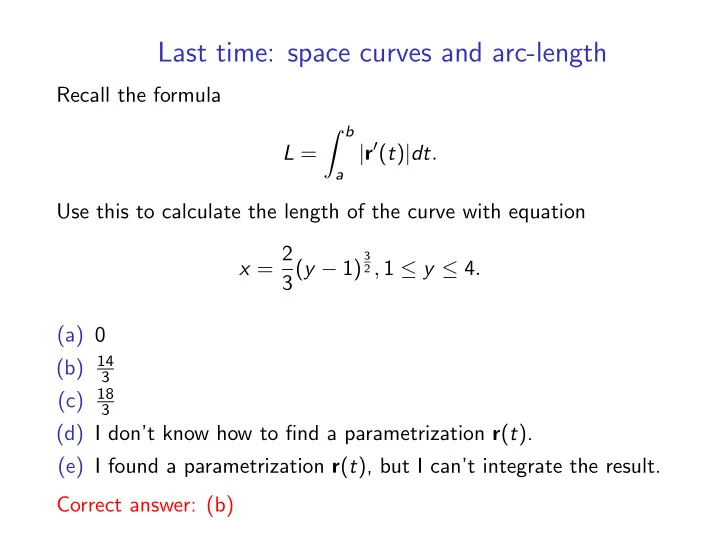
SLIDE 1 Last time: space curves and arc-length
Recall the formula L = ∫︂ b
a
|r′(t)|dt. Use this to calculate the length of the curve with equation x = 2 3(y − 1)
3 2 , 1 ≤ y ≤ 4.
(a) 0 (b)
14 3
(c)
18 3
(d) I don’t know how to find a parametrization r(t). (e) I found a parametrization r(t), but I can’t integrate the result. Correct answer: (b)
SLIDE 2
Cycloid
Tautochrone (“same time”) Brachistochrone (“shortest time”)
SLIDE 3
Integration in one variable
Fix g : [a, b] → R.
∙ Divide [a, b] into n subintervals [xi−1, xi] of equal length
∆x = b−a
n .
∙ For each i choose any x*
i ∈ [xi−1, xi].
∫︂ b
a
g(x)dx = lim
n→∞ n
∑︂
i=1
g(x*
i )∆x
(assuming the limit exists and is independent of the choices of x*
i ).
SLIDE 4 Geometric interpretation of integration
∙ ∫︁ b
a g(x)dx = (b − a) × (average value of g on [a, b]).
∙ If g ≥ 0,
∫︁ b
a g(x)dx gives the area under the graph of g over
the interval [a, b].
∙ If g(x) is the linear density of a straight piece of wire with
endpoints a and b, then ∫︁ b
a g(x)dx calculates the total mass
∙ Furthermore, the point x ∈ [a, b] corresponding to the centre
- f mass of the wire is given by
x = ∫︁ b
a xg(x)dx
∫︁ b
a g(x)dx
SLIDE 5
Practice with integration
Let C be the semicircle given by x2 + y2 = 1, y ≥ 0, and consider f (x, y) = y. Calculate ∫︁
C fds, using the parametrization r(t) = ⟨cos t, sin t⟩,
t ∈ [0, π]. (a) 1 (b) −1 (c) 0 (d) 2 (e) I don’t know how. Correct answer: (d)
SLIDE 6 Studying a wire
Suppose we have a wire bent in the shape of the semicircle C given by x2 + y2 = 1, y ≥ 0. Assume the wire has constant linear density ρ. Use geometric intuition to guess the centre of mass from the
(a) (0, 0) (b) (0, 1) (c) (1, 1) (d) ( 2
π, 2 π)
(e) (0, 2
π)
Correct answer: (a)