LANGUAGE PROGRAMS: PREPARING STUDENTS FOR THE REAL WORLD Shuhan C. - - PowerPoint PPT Presentation

language programs preparing
SMART_READER_LITE
LIVE PREVIEW

LANGUAGE PROGRAMS: PREPARING STUDENTS FOR THE REAL WORLD Shuhan C. - - PowerPoint PPT Presentation

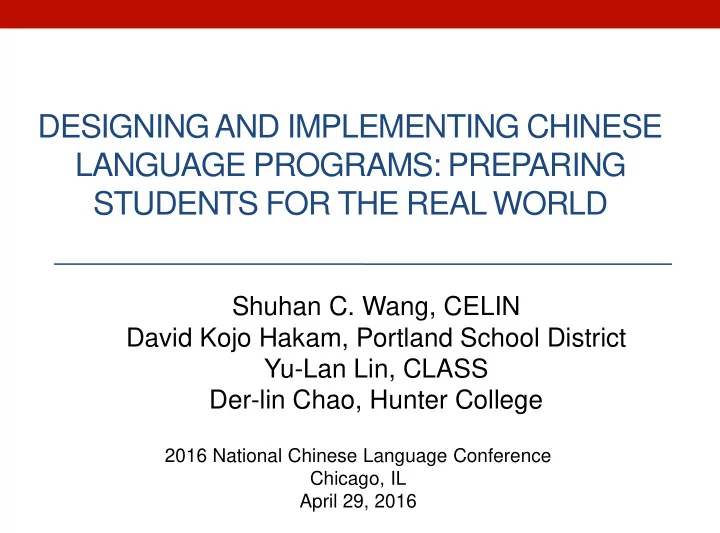
DESIGNING AND IMPLEMENTING CHINESE LANGUAGE PROGRAMS: PREPARING STUDENTS FOR THE REAL WORLD Shuhan C. Wang, CELIN David Kojo Hakam, Portland School District Yu-Lan Lin, CLASS Der-lin Chao, Hunter College 2016 National Chinese Language


slide-1
SLIDE 1

DESIGNING AND IMPLEMENTING CHINESE LANGUAGE PROGRAMS: PREPARING STUDENTS FOR THE REAL WORLD

Shuhan C. Wang, CELIN David Kojo Hakam, Portland School District Yu-Lan Lin, CLASS Der-lin Chao, Hunter College

2016 National Chinese Language Conference Chicago, IL April 29, 2016

slide-2
SLIDE 2

CELIN: Chinese Early Language and Immersion Network

2

CELIN seeks to connect with and provide resources for language practitioners, researchers, policy makers, parents, and advocates for language learning across the United States. Staff: Project director: Shuhan C. Wang, Ph.D. Senior Project Associate: Joy Peyton, Ph.D. We are affiliated with and supported by China Learning Initiatives at Asia Society, which has a strong track record in leading and supporting the Chinese language field.

slide-3
SLIDE 3

CELIN BRIEFS

Discussion of ways to develop students’ literacy and global competency through learning of Chinese language and culture

slide-4
SLIDE 4

Purposes:

  • Respond to an urgent need in the field of Chinese language

education for research-based information; examples of best practices; and resources for administrators, teachers, and parents

  • Address different aspects of Chinese language education;

available in English and Chinese; applicable to elementary (K−8), middle, and high school, and even college Chinese language programs

slide-5
SLIDE 5

5

Authors: Der-lin Chao Yu-Lan Lin David Kojo Hakam Editors: Shuhan C. Wang Joy K. Peyton

slide-6
SLIDE 6

Global Competency for the Real World

  • Advanced language &

cultural competency in Chinese is increasingly important

  • Critical need for bilingual

professionals in all fields

  • Critical need for 21st

century skills in problem solving, critical thinking, global competency

slide-7
SLIDE 7

Global Competency in the Classroom

  • Investigate the world

beyond the immediate environment

  • Recognize multiple

perspectives

  • Bridge geographic,

linguistic, ideological, and cultural barriers

  • Take action to improve

conditions

slide-8
SLIDE 8

Student-Centered and Experiential Learning

I hear and I forget. I see and I remember. I do and I understand.

  • Confucius
slide-9
SLIDE 9

Student-Centered and Experiential Learning

Why?

  • Chinese programs need to be inclusive of students from

diverse backgrounds

  • Curriculum and instruction must be aligned with the

needs and realities of students

  • Impact must be measured by student progress
  • Traditional textbook-/teacher-centered programs do not

serve students well

  • Learning must be personally meaningful
  • Expected outcomes cannot be divorced from real-world

experiences

slide-10
SLIDE 10

Experiential Learning: Benefits

  • Emphasis on “learning by doing”
  • Provides rich opportunities for improving skills
  • Increases motivation
  • Helps students become independent learners
  • Brings the classroom alive
  • Prepares students for real-world language use
  • Builds cross-cultural understanding and

friendships

slide-11
SLIDE 11

Experiential Learning: What the Research Says … Students who have the opportunity to be immersed in Chinese language, culture, and society both in and out of the classroom typically have significantly better short-term and long-term appreciation for the target language and culture.

(Xu, Padilla, Silva, & Masuda, 2013)

slide-12
SLIDE 12

The Hosford Middle School Experience

  • Two-week residency in Suzhou area
  • Maximizes language skills and cultural competency
  • Homestay, small-group field studies, research projects
  • Community service
  • Reflection
  • Capstone

Video: China Research Residency, Suzhou, China

slide-13
SLIDE 13

Standards-Based Curriculum

I.

World-Readiness Standards for Learning Languages 5 Goals

  • Communication
  • Culture
  • Connections
  • Comparisons
  • Communities
slide-14
SLIDE 14

Standards-Based Curriculum

  • II. Common Core State Standards
  • K-12 benchmarks for reading skills
  • K-12 benchmarks for writing skills
  • III. 21st Century Skills
  • Life and Career Skills
  • Learning and Innovation Skills
  • Technology Skills

14

slide-15
SLIDE 15

Integration of Language, Subject Matter, and Culture

  • Constant integration of culture and content
  • Use of
  • A variety of authentic materials
  • Print and non-print materials
  • Auditory materials
  • Digital multimedia materials
  • Age- and level-appropriate materials

15

slide-16
SLIDE 16

Performance-Based Assessment

  • Conduct ongoing assessment
  • Avoid paper-pencil tests
  • Refer to ACTFL Can-Do statements

(https://www.actfl.org/sites/default/files/pdfs/Can- Do_Statements.pdf)

  • Assess various dimensions
  • Use scoring rubrics
  • Provide ongoing feedback

16

slide-17
SLIDE 17

Best Practices in Instruction

  • End goals are clearly set
  • Content is organized into thematic units
  • Instruction is student-centered
  • Language input and output are comprehensible
  • 90% or higher of language used is the target language
  • Language is used both inside and outside the classroom
slide-18
SLIDE 18

Best Practices Ensure Best Learning Experiences

  • Age- and level-appropriate

real-world materials and tasks

  • Learner-centered

instruction with emphasis

  • n comprehensible

language input and ample language output at the target proficiency level

  • Individualized instruction

and group collaborative learning for problem solving and critical thinking

18

slide-19
SLIDE 19

Language Learning for Sustaining Lifelong Engagement

Real-world communications in rich cultural contexts for young learners Develop lifelong language and cultural proficiency and appreciation

19

slide-20
SLIDE 20

Teachers Who Make Change and Lead

1.昨夜西风凋碧树。独上高楼,望尽天涯路。 Westerly winds withered the trees last night. Alone, climbing up the stairs, I looked out over the endless distance. 2.衣带渐宽终不悔,为伊消得人憔悴。 My clothes loosen gradually for I am becoming thin; yet I have no regrets, I languish for her. 3.蓦然回首,那人却在灯火阑珊处。 Suddenly I turned my head, and I found her where the lantern light is dimly shed.

20

slide-21
SLIDE 21

WE HOPE YOU WILL JOIN US!

slide-22
SLIDE 22

Questions? Comments?

David Kojo Hakam, 韩天衡 dhakam@pps.net Yulan Lin, 林游岚 yulanlin49@gmail.com Der-lin Chao, 赵德麟 cderlin@hotmail.com Shuhan C. Wang, PhD 王周淑涵, shuhancw@gmail.com

22

谢谢! Thank you!

slide-23
SLIDE 23

Find CELIN Briefs at: http://AsiaSociety.org/CELIN Please send suggestions and comments to CELIN Briefs Editors: Shuhan C. Wang, Ph.D., shuhancw@gmail.com Joy K. Peyton, Ph.D., joy@peytons.us