landing obligation 10:45 Coffee break - Focus Group 11:00 PELAC - - PDF document

landing obligation
SMART_READER_LITE
LIVE PREVIEW

landing obligation 10:45 Coffee break - Focus Group 11:00 PELAC - - PDF document

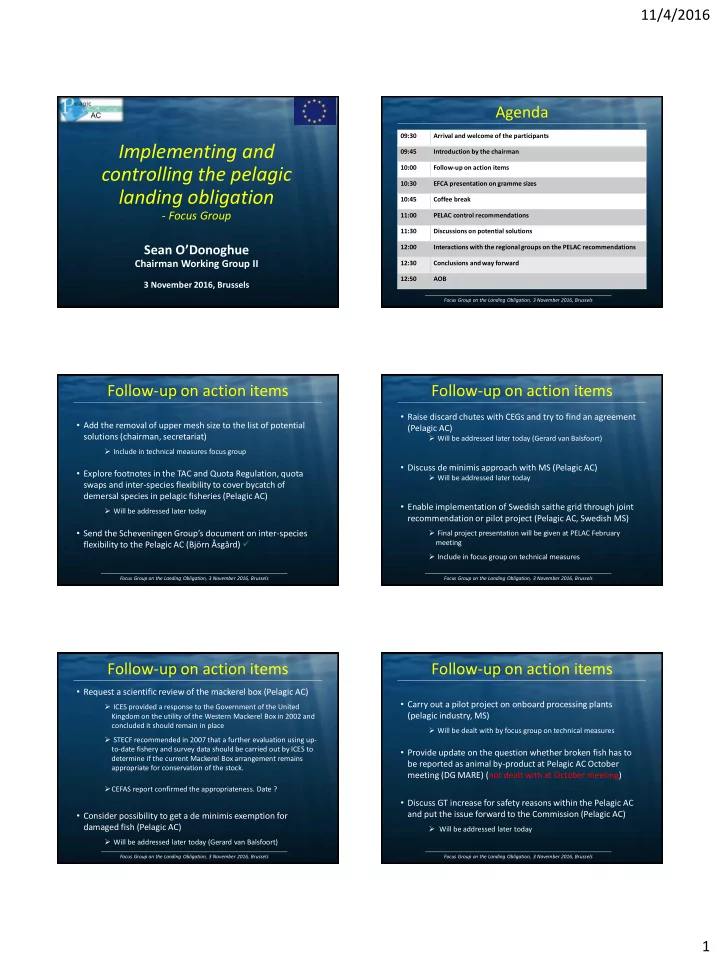
11/4/2016 Agenda 09:30 Arrival and welcome of the participants Implementing and 09:45 Introduction by the chairman controlling the pelagic 10:00 Follow-up on action items 10:30 EFCA presentation on gramme sizes landing obligation 10:45


slide-1
SLIDE 1

11/4/2016 1

Implementing and controlling the pelagic landing obligation

  • Focus Group

Sean O’Donoghue

Chairman Working Group II

3 November 2016, Brussels

Focus Group on the Landing Obligation, 3 November 2016, Brussels

Agenda

09:30 Arrival and welcome of the participants 09:45 Introduction by the chairman 10:00 Follow-up on action items 10:30 EFCA presentation on gramme sizes 10:45 Coffee break 11:00 PELAC control recommendations 11:30 Discussions on potential solutions 12:00 Interactions with the regional groups on the PELAC recommendations 12:30 Conclusions and way forward 12:50 AOB

Follow-up on action items

  • Add the removal of upper mesh size to the list of potential

solutions (chairman, secretariat)

  • Include in technical measures focus group
  • Explore footnotes in the TAC and Quota Regulation, quota

swaps and inter-species flexibility to cover bycatch of demersal species in pelagic fisheries (Pelagic AC)

  • Will be addressed later today
  • Send the Scheveningen Group’s document on inter-species

flexibility to the Pelagic AC (Björn Åsgård) 

Focus Group on the Landing Obligation, 3 November 2016, Brussels

Follow-up on action items

  • Raise discard chutes with CEGs and try to find an agreement

(Pelagic AC)

  • Will be addressed later today (Gerard van Balsfoort)
  • Discuss de minimis approach with MS (Pelagic AC)
  • Will be addressed later today
  • Enable implementation of Swedish saithe grid through joint

recommendation or pilot project (Pelagic AC, Swedish MS)

  • Final project presentation will be given at PELAC February

meeting

  • Include in focus group on technical measures

Focus Group on the Landing Obligation, 3 November 2016, Brussels

Follow-up on action items

  • Request a scientific review of the mackerel box (Pelagic AC)
  • ICES provided a response to the Government of the United

Kingdom on the utility of the Western Mackerel Box in 2002 and concluded it should remain in place

  • STECF recommended in 2007 that a further evaluation using up-

to-date fishery and survey data should be carried out by ICES to determine if the current Mackerel Box arrangement remains appropriate for conservation of the stock.

  • CEFAS report confirmed the appropriateness. Date ?
  • Consider possibility to get a de minimis exemption for

damaged fish (Pelagic AC)

  • Will be addressed later today (Gerard van Balsfoort)

Focus Group on the Landing Obligation, 3 November 2016, Brussels

Follow-up on action items

  • Carry out a pilot project on onboard processing plants

(pelagic industry, MS)

  • Will be dealt with by focus group on technical measures
  • Provide update on the question whether broken fish has to

be reported as animal by-product at Pelagic AC October meeting (DG MARE) (not dealt with at October meeting)

  • Discuss GT increase for safety reasons within the Pelagic AC

and put the issue forward to the Commission (Pelagic AC)

  • Will be addressed later today

Focus Group on the Landing Obligation, 3 November 2016, Brussels

slide-2
SLIDE 2

11/4/2016 2

Follow-up on action items

  • Provide update on EFCA gramme size project at Pelagic AC

October meeting (EFCA)

  • Will be addressed later today
  • Add non-compliance with the discard-logging obligation to

the problems identified (chairman, secretariat)

  • Will be addressed later today
  • Organise another meeting on implementing the landing
  • bligation in October (chairman, secretariat) 

Focus Group on the Landing Obligation, 3 November 2016, Brussels

EFCA presentation on gramme sizes

Focus Group on the Landing Obligation, 3 November 2016, Brussels

Control recommendations

Focus Group on the Landing Obligation, 3 November 2016, Brussels

Mandatory gramme sizes

  • Mandatory, recorded in the logbook

Focus Group on the Landing Obligation, 3 November 2016, Brussels

Mandatory gramme sizes

  • Mandatory, recorded in the logbook
  • Real-time

Focus Group on the Landing Obligation, 3 November 2016, Brussels

Mandatory gramme sizes

  • Mandatory, recorded in the logbook
  • Real-time
  • Vessels are already recording the information

for market purpose

Focus Group on the Landing Obligation, 3 November 2016, Brussels

slide-3
SLIDE 3

11/4/2016 3

Mandatory gramme sizes

  • Mandatory, recorded in the logbook
  • Real-time
  • Vessels are already recording the information

for market purpose

  • Excellent tool to identify high risk vessels

Focus Group on the Landing Obligation, 3 November 2016, Brussels

Mandatory gramme sizes

  • Mandatory, recorded in the logbook
  • Real-time
  • Vessels are already recording the information

for market purpose

  • Excellent tool to identify high risk vessels
  • Additional controls, e.g. CCTV, observers,

VMS, ERS and others on high risk vessels

Focus Group on the Landing Obligation, 3 November 2016, Brussels

Other recommendations

  • Level-playing field

Focus Group on the Landing Obligation, 3 November 2016, Brussels

Other recommendations

  • Level-playing field
  • Risk evaluation by gear and species rather

than vessel type

Focus Group on the Landing Obligation, 3 November 2016, Brussels

Other recommendations

  • Level-playing field
  • Risk evaluation by gear and species rather

than vessel type

  • One pelagic regional group instead of three or

four separate groups

Focus Group on the Landing Obligation, 3 November 2016, Brussels

Problems and possible solutions

Footnotes in the TAC and quota regulation, quota swaps & inter-species flexibility to cover demersal bycatch

  • Hake bycatch on freezer-trawlers
  • Demersal sector not fond of the idea

Example: Horse mackerel in 4.b-c, 7d:

Without prejudice to the landing obligation, catches of boarfish, whiting and mackerel may be counted against up to 5 % of the quota (OTH/*4BC7D), provided that not more than 9 % in total of this quota for horse mackerel is accounted for by these catches and by-catches of those species that are accounted for under Article 15 (8) of Regulation (EU) No 1380/2013.

Focus Group on the Landing Obligation, 3 November 2016, Brussels

slide-4
SLIDE 4

11/4/2016 4

Problems and possible solutions

Discard chutes

Focus Group on the Landing Obligation, 3 November 2016, Brussels

Problems and possible solutions

De minimis approach

Focus Group on the Landing Obligation, 3 November 2016, Brussels

Problems and possible solutions

Last haul

Example: A skipper has 80 tonnes left to catch (in terms of space in RSW tank), but in the last haul accidentally catches 100

  • tonnes. He cannot pump the last 20 tonnes onboard,

because the tanks are full and there is no other vessel in the vicinity to take onboard the remaining catch. What should he do?

Focus Group on the Landing Obligation, 3 November 2016, Brussels

Problems and possible solutions

De minimis exemption for damaged fish

Focus Group on the Landing Obligation, 3 November 2016, Brussels

Problems and possible solutions

GT recommendation

  • Policy-makers measure fishing capacity through engine power in kW and

gross tonnage (GT)

  • Each MS has a capacity ceiling for its fleet in regards to kW and GT which

must not be exceeded at any time

  • Under the previous CFP there was flexibility to increase GT if the increase

was only due to safety or comfort improvements and did not increase the ability of a vessel to catch fish

  • This flexibility has been repealed
  • The Landing Obligation will lead to storage shortage for unwanted

catches and more trips will be needed for the same amount of catch

  • A vessel cannot improve safety and comfort anymore

Focus Group on the Landing Obligation, 3 November 2016, Brussels

Problems and possible solutions

GT recommendation

  • It is recommended to allow a GT increase for storage space of

unwanted catches or processing equipment for processing unwanted catches

  • It is also recommended that the safety tonnage provisions of

Article 11.5 of Council Regulation (EC) 2372/2002 will be re- instated

Focus Group on the Landing Obligation, 3 November 2016, Brussels

slide-5
SLIDE 5

11/4/2016 5

Problems and potential solutions

Non-compliance with the discard-logging requirement:

  • Dichotomy of some problems identified and declared as

non-existent, i.e. not having been logged, prior to the LO

  • E.g.: horse mackerel falling off processing belt have not

been reported prior to the LO as discards nor stored as ABP

  • E.g.: unintended demersal catches in targeted pelagic

fisheries have not been logged and landed prior to the LO; were they discarded, but not logged?

  • Why should MS grant exemptions if those discards have not been

logged in the past and are declared to rarely happen now?

Focus Group on the Landing Obligation, 3 November 2016, Brussels

  • The Pelagic AC asked the Commission to arrange

a meeting with the regional groups and act as facilitator

  • Status of the request?

Interaction with the regional groups

Focus Group on the Landing Obligation, 3 November 2016, Brussels

Thanks for your participation

Focus Group on the Landing Obligation, 3 November 2016, Brussels