L U B N A Q U R E S H I D I E T E T I C I N T E R N , U T H S C S - - PowerPoint PPT Presentation

l u b n a q u r e s h i d i e t e t i c i n t e r n u t h
SMART_READER_LITE
LIVE PREVIEW

L U B N A Q U R E S H I D I E T E T I C I N T E R N , U T H S C S - - PowerPoint PPT Presentation

Growth Hormone Treatment in Prader-Willi Syndrome L U B N A Q U R E S H I D I E T E T I C I N T E R N , U T H S C S A N T D T 5 3 4 0 Photo source: http://www.clpmag.com/news /18982-a-ceaseless-hunger- the-prader-willi-syndrome


slide-1
SLIDE 1

L U B N A Q U R E S H I D I E T E T I C I N T E R N , U T H S C S A N T D T 5 3 4 0

Growth Hormone Treatment in Prader-Willi Syndrome

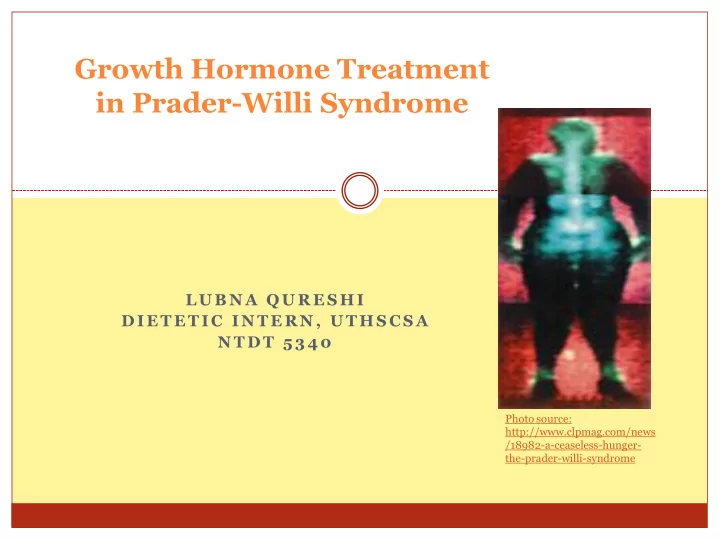
Photo source: http://www.clpmag.com/news /18982-a-ceaseless-hunger- the-prader-willi-syndrome
slide-2
SLIDE 2

Objectives

 Explore the metabolic effects of Growth

Hormone (GH) on Prader-WillI syndrome(PWS)

 Identify possible causes and sign/symptoms

  • f PWS

 Evaluate the current research on the

effectiveness of GH

 Analyze the administration of GH as a

treatment option for PWS

slide-3
SLIDE 3

Introduction

 Initially described by Prader, Willi and

Labhart in 1956.1

 Prader-Willi syndrome (PWS) is a

congenital disease

 Effects one in 10,000 to 15,000 children.2

slide-4
SLIDE 4

Signs

 Early Failure To Thrive(FTT)  Hypotonia  Poor sucking  Almond-shaped eyes,  Narrow bi-frontal skull  Scoliosis  Small hands and feet in comparison to child's body  Increased fat mass  Hypogonadism  Short stature3

Photo source : http://www.aafp.org/afp/2005/0901/p827.html

slide-5
SLIDE 5

Symptoms

 Delayed motor development skills  Compromised respiratory function  Intense craving for food and hyperphagia  Uncontrollable weight gain  Abnormal body composition  Reduced muscle tone and lean body mass  Morbid obesity

slide-6
SLIDE 6

Symptoms

 Decreased Growth Hormone (GH)  Decreased IGF-I secretion  Diminished bone mineral density  Reduced mental ability  Sleep disorder  Temperature instability

slide-7
SLIDE 7

Main Causes of Genetic Defect

Lack of genetic expression on

chromosome 15q11-q13

Deletion Maternal disomy Translocation

Photo Source: http://www.clpmag.com/news/18982-a- ceaseless-hunger-the-prader-willi-syndrome

slide-8
SLIDE 8

Growth Hormone (GH)

An approved medication by Food and Drug Administration for long term treatment of children with growth failure due to PWS in the United States.6

Photo Source: http://en.wikipedia.org/wiki/Growth_hormone

slide-9
SLIDE 9

Growth Hormone (GH)5

 Produced by the pituitary gland  Fuels childhood growth  Helps maintain tissues and organs system  Stimulates production of insulin-like growth factor I

(IGF-I)

 Glucose sparing effect  Protein synthesis  Lipolysis

Photo Source: http://www.umm.edu/presentations/100146.htm

slide-10
SLIDE 10

The Early Treatment Cohort Study

Objective: To compare similar aged children who have or have not received long term GH treatment in

  • rder to assess the impact of GH therapy begun

early in life Population: 48 children

  • 21 children, (6 to 9 years) treated with 1mg/m2/d
  • 27 children (5-9 years) prior to treatment

Methods: Comparisons were made for percent body fat, lean body mass, carbohydrate/lipid metabolism, and motor strength

slide-11
SLIDE 11

The Early Treatment Cohort Study

Results: children treated with GH early in life 8.5% body fat 31mg/dl lower LDL 14mg/dl higher HDL 16 cm in height Conclusion: GH treatment begun prior to 2 years of age, improves body composition, motor function, height, and lipid profiles.1

slide-12
SLIDE 12

The Dutch Multicenter Prospective Trial4

 Objective: To investigate the effects of long term

treatment on body composition

 Population: 55 pre-pubertal children, age 5.9 years  Method: Children received a dose of 0.5mg/m2/d  Dose adjustment  Maximum dose 1mg/m2/d  Dietary counseling  Continuous physical therapy

slide-13
SLIDE 13

The Dutch Multicenter Prospective Trial

Results Fat %, LDL cholesterol, BMI LBM, height , head circumference No significant change

Total cholesterol, HDL , blood pressure, hand and foot length, arm span, insulin dependent Diabetes Mellitus. Conclusion: Long term administration of a standard dose of 1mg/m2/d has beneficial effects specially on height if administered several years before puberty.

slide-14
SLIDE 14

A Retrospective Study in France8

Objective: Compared changes in serum IGF-I, IGF binding protein 3 (IGFBP-3), IGF-I to IGFBP-3 molar ratio and growth velocity Population: 33 children with PWS and 591 with GH deficiency (GHD) Method:

 Mean initial dose 0.9 and 1 mg/m2/d in the PWS and

GHD groups, respectively.

 Serum IGF-I and IGFBP-3 measured at 0, 6, 12, and 24

months

slide-15
SLIDE 15

A Retrospective Study in France

Results: Serum IGF-I and IGFBP-3 in the PWS group Conclusion: Positive association between higher growth velocity and sensitivity to GH in PWS children

slide-16
SLIDE 16

US Adult Prader-Willi Syndrome Study6

Objective: Evaluate the effectiveness and safety of GH in adults Population: 30 adults between the ages of 17 and 49 years. Method: 12 month open label multicenter trial

 6 months dose optimization period-dose of 0.2mg/d  6 months stable treatment periods  Constant mean does of 0.6mg/d  Dose adjustment for water retention and edema  Qualitative data -physical strength

slide-17
SLIDE 17

US Adult Prader-Willi Syndrome Study

Results: %fat ~43 to 40 LBM T3

No significant change

HbA1c Normal fasting BG

TSH

Conclusion:

GH treatment has beneficial effects on percent fat and LBM and it normalizes IGF-I without glucose impairment.6

slide-18
SLIDE 18

The Scandinavian Multicenter Placebo Control, Double Blind Trial

Objective To explore the effects of one year GH treatment on different fat compositions and LBM Population 46 Adults (16-50 years) Method

 0.3 or 0.4 mg/d for initial 4 weeks phase  0.6 or 0.8mg/d for the next 11 months  Consistent caloric intake and exercise 2

slide-19
SLIDE 19

Results:

Subcutaneous & visceral

fat Total fat LDL cholesterol IGF-I level LBM

No significant change Total cholesterol HDL TG

fasting glucose/ insulin BMI

Conclusion:

GH treatment for 12 months can decrease total and regional fat mass and improve LBM in adults.2

The Scandinavian Multicenter Placebo Control, Double Blind Trial

slide-20
SLIDE 20

Bottom Line

 Diet and lifestyle modification  Strict physical activity regimen  Length of treatment----Short term studies as

compared with the long term studies

slide-21
SLIDE 21

Bottom Line

 Treatment dosage  Assess if the benefits outweigh the side effects  PWS is a relatively young disease with not

enough data

slide-22
SLIDE 22

Q

slide-23
SLIDE 23

References:

1.

Aaron L. Carrel, Susan E. Myers, Barbara Y. Whitman, Jens Eickhoff and David B. Allen, Long-Term Growth Hormone Therapy Changes the Natural History of Body Composition and Motor Function in Children with Prader-Willi Syndrome. The Journal of Clinical Endocrinology & Metabolism2010; Vol. 95, No. 3 1131-1136

2.

Sode-Carlsen R, Farholt S, Rabben KF, Bollerslev J, Schreiner T, Jurik AG, Christiansen JS, Höybye C, One year of growth hormone treatment in adults with Prader-Willi syndrome improves body composition: results from a randomized, placebo-controlled study; J Clin Endocrinol Metab. 2010 Nov; 95(11):4943-50. Epub 2010 Aug 11.

3.

Prader-Willi syndrome Genetic Home reference, Reviewed: October 2011, Published: December 2, 2012. National Institute of Health, - retreived Nov 23rd from http://ghr.nlm.nih.gov/condition/prader-willi-syndrome

4.

De Lind van Wijngaarden RF, Siemensma EP, Festen DA, Otten BJ, van Mil EG, Rotteveel J, Odink RJ, Bindels-de Heus GC, van Leeuwen M, Haring DA, Bocca G, Houdijk EC, Hoorweg-Nijman JJ, Vreuls RC, Jira PE, van Trotsenburg AS, Bakker B, Schroor EJ, Pilon JW, Wit JM, Drop SL, Hokken-Koelega AC, Efficacy and safety of long- term continuous growth hormone treatment in children with Prader-Willi syndrome. J Clin Endocrinol Metab. 2009 Nov;94(11):4205-15. Epub 2009 Oct 16.

5.

Nelms Marcia, Sucher Kathryn, Lacey Karen, Roth, Sara Long, Nutrition Therapy and Pathphysiology.(2nd Edition, p 473t,480t) 2011 Wadsworth, Cengage Learning

slide-24
SLIDE 24

References:

1.

Mogul HR, Lee PD, Whitman BY, Zipf WB, Frey M, Myers S, Cahan M, Pinyerd B, Southren AL.Growth hormone treatment of adults with Prader-Willi syndrome and growth hormonedeficiency improves lean body mass, fractional body fat, and serum triiodothyronine without glucose impairment: results from the United States multicenter trial. J Clin Endocrinol Metab. 2008 Apr;93(4):1238-45. Epub 2008 Jan 22.

2.

Sode-Carlsen R, Farholt S, Rabben KF, Bollerslev J, Schreiner T, Jurik AG, Frystyk J, Christiansen JS, Höybye C.Growth hormone treatment for two years is safe and effective in adults with Prader-Willi syndrome. Growth Horm IGF Res. 2011 Aug; 21(4):185-90. Epub 2011 Jun 12.

3.

Feigerlová E, Diene G, Oliver I, Gennero I, Salles JP, Arnaud C, Tauber M. Elevated insulin-like growth factor-I values in children with Prader-Willi syndrome compared withgrowth hormone (GH) deficiency children over two years of GH treatment. J Clin Endocrinol Metab. 2010 Oct;95(10):4600-8.