SLIDE 1
SLIDE 2
The qq model in a potential
L
s1 s2
| us > | ds > | us > | ds > Isospin I = ½
SLIDE 3
Isospin = ½ light meson spectrum
| us > | ds > | us > | ds >
Energy = Mass [MeV/c²] Kaon (494) S = 0 S = 1 K* (892) K (1460)
1 2 1
K1 (B) K0*(1430) K2*(1430) K1(A)
L
SLIDE 4
Isospin = ½ light meson spectrum
Energy = Mass [MeV/c²] Kaon (494) S = 0 S = 1 K* (892) K (1460)
L
1 2 1
K1 (B) K0*(1430) K2*(1430) K1(A) And many many more How do we produce those resonances?
SLIDE 5
Diffractive dissociation into Κ− π+ π− R,P ptarget precoil Κ− π+ π− Κ−
X
t'
SLIDE 6
The measurement at COMPASS
SLIDE 7
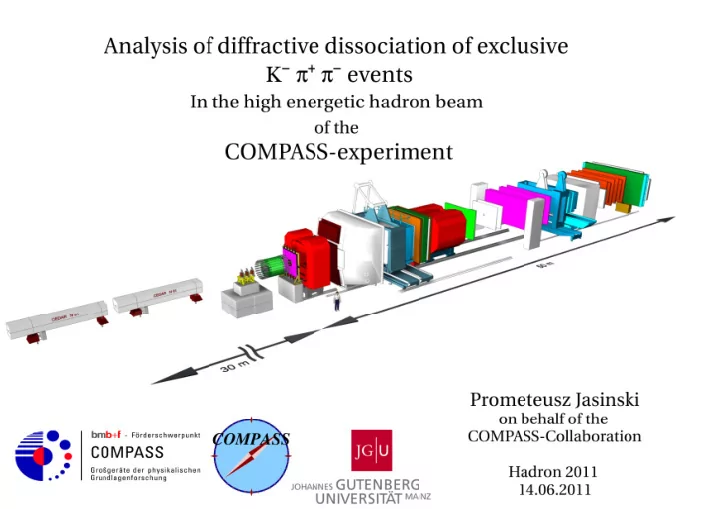
The COMPASS Spectrometer 2008/2009
SLIDE 8 The COMPASS Spectrometer 2008/2009
beam
Beam properties Beam momentum 190 GeV/c Beam composition: π− : Κ− : p = 0.97 : 0.024 : 0.008
Beam properties Beam momentum 190 GeV/c Beam composition: π− : Κ− : p = 0.97 : 0.024 : 0.008
SLIDE 9
The COMPASS Spectrometer 2008/2009
CEDAR detectors for beam particle identification CEDAR detectors for beam particle identification
SLIDE 10 CEDAR particle identification
Cerenkov Differential counter with Achromatic Ring Focus
SLIDE 11
CEDAR particle identification
Difference of the cherenkov ring radii of a pion and a kaon is below 0.1 mm at 190 GeV/c beam momentum !
SLIDE 12
The COMPASS Spectrometer 2008/2009
Recoil proton detector around 40 cm long lH2 target Recoil proton detector around 40 cm long lH2 target
SLIDE 13
The COMPASS Spectrometer 2008/2009
Recoil proton detector around 40 cm long lH2 target Recoil proton detector around 40 cm long lH2 target
SLIDE 14
The COMPASS Spectrometer 2008/2009
RICH RICH
SLIDE 15
The COMPASS Spectrometer 2008/2009
π K p
SLIDE 16
Invariant mass distribution (K- π+ π−)
Are those resonances decaying directly into 3 particles? ...
SLIDE 17
Invariant mass distributions (K- π+) and (π+ π−)
SLIDE 18
RPD: determination of t' slopes
data
SLIDE 19
RPD: determination of t' slopes
data data
SLIDE 20
RPD: determination of t' slopes
data data data fit
SLIDE 21
RPD: determination of t' slopes
data data data fit
SLIDE 22
Determination of acceptance via MC
SLIDE 23
Acceptance in the Κ− π+ π− invariant mass
SLIDE 24
SLIDE 25
Acceptance in the Gottfried Jackson frame
SLIDE 26
Acceptance in the Gottfried Jackson frame
SLIDE 27
Acceptance corrected partial wave analysis
SLIDE 28
Acceptance corrected partial wave analysis
SLIDE 29
The partial wave set
SLIDE 30
The total intensity
SLIDE 31
Spin totals
SLIDE 32
Spin totals
SLIDE 33
JP = 1+ waves
SLIDE 34
JP = 2- waves
SLIDE 35
JP = 2+ waves
SLIDE 36
JP = 0- waves
SLIDE 37 Summary and outlook
- Open strangness single diffractive mechanisms show resonant behavior
- Those resonances are understood to be qq bar states with isospin ½
- The Κ− π+ π− final state is shown to decay via substates
- Tools of partial wave analysis (PWA) in the Ascoli approach are used to
determine resonances
- A mass independent acceptance corrected PWA fit was performed
- Results are mostly in agreement with previous measurements but show
also also some interesting features
- For a final conclusion a mass dependent fit has to be performed
- COMPASS is expected to double the number of events found in 2008 when
having reconstructed data of 2009
SLIDE 38
Thank you!
SLIDE 39
backup slides
SLIDE 40
Measured strange meson level scheme
SLIDE 41
resonances fitting the qq model
SLIDE 42
Resonances as listed in the PDG review
SLIDE 43
JP = 0- waves
SLIDE 44
JP = 1+ M=1 waves
SLIDE 45
JP = 1- waves
SLIDE 46
JP = 2- waves