Localization revisited Fr ed eric Klopp Jeffrey Schenker - - PDF document

localization revisited
SMART_READER_LITE
LIVE PREVIEW

Localization revisited Fr ed eric Klopp Jeffrey Schenker - - PDF document

Localization revisited Fr ed eric Klopp Jeffrey Schenker Sorbonne Universit e Michigan State University Quantissima in the Serenissima III Venice, 20/08/2019 F. Klopp (Sorbonne Universit e) Localization Localization in I On Z d


slide-1
SLIDE 1

Localization revisited

Fr´ ed´ eric Klopp Jeffrey Schenker

Sorbonne Universit´ e Michigan State University

Quantissima in the Serenissima III Venice, 20/08/2019

  • F. Klopp (Sorbonne Universit´

e) Localization

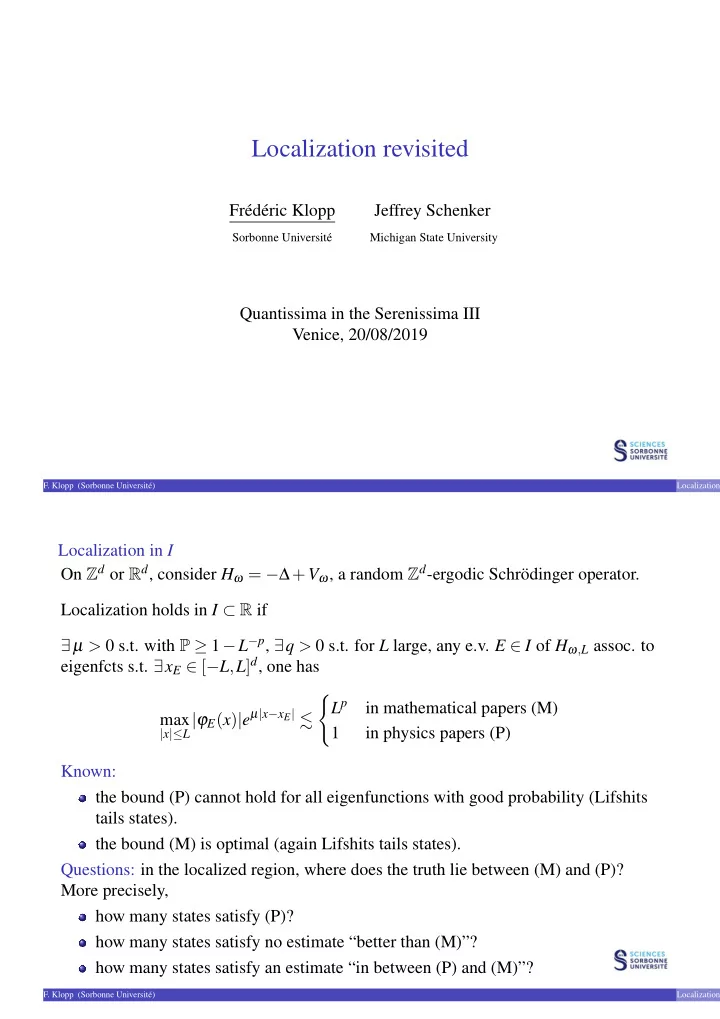
Localization in I On Zd or Rd, consider Hω = −∆+Vω, a random Zd-ergodic Schr¨

  • dinger operator.

Localization holds in I ⊂ R if ∃µ > 0 s.t. with P ≥ 1−L−p, ∃q > 0 s.t. for L large, any e.v. E ∈ I of Hω,L assoc. to eigenfcts s.t. ∃xE ∈ [−L,L]d, one has max

|x|≤L|ϕE(x)|eµ|x−xE|

  • Lp

in mathematical papers (M) 1 in physics papers (P) Known: the bound (P) cannot hold for all eigenfunctions with good probability (Lifshits tails states). the bound (M) is optimal (again Lifshits tails states). Questions: in the localized region, where does the truth lie between (M) and (P)? More precisely, how many states satisfy (P)? how many states satisfy no estimate “better than (M)”? how many states satisfy an estimate “in between (P) and (M)”?

  • F. Klopp (Sorbonne Universit´

e) Localization

slide-2
SLIDE 2

On Zd or Rd, consider Hω = −∆+Vω, a Zd-ergodic R.S.O. s.t. (IAD): if d(Λ, ˜ Λ) > r, (Hω)|Λ and (Hω)| ˜

Λ are independent.

Well known: ∃Σ ⊂ R s.t. σ(Hω) = Σ a.s.; the integrated density of states exists i.e. for any E ∈ R, ω-a.s. N(E) := lim

L→+∞

1 |ΛL|#{eigenvalues of (Hω)|ΛL ≤ E} Assume (Localization): ∃I ⊆ Σ, µ,p,q,L0 > 0 s.t., for L ≥ L0, with P ≥ 1−L−p, for E ∈ I ∩σ((Hω)|ΛL), for ϕE norm. eigenfct of (Hω)|ΛL ass. to E, ∃xE loc. center s.t. max

|x|≤LϕE2(x)eµ|x−xE| ≤ Lq.

Here ϕ2(x) = ϕL2(x+]−1/2,1/2]d) and ϕ2,∞ = max

x∈ΛL

ϕ2(x).

Theorem

For any 0 < ˜ µ < µ, ∃L0 > 0 s.t., for L ≥ L0, with P ≥ 1−L−p, for E ∈ I ∩σ((Hω)|ΛL), for ϕE norm. eigenfct of (Hω)|ΛL ass. to E, ∃xE loc. cent. s.t. max

|x|≤LϕE2(x)e ˜ µ|x−xE| ≤ e2(d+1)/d ˜ µϕE−2/d

2,∞

(1)

  • F. Klopp (Sorbonne Universit´

e) Localization

For normalized eigenfunctions, the inverse of the (2,∞)-norm serves as a measure of extension of eigenfunction. The maximal distance between localization centers of an eigenfct is controlled by its (2,∞)-norm; more precisely, for 0 < α < 1,

  • x;αϕE2,∞ ≤ ϕE2(x)
  • ⊂ B
  • xE,2(d+1)/dϕE−2/d

2,∞ −logϕE2,∞ −logα

  • .

Let us now count the number of eigenfunctions with a given extension.

Theorem

For µ,I,p as above, ∃C,t0,L0 > 0 s.t. for L ≥ L0, for 0 < t ≤ t0, with P ≥ 1−L−p,

  • ne has

#{ev E of (Hω)|ΛL in I ass. to ϕE s.t. ϕE2,∞ ≤ t} |ΛL| ≤ e−t−2/d/C. (2) So eigenfcts with a large extension are rare. Estimate (P) holds for most eigenfcts while (M) is needed only for a small number of eigenfcts.

  • F. Klopp (Sorbonne Universit´

e) Localization

slide-3
SLIDE 3

Optimality of the upper bound on the counting function: a lower bound Let us assume: (HL) there exists an increasing function t > 0 → ν(t) > 0 such that, ∀p > 0, for L large, with Pω ≥ 1−L−p, one has Pω′((Vω)|ΛL −(Vω′)|ΛL∞ ≤ t) ≥ e−|ΛL|ν(t). Example: for the Anderson model with single site distribution density that is compactly supported, bounded and lower bound by a constant on its support, one can pick ν(t) = C|logt| for some constant C > 0. More generally,

Proposition

For Hω the (discrete or continuous) Anderson model with an a.c. single site distribution with compactly supported density. Then, there exists C > 0 such that (HL) holds for ν(t) = C|logt|.

  • F. Klopp (Sorbonne Universit´

e) Localization

One proves

Theorem

Assume (HL). For µ,p and I as above, for δ ∈ (0,1) ∃C,t0,L0 > 0 s.t. for L ≥ L0, with P ≥ 1−L−p, for (logL/C)−d/2 ≤ t ≤ t0, one has #{ev E of (Hω)|ΛL in I ass. to ϕ s.t. ϕ2,∞ ≤ t} |ΛL| ≥ e−Ct−2/dν(t1+δ ). (3) In the case of Proposition 0.3, for the discrete or continuous Anderson model, the bound (3) becomes #{ev E of (Hω)|ΛL in I ass. to ϕ s.t. ϕ∞ ≤ t} |ΛL| ≥ eCt2/d logt. Expected: upper bound of the same form as lower bound (3) where 1+δ is replaced by 1−δ (similar to Lifshits tails).

  • F. Klopp (Sorbonne Universit´

e) Localization

slide-4
SLIDE 4

Consequence of the above theorems

Theorem

For a < b and t > 0, the limit N∞([a,b],t) := lim

L→+∞

#

  • e.v. in [a,b]∩I of (Hω)|ΛL ass. to ϕ s.t. ϕ2,∞ ≤ t
  • N(I)·|ΛL|

(4) exists almost surely and is a.s. independent of ω. Moreover, (E,t) → N(E,t) := lim

a↓−∞N([a,E],t) exists and is the distribution function of

a probability measure on R×R+ supported in I ×R+.

Proposition

Assume (HL). There exists C > 0 such that, for δ ∈ (0,1) t ≥ C and a < b, one has N([a,b]∩I) N(I) e−Ct2/dν(t1+δ ) ≤ N∞([a,b],t) ≤ N([a,b]∩I) N(I) e−t2/d/C

  • F. Klopp (Sorbonne Universit´

e) Localization