Knowledge Translation and Implementation Science Professor Sharon - - PDF document

knowledge translation and implementation science
SMART_READER_LITE
LIVE PREVIEW

Knowledge Translation and Implementation Science Professor Sharon - - PDF document

27/04/2015 Knowledge Translation and Implementation Science Professor Sharon Mickan Professor of Allied Health, Gold Coast Health, Griffith University, Australia Honorary Tutor Nuffield Department of Primary Care Health Sciences, University


slide-1
SLIDE 1

27/04/2015 1

Knowledge Translation and Implementation Science

Professor Sharon Mickan

Professor of Allied Health, Gold Coast Health, Griffith University, Australia Honorary Tutor – Nuffield Department of Primary Care Health Sciences, University of Oxford

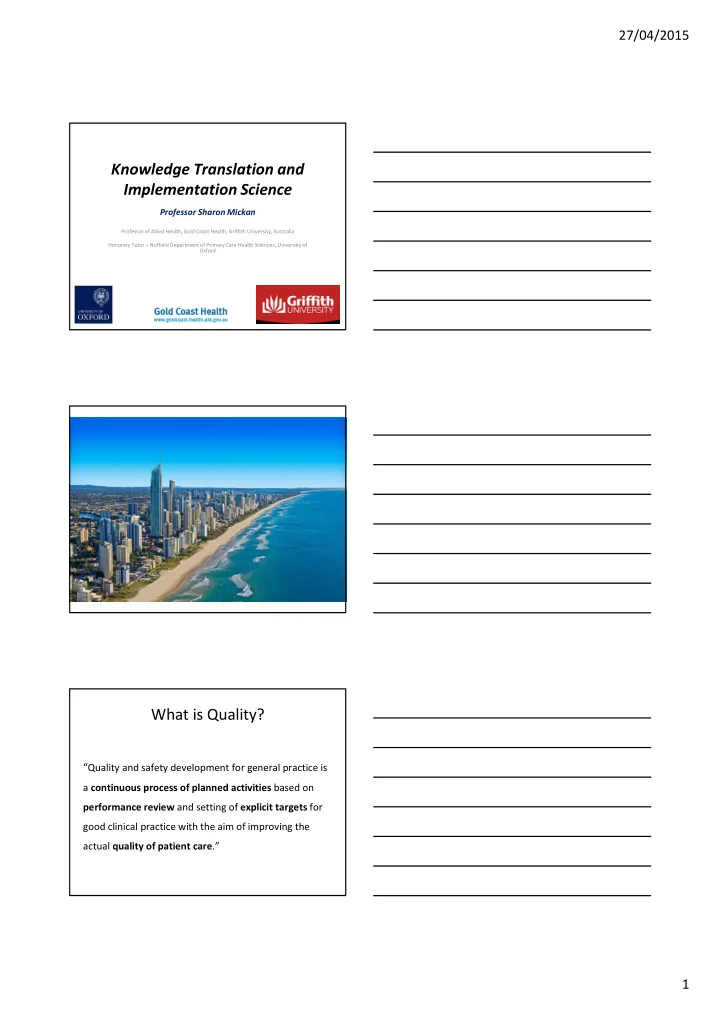
What is Quality?

“Quality and safety development for general practice is

a continuous process of planned activities based on performance review and setting of explicit targets for good clinical practice with the aim of improving the actual quality of patient care.”

slide-2
SLIDE 2

27/04/2015 2

Working with Quality

Members of EQuiP base their work on quality improvement and patient safety being; ! "

Improving Quality

How are you improving quality of patient care? How do you know this?

Improving Quality

the combined efforts of healthcare professionals, patients and their families, researchers, payers, planners and educators—to make the changes that will lead to better patient outcomes (health), better system performance (care) and better professional development (learning).

  • all improvement involves change, BUT not all changes are

improvement.

  • how can we be sure that the changes we make systematically

incorporate high QUALITY research knowledge?

Batalden & Davidoff, What is ''quality improvement'' and how can it transform healthcare? Qual Saf Health Care 2007 16: 2-3

slide-3
SLIDE 3

27/04/2015 3

Knowledge translated into action?

Research implemented in practice?

Is this sufficient?

Why? - Current challenges

  • Published research is insufficient

– poorly designed, reported

  • Clinical environments are not uniform

– geography, policy, organisations, culture

  • Research evidence is necessary but insufficient to improve

practice

– Tacit knowledge, routine data, experience

  • Limited evidence re how translate knowledge into action

– Health, management, psychology, sociology, education

slide-4
SLIDE 4

27/04/2015 4 What and How? - Current challenges

Results from this study show that all regular exercise training (regardless of type of exercise, intensity, length of intervention, or supervision) improves aerobic capacity, but it also showed that when aiming to increase aerobic capacity as effectively as possible in adults with CKD the following exercise regimen is recommended: 4-6 months supervised, regular (3 sessions/week) high intensity mixed cardiovascular and resistance training lasting 30 to 90

  • minutes. To maintain this peak effect the patient has to continue with the

regular exercise training intervention. Modes of activities that were shown to improve aerobic capacity in adults with CKD were activities that use large muscle groups and that can be maintained continuously, such as cycling, walking, and jogging.

Research-practice Gap

Disconnect between Knowledge and Action Gap between what we know and what we do

Systematic review recommends regular exercise training What type, intensity, frequency, duration? How do we introduce, monitor, sustain regular exercise?

Research to practice pipeline
slide-5
SLIDE 5

27/04/2015 5

Using knowledge to cross the ‘gap’

  • Use the knowledge of evidence-based medicine

– research evidence – clinician expertise – patient needs, wants, expectations

  • Consider local context, policy, habits
  • Build research knowledge about what works

– knowledge translation

Research evidence Patient needs, values Clinician experience Local Context

What is Context

Everything that impacts on how we create, use knowledge Includes

  • Organisational culture ‘way things are done’
  • Resources
  • Tools, systems, processes
  • Leadership and governance

– Influenced by power, politics, policy

slide-6
SLIDE 6

27/04/2015 6

Building a conceptual model

Forms of knowledge Research evidence Clinician knowledge, skills, experience Patient values, choice, engagement

Knowledge is derived from…

Adapt knowledge to context

Forms of Knowledge Local Context Research evidence Local, national policy Organisational setting Clinician knowledge, skills, experience Environment resources Staffing profile Patient values, choice, engagement Work practices

It is often unclear how to identify, and map what is important

Assess barriers to knowledge use

Knowledge Local Context Barriers Research evidence Local, national policy Lack of awareness Organisational setting Lack of agreement Clinician knowledge, skills Environment resources Low self-efficacy Staffing profile Environmental factors Patient values, choices Work practices Patient factors

Barriers often related to research evidence & contextual factors

slide-7
SLIDE 7

27/04/2015 7 Select, Tailor, Implement an Intervention

Knowledge Local Context Barriers Implement Research evidence Local, national policy Lack of awareness Engage stakeholders Organisational setting Lack of agreement Leadership & support Clinician knowledge, skills Environment resources Low self-efficacy Change management Staffing profile Environmental factors Stable teams Patient values, choices Work practices Patient factors Education & training

The Knowledge to Action Cycle

  • Canadian Institutes of Health Research

In other words…

  • KT Program, Faculty of Medicine, University of Toronto, 2004

What is Knowledge Translation

slide-8
SLIDE 8

27/04/2015 8

22

  • Implementation Science 2006, 1:1

In other words…

  • What is Implementation Science
  • !

"

  • #

What is Implementation Science

slide-9
SLIDE 9

27/04/2015 9

A model for Implementation

WHO Implementation Toolkit 2014

A model for Implementation

Consolidated Framework for Advancing Implementation Science Damschroder et al, 2009

  • Healthcare occurs within complex, adaptive systems
  • many common interventions are complex
  • Implementation is a social process, embedded in a local

context

  • Context = interacting circumstances, factors
  • inner vs outer environment
  • physical environment vs systems, processes
  • people vs other resources
  • Behaviour change is also influenced by context
  • Psychological theories of behaviour (change) + patterns of

association —> causal explanations

Clarifying concepts

slide-10
SLIDE 10

27/04/2015 10

PEAK: evidence based education

Tilson & Mickan, BMC Medical Education 2014, 14:125

Using the Knowledge to Action Cycle

Problem: PTs don’t update clinical practice regularly wrt evidence Evidence: multifaceted education works best, in practice Selection: constructed PEAK EB Education project 2 day EBP training workshop Secure IT & librarian resources, leadership support Guided small group work, identify EB best practice Medical record audit Monthly reporting, feedback,

  • ngoing education

Mixed methods evaluation at 6 months

  • Knowledge translation and
  • $
  • %
  • &'
  • (
  • (
  • )*
  • (
  • (

Moving forward

slide-11
SLIDE 11

27/04/2015 11

Define your GAP - between knowledge & action

Consider one gap in your

  • wn professional practice
  • What will you do next week to

clarify the research evidence for what you should or could do?