Key Issues for Asia-Pacific Third ESCAP High-Level Consultation - - PDF document

key issues for asia pacific
SMART_READER_LITE
LIVE PREVIEW

Key Issues for Asia-Pacific Third ESCAP High-Level Consultation - - PDF document

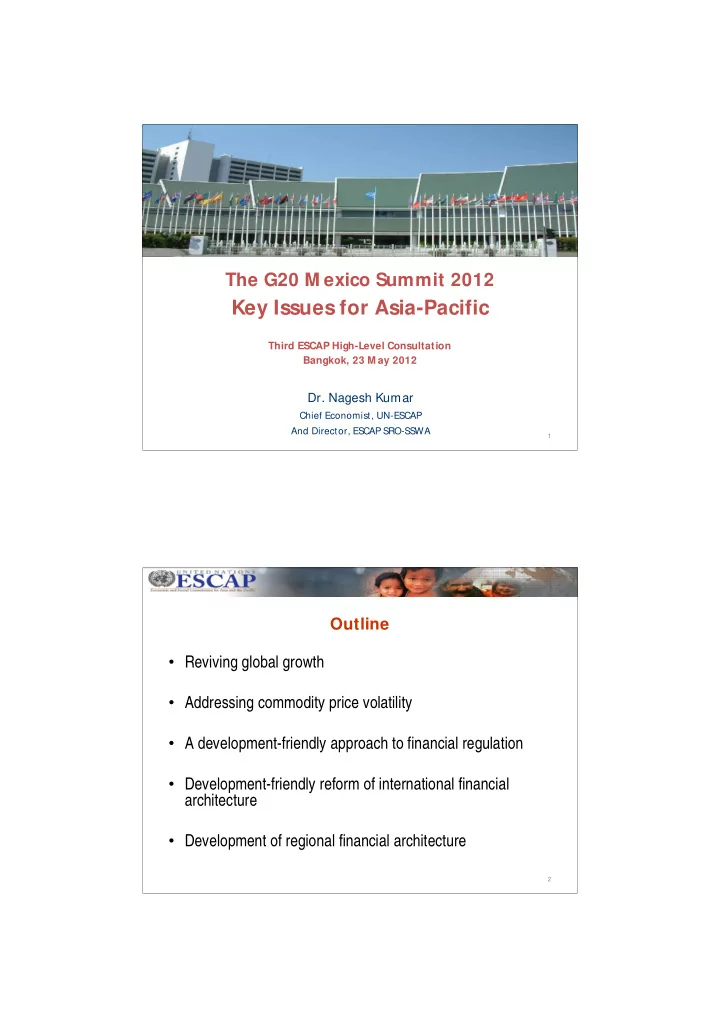
The G20 M exico Summit 2012 Key Issues for Asia-Pacific Third ESCAP High-Level Consultation Bangkok, 23 M ay 2012 Dr. Nagesh Kumar Chief Economist, UN-ESCAP And Director, ESCAP SRO-SS WA 1 Outline Reviving global growth Addressing


slide-1
SLIDE 1

The G20 M exico Summit 2012

Key Issues for Asia-Pacific

Third ESCAP High-Level Consultation Bangkok, 23 M ay 2012

1

  • Dr. Nagesh Kumar

Chief Economist, UN-ESCAP And Director, ESCAP SRO-SS WA

Outline

  • Reviving global growth
  • Addressing commodity price volatility
  • A development-friendly approach to financial regulation
  • Development-friendly reform of international financial

architecture

  • Development of regional financial architecture

2

slide-2
SLIDE 2
  • 1. Reviving global growth
  • Advanced economies started to slow

down in 2011

  • Growth outlook of A-P also affected with

serious down side risks

  • Global imbalances widening again
  • Policy responses in developed countries

further complicate the situation

  • austerity programmes
  • Liquidity expansion
  • Protectionism
  • Declining ODA and long-term finance
  • 1. Reviving global growth contd.
  • Immediate concerted action to boost global

growth and jobs creation

  • counter-cyclical policies and using the fiscal space

available in some advanced economies

  • M edium-term credible and sustainable programme of

fiscal consolidation

  • Avoiding excessive liquidity creation
  • Roll back of protectionism
  • Need for sustaining longer-term finance and

ODA flows

slide-3
SLIDE 3
  • 2. Addressing commodity price volatility
  • Volatile and rising commodity prices

– High food and energy prices affecting growth in developing countries and aggravating poverty situation

  • G-20 action needs to be

– Reversing the neglect of agriculture in public policy for a new sustainable green revolution – Regulating derivatives and financial speculation in commodities markets – Creating global strategic reserves – Agreement to restrict oil prices within a narrow band around a negotiated ‘fair’ price

5

  • 3. A development-friendly approach to

financial regulation

  • Tighter financial sector regulation

(Basel III) may limit access to financing in developing countries

– No ‘one-size-fits-all’ approach to regulation – Consider impact on trade finance, strengthen facilities to support trade

  • Curbing excessive risk taking
  • Regulation of ‘too-big-to-fail’ and

systemically important financial institutions

  • Address inadequate representation of

developing countries in the FSB

  • Strengthen financial inclusion for

development

6

Access to formal financial services (percentage of households)

slide-4
SLIDE 4
  • 4. Development-friendly reform of international

financial architecture

  • Strengthen crisis prevention and management by

– Increasing flexibility and coverage of IFI lending facilities

  • Reform of reserve currency system
  • Increased availability of longer term resources for

development

  • A global financial transaction tax
  • A new source of revenue for funding development
  • Governance reform of IFIs
  • Better reflect the role of emerging economies
  • Enhancing the voice and quota of smaller economies

7

8

  • 5. Development of regional financial architecture
  • Extending the scope and

coverage of CM IM to make it an effective regional lender of last resort for liquidity crisis

  • Developing regional bond

markets

  • Need to provide

institutional intermediation for recycling region’s large foreign exchange reserves for infrastructure investments

– Pooling foreign exchange reserves to create a large scale regional lending facility for closing infrastructure gaps

Infrastructure Com posite Scores in Asia-Pacific, 2007

0.0 0.1 0.2 0.3 0.4 0.5 0.6 Singapore Japan New Zealand Korea, Rep. A ustralia Hong Kong, Macao, China Brunei Malaysia Russian China Thailand Turkey Iran, Islamic A zerbaijan Kazakhstan Georgia A rmenia Sri Lanka V iet Nam India Fiji Kyrgyz Republic Maldives Indonesia Philippines Uzbekistan Bangladesh Pakistan Tonga Tajikistan Samoa Mongolia V anuatu Bhutan Cambodia Solomon Islands Lao PDR Nepal Papua New Inde x s core

slide-5
SLIDE 5

To conclude

  • Imperative to revive growth and create jobs and provide a

development-friendly global economic environment

  • Need to address commodity price volatility
  • More development friendly approach to financial regulation
  • Addressing the long pending reform of international

financial system

  • Develop a complementary regional financial architecture

9

Thank you

www.unescap.org/ pdd

10