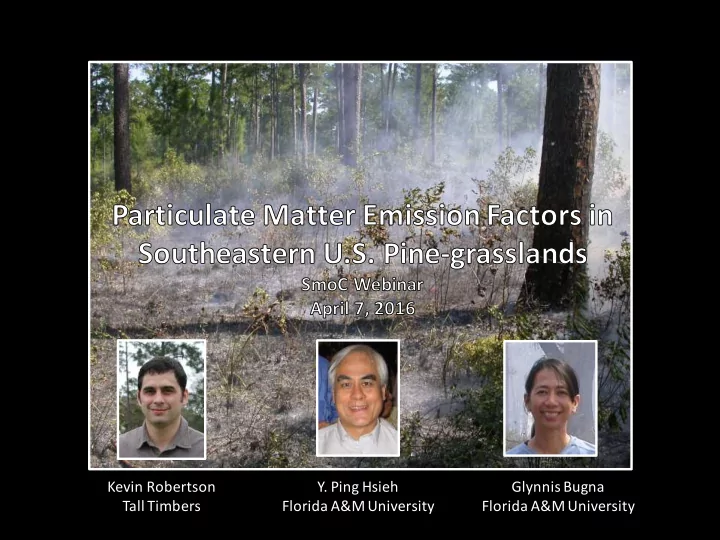
Kevin Robertson Y. Ping Hsieh Glynnis Bugna Tall Timbers Florida - - PowerPoint PPT Presentation

kevin robertson y ping hsieh glynnis bugna tall timbers
SMART_READER_LITE
LIVE PREVIEW

Kevin Robertson Y. Ping Hsieh Glynnis Bugna Tall Timbers Florida - - PowerPoint PPT Presentation

Kevin Robertson Y. Ping Hsieh Glynnis Bugna Tall Timbers Florida A&M University Florida A&M University H 2 O CO 2 C x H y O z + 2O 2 CO PM NO, NO 2 VOCs (CH 4 , PAHs) PM 2.5 Emission Factor (EF) = PM 2.5 emitted / fuel consumed


slide-1
SLIDE 1

Kevin Robertson Tall Timbers Glynnis Bugna Florida A&M University

  • Y. Ping Hsieh

Florida A&M University

slide-2
SLIDE 2

CxHyOz + 2O2 H2O CO2 CO PM NO, NO2 VOCs (CH4, PAHs)

slide-3
SLIDE 3

PM2.5 Emission Factor (EF) = PM2.5 emitted / fuel consumed

slide-4
SLIDE 4

Emissions Inventories

Burned Area Fuel Loading Fuel Consumption Emission Factor Emission Production Rate Dispersion/Concentration

slide-5
SLIDE 5
  • Combustion phase (flaming, smoldering, glowing)
  • Combustion efficiency (CO2 / total C released)
  • Fuel moisture
  • Fuel bulk density (packing ratio)
  • Fuel composition
  • Fire behavior
  • Community type
  • Season
  • Weather
  • Time since fire

Factors potentially influencing EFPM2.5

slide-6
SLIDE 6

0.88 0.86 0.90 0.92 0.94 0.96

MCE

Chaparral Grass Pocosin, palmetto Conifer forest

wildfires Rx fires Mountain west southeast

Urbanski et al. 2012

slide-7
SLIDE 7
  • Investigate effects of fire environmental conditions

and ecological variables on PM2.5 emission factors within southeastern U.S. pine-grassland communities

  • Suggest whether or not developing models to predict

PM2.5 emissions using such conditions as input would improve emissions estimates

Purpose

slide-8
SLIDE 8

Ê Ú

#

Red Hills Region GEORGIA FLORIDA

Gulf of Mexico

50 50 Miles

A

slide-9
SLIDE 9
  • Measure a EFPM2.5 in the field from the ground during

prescribed burns across a range of common environmental conditions

  • Use Structural Equation Modeling to identify variables

influencing EFPM2.5 and their interactions

Methods

slide-10
SLIDE 10
  • Live herbaceous
  • Aerated 1-hr (0-0.6 cm dead grass, pine needles, etc.)
  • Fine 1-hr unaerated (smaller particles)
  • 10-hr (0.6-2.5 cm)
  • Bed depth and density
  • Time since fire

Fire Environmental Variables: Fuel load, moisture, and consumption

slide-11
SLIDE 11
  • Heat per unit area (kJ m-2)
  • Reaction Intensity (kJ m-2 s-1)
  • Fireline Intensity (kJ m-1 s-1)
  • Flaming and smoldering residence time
  • Maximum temperature
  • Flame length
  • Rate of spread
  • Ignition type (backing, heading)

Fire Environmental Variables: Fire behavior

slide-12
SLIDE 12
  • Relative humidity
  • Ambient temperature
  • Wind speed
  • Keetch-Byrum Drought Index
  • Season

Fire Environmental Variables: Weather

slide-13
SLIDE 13

1 Year Interval 2 Year Interval 3 Year Interval Tall Timbers Fire Ecology (Stoddard) Plots

slide-14
SLIDE 14

3 years post-burn 4 years post-burn 4 months post-burn 1 year post-burn

Pebble Hill Fire Plots, Thomasville, Georgia

slide-15
SLIDE 15

September 2009 February 2010

Pebble Hill Fire Plots, Thomasville, Georgia

slide-16
SLIDE 16

Emission factors

EFPM = PM emitted (g) Fuel consumed (kg) EFPM = PMplume - PMambient Cplume - Cambient w

*

slide-17
SLIDE 17

PM, CO2, CO sample Emission intake

slide-18
SLIDE 18

Principal Component Analysis (PCA) – Reduce variables

slide-19
SLIDE 19

Structural Equation Model (SEM) – Theoretical model

slide-20
SLIDE 20

Structural Equation Model (SEM) – Initial model

slide-21
SLIDE 21

Structural Equation Model (SEM) – Final model

slide-22
SLIDE 22

8.4 m2 ha-1 (36 ft2/acre) 15% needles EFPM2.5 = 15.4 g kg-1 18 m2 ha-1 (78 ft2 ac-1) 29% needles EFPM2.5 = 24.1 g kg-1

slide-23
SLIDE 23

TP = 33 C (91 F) RH = 47 VD = 15 EFPM2.5 = 24.3 g kg-1 TP = 20 C (68 F) RH = 38 VD = 7.0 EFPM2.5 = 18.8 g kg-1

slide-24
SLIDE 24
slide-25
SLIDE 25
  • Fuel characteristics have significant effects on EFPM2.5 in

periodically burned southern pine-grasslands

  • Lowest EFPM2.5 was associated with low pine stocking, high grass

loads, frequent burning, and dormant season burns

  • Model development for predicting EFPM2.5 based on forest

structure and fuel composition should improve the accuracy of PM emission estimates

  • Low EFPM2.5 conditions generally correspond with goals for

ecological management of this community type, apart from dormant season burning

  • Effect of season on EFPM2.5 appears to be because of air

moisture rather than fuel moisture

  • Growing season burns promote grass cover over time which

might offset higher EFPM2.5

Conclusions

slide-26
SLIDE 26

Emission factors

EFPM = PMplume - PMambient CPM + Cplume - Cambient w

*

Mass balance method Carbon isotope method

EFPM = PMplume - PMambient CPM + Cplume w

*

d13Cplume – d13Cambient d13Cfuel – d13Cambient

( )

slide-27
SLIDE 27
slide-28
SLIDE 28

O2 CO2 CO2 CO2

Ambient Plume

slide-29
SLIDE 29
slide-30
SLIDE 30

Emission factor assumption:

PMplume and CO2plume are evenly mixed

PM:CO2 PM:CO2 PM:CO2 PM:CO2

slide-31
SLIDE 31

Emission factor assumption:

PMplume and CO2plume are evenly mixed

slide-32
SLIDE 32

PM2.5 conc (mg m-3) Fire-CO2 (ppm) MCE EFPM2.5 (g kg-1) 2.3 20.4 340 3020 0.97 0.91 5.8 5.3 2.0 m 0.3 m

slide-33
SLIDE 33

PM2.5 conc (mg m-3) Fire-CO2 (ppm) MCE EFPM2.5 (g kg-1) 1.4 3.1 255 56 0.94 0.94 5.3 46.4 2.0 m

slide-34
SLIDE 34

MESTA thermograms

slide-35
SLIDE 35
  • Ambient CO2 concentrations are increased in the fire plume

relative to ambient air conditions

  • There is a non-stoichiometric relationship between ambient CO2

+ O2 and gaseous products of combustion that results in a systematic 15% (±2%) under-estimation of EFPM2.5 using the traditional mass balance method

  • The assumption that emitted PM2.5 and CO2 are well mixed holds

true only within flaming combustion convection column

  • Conversely, emitted PM2.5 and CO2 are rapidly decoupled (<1 hr)

where convective mixing is weak

  • Such conditions might include the turbulent edges and exterior
  • f convection columns and convection from low-energy

combustion (low intensity flaming or smoldering combustion)

Conclusions

slide-36
SLIDE 36

Thanks to: National Science Foundation Angie Reid George Bruner Tracy Hmielowski Eric Staller Bailey Spitzner Meredith Liedy Djanan Nemours Marcos Colina Vega Josh Picotte Tim Malo Christopher Odezulu

Kevin Robertson krobertson@ttrs.org