
SLIDE 1
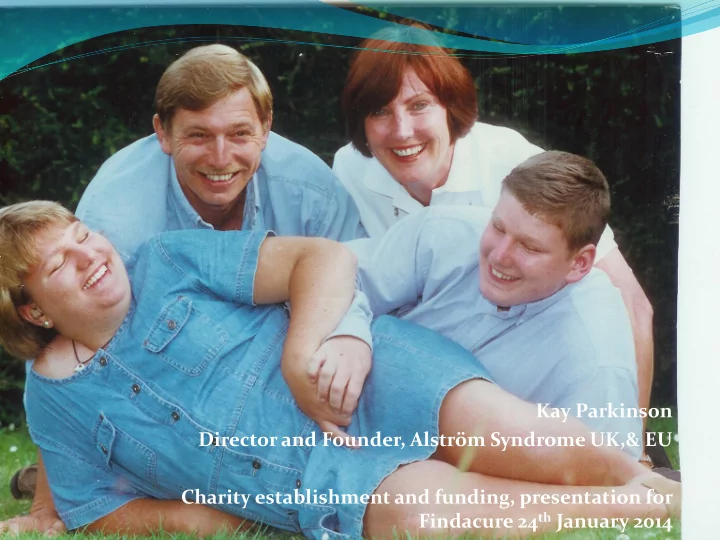
Kay Parkinson Director and Founder, Alström Syndrome UK,& EU Charity establishment and funding, presentation for Findacure 24th January 2014
Kay Parkinson Director and Founder, Alstrm Syndrome UK,& EU - - PowerPoint PPT Presentation
Kay Parkinson Director and Founder, Alstrm Syndrome UK,& EU Charity establishment and funding, presentation for Findacure 24 th January 2014 Matthew Born 9 February 1975 Normal birth By 3 months knew something was wrong
Kay Parkinson Director and Founder, Alström Syndrome UK,& EU Charity establishment and funding, presentation for Findacure 24th January 2014
Born 9 February 1975 Normal birth By 3 months knew “something was wrong” Nystagmus present Clinic assured that he was OK and babies eyes were
Very hungry baby and difficult to fill him up
Concerns increased Matthew taken to GP Referred to ophthalmologist Severe eye problems may have..... ocular albinism. ...or
At 18 months Matthew was diagnosed with congenital
One session arranged with a genetic counsellor- GP
When Matthew was 3 seen at Moorfield Eye Hospital -
Born 11 April 1981 Normal Birth Nystagmus seen at 7weeks ( investigated under
Collapsed in heart failure 11weeks- thought to be
Hearing loss found at 6 years Paediatrician says no connection between symptoms Heart specialist says no need to test Matthew’s heart
For next ten years relatively few symptoms appear. Weight is difficult to maintain Charlotte is extremely thirsty Diagnosis changes as often as specialists, ocular
Both do well at school and Matthew passes the 11+. The
Matthew collapses in heart failure age 16. Given 24 hours to
live.
18 months later -Lebers Amaurosis diagnosed-referred to
Great Ormond Street -
Miss Isabelle Russell Eggitt ( Now Mrs Chazhart) knows
what has caused the catalogue of problems and diagnoses Alström Syndrome. Matthew is 18 and Charlotte 15.
Advised to get them both checked for Diabetes which is a
known feature of AS.
Both found to be diabetic- probably have been for a
number of years
The difference a “correct” diagnosis makes............
We find that there is an International Society of
Talk to another mum and hear a mirror image of
Try and find other UK families Realise that nobody knows anything about the
Decide to start Alström Syndrome UK charity
Alström Syndrome UK charity is founded and the first
family conference is held in 1998. Funded by Awards for All.
7 Families attend. 1999 Doctors hold impromptu clinics in hotel rooms Doctors gain understanding through seeing more patients. Patients and doctors work together to develop better care . We start up a web site www.alstrom.org.uk and begin to
develop family support.
All this from the back bedroom whilst working full time
and looking after two children whose problems seem to be ever increasing.
Heart problems increase from 21 years Hearing loss diagnosed Fitted with 3 different pacemakers Problems do not subside and he is referred to Papworth for a
heart transplant.
Transplant doctors would have liked to have seen him 12 months
earlier.
First offer of a heart is received 4 hours after going on the
transplant list- later found not suitable.
Two days after going on the list he receives a heart. Soon after the heart transplant he went into kidney failure and
sadly died 8 days after transplantation.
Matthew was 25 years old and a student at the University of
Central Lancashire studying social science.
At 19 operation for an illeal conduit. Aged 27 kidney failure and needs dialysis. After 5 episodes of pulmonary oedema, dialysis is increased to 4
x per week.
Charlotte’s heart cannot cope very well with the dialysis and
starts to fail.
Referred for a combined heart and kidney transplant. Obstacles to listing mean there is a year delay before she goes on
the transplant list.
On 28th April 2010 Charlotte gets the call that a heart and kidney
are available for her.
Charlotte died on the 29th April 2010 she never awoke from the
surgery.
Not what we expected children to be like! Not what we expected hospitals to be like! Multiple hospital visits-No co-ordination of care No information about the disease even when diagnosed No medical expertise-No care pathway -No knowledge of
what to test
A&E diagnosis and care-Poor care when in-patients Transplant referrals made far too late An NHS with no protocols for treating rare diseases No adequate social care packages Attitude issues- Oh she’s now thought of something else
that's wrong!
Ahead of their time Trail Blazers – multi-disciplinary clinics set up on the back of the
experience of what they went through.
National Commissioning Group Funding for AS clinics in
recognition of the highly specialised services required by patients.
Family Support now available and medical expertise beginning
to grow.
Big Lottery Medical and Scientific Funding obtained to begin
fundamental research into what is happening and why
BBC Children in Need Funding for children’s activities Raised awareness of life with a rare disease and helped to
instigate change.
Not what we would have asked for- but a privilege to know.
A DSS Mobility Allowance tribunal-successful An Education appeal tribunal-successful A Disability Discrimination case-successful A Medical negligence claim-settled out of court. Social service review instigated investigation of treatment
Failure to treat is never cost effective. All added burdens on a family already living with high
pressures.
1998 Founded Alström Syndrome UK- where we unite and
support families
Developed a web site, patient information and a medical
handbook.
Organised an developed multi-disciplinary clinics in
partnership with Torbay Hospital and later Birmingham Children's Hospital.
Instigated and obtained NHS Funding from the National
Specialised Commissioning Group. Clinics are hailed as a role model for other rare diseases.
Secured funding from Jeans for Genes, BBC Children in
Need and Big Lottery.
Started patient led-research
60 families are known to Alström Syndrome UK AS UK is responsible for 5 contracted staff working on secured
contracts from NSCG, Big Lottery.
Working member of the National Plan for Rare Diseases
Joined forces with allied groups, EURORDIS, Genetic
Alliance, Contact a Family, Rare Disease UK.
Developed an Asian mentoring scheme.
Moved clinics to the Queen Elizabeth Hospital, Birmingham-
the most “state of art hospital” in Europe.
Founder member of the Ciliopathy Alliance Associate partner on the EU WABB project Currently: developing an International Big Lottery Grant Starting up Alström Europe Applying for Horizon Health Funding and IMI2 Funding
Appointment of a fundraiser-dedicated to applying for
small-medium sized grants.
Keep funders informed-newsletter-”glossy "annual report! BBC Children in Need-great support Grant specific funds-i.e. Asian mentoring service Funders like to fund a project Keep vibrant- re-vamp Be innovative- new technologies You can’t standstill-you must be moving forward Keep an eye on what the “big funders” want to fund.
Matthew and Charlotte Parkinson John Parkinson Patients and Families from Alström Syndrome UK ASUK Contracted staff Prof Barrett and Staff at Birmingham Children's Hospital. Dr’s Tarek & Cramb at Queen Elizabeth Hospital
NHS National Specialised Commissioning Group