Justice Issues in Health Care Some slides modified from Maureen - - PDF document

justice issues in health care
SMART_READER_LITE
LIVE PREVIEW

Justice Issues in Health Care Some slides modified from Maureen - - PDF document

Macroallocation and Economic Justice Justice Issues in Health Care Some slides modified from Maureen Giacomazza, RN Limiting Resources Macroallocation large-scale decisions that are made regarding the use of medical resources, do not


slide-1
SLIDE 1

Macroallocation and Economic Justice Medical Ethics 1

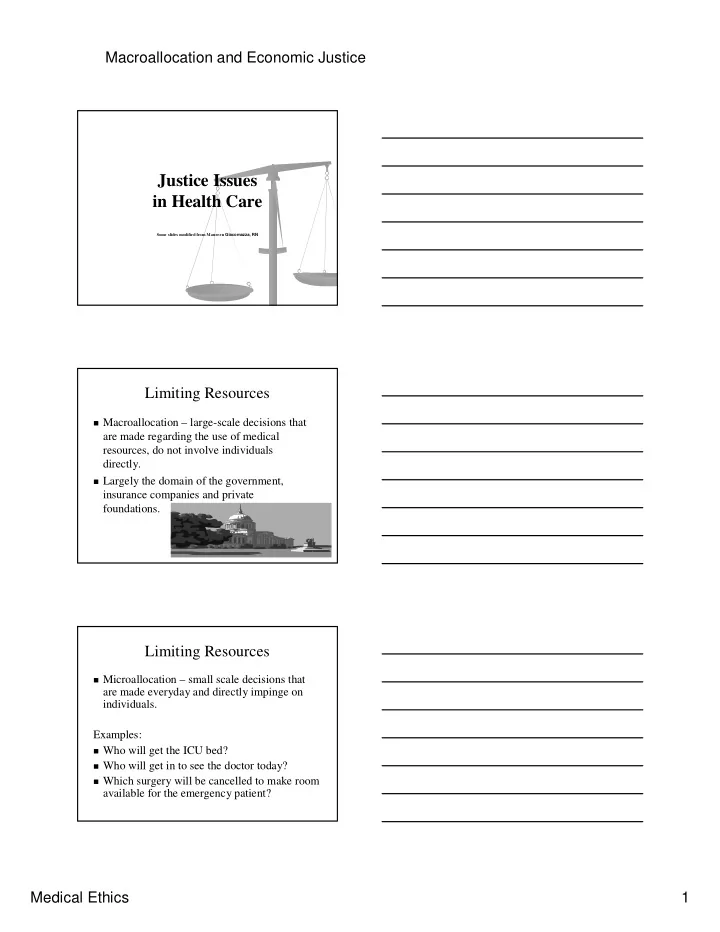
Justice Issues in Health Care

Some slides modified from Maureen Giacomazza, RN

Limiting Resources

Macroallocation – large-scale decisions that

are made regarding the use of medical resources, do not involve individuals directly.

Largely the domain of the government,

insurance companies and private foundations.

Limiting Resources

Microallocation – small scale decisions that

are made everyday and directly impinge on individuals. Examples:

Who will get the ICU bed? Who will get in to see the doctor today? Which surgery will be cancelled to make room

available for the emergency patient?

slide-2
SLIDE 2

Macroallocation and Economic Justice Medical Ethics 2 Historical perspective

Renal dialysis Available since early 1960’s, but machines

were few and expensive.

Munson discusses a “selection committee” for

choosing who will receive dialysis and who will not.

Do you think this is a “just” way of

distributing scarce resources? What other criteria should we use?

Historical perspective

Congress stepped in to make a

macroallocation decision to cover the costs

  • f dialysis.

Now dialysis and kidney transplants are

covered under Medicare.

Present costs of this program alone is over

$8 billion/year.

The Health Care Crisis

slide-3
SLIDE 3

Macroallocation and Economic Justice Medical Ethics 3 The Health Care Crisis

Health care expenditures in the U.S. far exceed those in any other industrialized country. U.S. spends 14% GNP Japan 6.8% GNP Greece 4.8% GNP

The Health Care Crisis

Single-payer plans such

as Canada’s spend approximately 12% on administrative costs.

The U.S. spends 25-30%

  • f all our health care

dollars on multiple-payer administrative costs.

Disturbing Facts

  • !"#$%&

'

slide-4
SLIDE 4

Macroallocation and Economic Justice Medical Ethics 4 Questions

(

)**+ ++,-

.+

/- 0- 1-

  • Part of larger debate on

economic justice

.

  • 1

),-

(

  • Economic justice in general

!

  • *

.

  • 2)3,

4

.!

3! !55#**56575859*

slide-5
SLIDE 5

Macroallocation and Economic Justice Medical Ethics 5 (Too) Briefly Considered

:;!

  • 3-

;;

<=>?@ )"%%A, =:

Paper topic?

1

  • *)/!
  • *,
  • B*<

=;BB !

Candidates for principle

CD

  • ;#

E+

  • ) 3,*

)E,

/

*),

C3

BB+ ++ *B)74,

slide-6
SLIDE 6

Macroallocation and Economic Justice Medical Ethics 6 Candidates (continuum)

C

),

  • *
  • 3*

)'1+9,

C++

  • 3D*)=

C,

Medical Individualism: Sade

)3,

8

  • F:),

*

8*

Strategies for Arguing Against Sade and Pure Free Enterprise

  • 9*

23

  • (-
slide-7
SLIDE 7

Macroallocation and Economic Justice Medical Ethics 7

Public Goods and Private Goods

( ; -

= G), F)-, 7!3

  • )***,

C :#

President’s Commission: Health Care Is Special

(# 2 <2++

>!

  • .

President’s Commission: Equitable Health Care

33 <>

)*$",2-

3 <2>? 7<> : 7-

slide-8
SLIDE 8

Macroallocation and Economic Justice Medical Ethics 8

Rawls’ approach: A Theory of Justice

= 2

*

(<> # H!<> !I

;3!++ * 9*

What Rules Would We Adopt?

3 =3

+*

8!;E

<>

.9! !

9 *

!3

Other Possibilities for Reducing Costs

=## :

  • ;-

=- .- (0I -