
SLIDE 1
Andy Mao
Elder Justice Coordinator US Department of Justice E L D E R A B U S E I N A M E R I C A C O N F E R E N C E
S E P T E M B E R 1 7 , 2 0 2 0
Department of Justice Enforcement & Resources
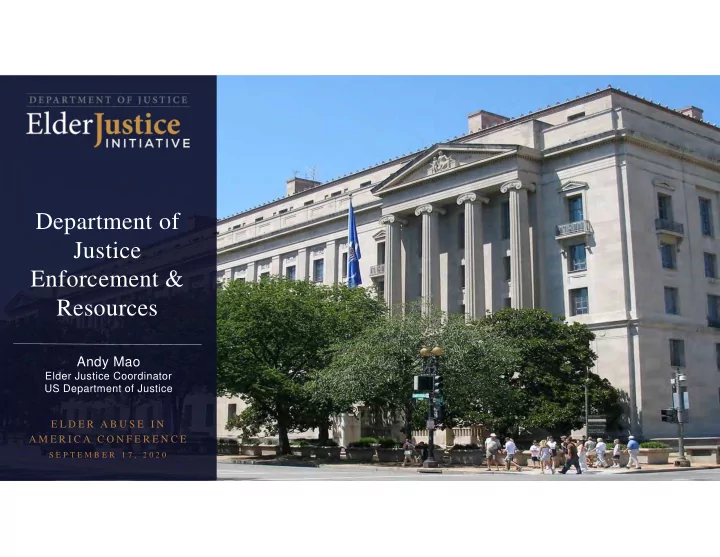
Department of Justice Enforcement & Resources Andy Mao Elder - - PowerPoint PPT Presentation
Department of Justice Enforcement & Resources Andy Mao Elder Justice Coordinator US Department of Justice E L D E R A B U S E I N A M E R I C A C O N F E R E N C E S E P T E M B E R 1 7 , 2 0 2 0 Civil Division: Elder Justice
Andy Mao
Elder Justice Coordinator US Department of Justice E L D E R A B U S E I N A M E R I C A C O N F E R E N C E
S E P T E M B E R 1 7 , 2 0 2 0
Department of Justice Enforcement & Resources
Civil Division: Elder Justice Initiative Executive Office
Criminal Division Consumer Protection Branch Office of Tribal Justice Office of the Deputy Attorney General Office on Violence Against Women COPS Office OJP: Bureau of Justice Statistics OJP: National Institute of Justice OJP: Office for Victims of Crime National Nursing Home Initiative Office of the Attorney General
ELDER JUSTICE INITIATIVE
Justice’s enforcement and programmatic efforts to combat elder abuse, neglect, and financial fraud and scams that target older adults.
KEEPING SENIORS SAFE SUMMIT
https://www.justice.gov/opa/speech/attorney‐general‐william‐p‐barr‐announces‐results‐department‐justices‐2020‐elder‐fraud
https://www.justice.gov/elderjustice/prosecutors‐0
http://eagle.trea.usc.edu/
ELDER ABUSE GUIDE FOR LAW ENFORCEMENT (EAGLE)
SAFTA (SENIOR ABUSE FINANCIAL TRACKING AND ACCOUNTING TOOL)
https://www.theiacp.org/elder‐abuse
https://www.justice.gov/elderjustice/rural‐and‐tribal‐resources
Andy Mao Andy.Mao@usdoj.gov
The opinions, findings, and conclusions or recommendations expressed do not necessarily represent the official position or policies of the U.S. Department of Justice.
MDT TAC
Adapting Elder Abuse MDTS to a Virtual Environment
Talitha Guinn‐Shaver, MDT Technical Advisor
MDT TAC
Our mission is to provide tools, resources, and individualized consultations to facilitate the expansion of elder abuse case review multidisciplinary teams across the nation.
MDT TAC
16
toolkits or research)
(e.g., confidentiality issues)
needing a more hands-on approach
SERVICES
MDT TAC
17
18
COMMON MDTS SERVING OLDER ADULTS
MDT TAC
19
COMMON CORE MEMBERS
MDT TAC
20
WHAT MODEL IS BEST FOR OUR COMMUNITY?
This Photo by Unknown Author is licensed under CC BY‐SA
21
This Photo by Unknown Author is licensed under CC BY‐SA This Photo by Unknown Author is licensed under CC BY This Photo by Unknown Author is licensed under CC BY This Photo by Unknown Author is licensed under CC BY‐SA‐NC
22
23
Shared Decision‐Making The entire team participates in the decision‐making process, sharing information, and sharing successes. Partnership MDTs are characterized by a formal Memorandum of Understanding (MOU) or an Interagency Agreement (IAA). Interdependency Group and individual outcomes are influenced by the team. Balanced Power All members of the MDT have equal input and prohibit a single member from dominating the group. Process The development and use of protocols to introduce predictability and accountability into the case review process, including protocols for conflict resolution.
24
STAGES OF TEAM DEVELOPMENT 1. Forming 3. Norming 2. Storming 4. Performing
25
“A sense of confidence that the team will not embarrass, reject or punish someone for speaking up…a team climate characterized by interpersonal trust and mutual respect in which people are comfortable being themselves.”
PSYCHOLOGICAL SAFETY
MDT TAC
26
laws and statues https://www.justice.gov/elderjustice/file/960791/download
https://www.justice.gov/elderjustice/6-mdt-coordinator
https://www.justice.gov/elderjustice/5-ethical-legal-considerations
https://www.justice.gov/archives/elderjustice/file/938806/download
https://www.justice.gov/elderjustice/4-building-strong-foundation
DEVELOP CLEAR ORGANIZATIONAL RULES
MDT TAC
27
Create mechanisms to evaluate team performance and make adjustments as needed. Managing an MDT requires ongoing commitment and resources.
REFINE WORK AS THEY PROCEED
MDT TAC
CULTIVATE TRUST
28GET TO KNOW EACH OTHER PERSONALLY HAVE STRONG, CLEAR, AND AGREED UPON COLLABORATION DOCUMENTS. ACTIVE LISTENING – TRY TO UNDERSTAND ONE ANOTHER’S PERSPECTIVE, CLARIFY WHEN NEEDED. ADDRESS PROBLEMS AND CONFLICT HEAD‐ON AND PROMPTLY. HOLD ONE ANOTHER ACCOUNTABLE (KINDLY). DON’T BLAME – FOCUS ON SOLUTIONS AND SUPPORTING ONE ANOTHER’S WORK. WORK CASES TOGETHER (HOME VISITS). REMEMBER WHY YOU ARE HERE – YOUR CLIENTS.
29
Therefore, It is possible to change and improve in this current environment. At their best, elder abuse teams:
Have meetings. MDTs aren’t meetings. Are relational and expand connections and knowledge. Refine and streamline process. Are active, collaborative and seek improved client
Embrace innovation and are highly adaptable.
MDT TAC
30
Some teams have decided to shift their focus to challenges that have emerged or become more pronounced by the current crisis. Focus areas include but are not limited to.
agencies
emergencies
HOW ARE TEAMS RESPONDING?
MDT TAC
HOW ARE TEAMS RESPONDING?
31
Some teams have decided to continue case review or similar client driven work while making appropriate adaptations. This next section contains things to consider and tips to continue your MDT related work.
MDT TAC
32
to-face contact – team coordination
visits
in emergencies
contact
and masks (See CDC for additional information)
SOCIAL DISTANCING
MDT TAC
33
Video Conferencing Considerations Choosing a platform – collaborate with partners regarding licensing teleconferencing software
enhance user familiarity
WORKING REMOTELY
MDT TAC 34
Video Conferencing Considerations
HIPAA compliant for-pay tiers
PROTOCOL TO BE EFFECTIVE
confidentiality agreements to cover remote communication (have attorneys for partner agencies review and approve)
MDT TAC 35
Video Conferencing Considerations
meetings
waiting room
read, understood and agree to confidentiality statement
compliance
agreement
MDT TAC 36
Video Conferencing Considerations
professional guidelines
MDT TAC 37
Video Conferencing Considerations
behind you)
MDT TAC 38
Training!
use new tools and resources. Other collaborative tools
documents
39
complicated than internal communication.
strategy-session-on-sustaining-services-session-1/
MDT TAC
VIRTUAL MEETING FACILITATION TIPS
40meeting needs
and sign on early
team
facilitate the meeting
run the technical aspect of the meeting
41
casual conversation at the beginning of the meeting
deliveries, etc.
VIRTUAL MEETING FACILITATION TIPS CONT.
MDT TAC
42
1. https://www.justice.gov/coronavirus 2. www.elderjustice.gov 3. https://www.cdc.gov/coronavirus/2019- ncov/communication/guidance- list.html?Sort=Date%3A%3Adesc 4. https://www.techsafety.org/ 5. http://reachingvictims.org/resource/national- strategy-session-on-sustaining-services-session-1/ 6. https://www.justice.gov/elderjustice/mdt 7. https://hbr.org/
AVAILABLE RESOURCES
MDT TAC
43
For consultation contact: Talitha Guinn-Shaver 202.598.0292 Talitha.j.guinn-shaver@usdoj.gov
REACH OUT FOR HELP WHEN YOU NEED IT