June 6, 2016 BACRDRs Ongoing Work with Stakeholders to Build a - - PowerPoint PPT Presentation

june 6 2016 bacrdr s ongoing work with stakeholders to
SMART_READER_LITE
LIVE PREVIEW

June 6, 2016 BACRDRs Ongoing Work with Stakeholders to Build a - - PowerPoint PPT Presentation

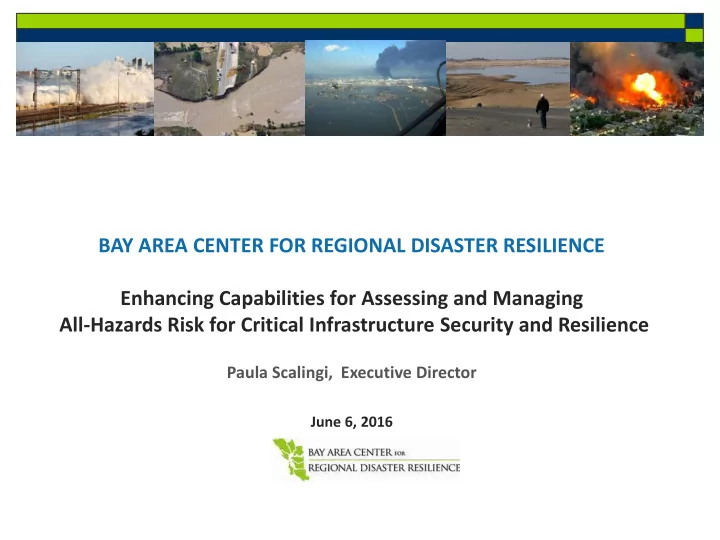
BAY AREA CENTER FOR REGIONAL DISASTER RESILIENCE Enhancing Capabilities for Assessing and Managing All-Hazards Risk for Critical Infrastructure Security and Resilience Paula Scalingi, Executive Director June 6, 2016 BACRDRs Ongoing Work

slide-1
SLIDE 1

BAY AREA CENTER FOR REGIONAL DISASTER RESILIENCE Enhancing Capabilities for Assessing and Managing All-Hazards Risk for Critical Infrastructure Security and Resilience

Paula Scalingi, Executive Director

June 6, 2016

slide-2
SLIDE 2

BACRDR’s Ongoing Work with Stakeholders to Build a Resilient Bay Area, Communities, and Regions

  • Our mission:
  • We are a nonprofit Section 501(c)(3) public

benefit corporation established to empower and enable the broad stakeholder community to undertake collaborative actions to improve all-hazards disaster resilience

  • Scope:
  • Community and regional resilience from

grass roots to global level, cross-sector and function with a strong focus on lifelines, critical infrastructures, and other essential service providers that are fundamental to health, economic, environmental, and societal well-being

2

slide-3
SLIDE 3

BACRDR Focus Areas

  • All-Hazards disaster preparedness
  • Recovery and long-term restoration
  • Community health resilience
  • Climate change resilience
  • IT security and resilience
  • Risk and mitigation
  • Energy assurance and resilience
  • Business continuity and economic resilience
  • Information sharing and public-private

partnership building

  • Education, training, and exercises

3

slide-4
SLIDE 4

Building Resilience through Six Activities

  • 1. Provide education and training to enable understanding
  • f vulnerabilities and associated infrastructure

interdependencies and consequences of all-hazards events and disasters

  • 2. Build regional cooperation & collaboration from local to

federal levels, across sectors and disciplines

  • 3. Foster and develop ways for trusted information-

sharing among diverse organizations, groups, and interests, promoting synergy among disaster resilience activities

  • 4. Work with stakeholders to develop and implement

comprehensive, dynamic regional resilience action strategies of prioritized policy and operational solutions as part of a continuous process of improvement

4

slide-5
SLIDE 5

Building Resilience through Six Activities, cont.

5. Serve as an impartial forum for government, industry, and non-profit leaders to:

  • Build relationships and share information on resilience

challenges, needs, capabilities, and areas of improvement

  • Enable dialogue among practitioners and experts

through roundtables, workshops, exercises, and

  • ther means on how to accelerate progress towards

sustainable regional disaster resilience through innovative approaches, policies, and technologies

  • 6. Provide guidance and informational resources to

practitioners, experts, and policymakers to help them examine and identify pressing regional and community resilience needs

5

slide-6
SLIDE 6

BACRDR Recent and Current* Activities

  • Infrastructure Interdependencies and Regional Cyber Resilience
  • Interdependent Lifelines and Critical Infrastructure Data Exchange Initiative with the

CA Earthquake Clearinghouse

  • Bay Area Regional Cyber Resilience Workshop with DHS and the NCRIC
  • South Napa Lessons Learned Workshop for Interdependent Lifelines
  • Alameda County-EMA Energy and Other Interdependent Infrastructures Tabletop

Exercise and follow-on Action Planning Activities

  • Emergency Fuel Tabletop Exercise with Bay Area Water Systems
  • Workshop on Developing a Bay Area Common Operating Picture
  • Community Health Resilience
  • Bay Area Community Health Resilience Forum and Coalition Building
  • National Community Health Resilience Initiative Guide and Toolkit with DHS Office of

Health Affairs

  • Regional & Community Health Resilience Exercise Series and Action Planning Project

with California Department of Public Health – Environmental Health Laboratory

  • Bay Area Geriatric Resilience Roundtable

6

slide-7
SLIDE 7

Recent and Current Activities, cont.

  • Regional Climate Change and Risk Mitigation
  • Bay Area Climate Change Roundtable (local, state, and federal partners & lifelines)
  • Bay Area Integrated Weather Resiliency Roundtable (multi-stakeholder)
  • Regional Risk Management Model Approach Development (for U.S. DHS OIP)
  • Partnership Building
  • Bay Area Resilience and Community Health Coalitions
  • Cross-Sector Collaboration
  • National Activities for Furthering and Sustaining Regional Resilience
  • Building Resilient Regions into a Resilient and Secure Nation Initiative
  • Regional Disaster Resilience Guide published by The Infrastructure Security Partnership
  • Energy Assurance and Resilience
  • National Energy Assurance Planning Initiative (with U.S. DOE)
  • Regional Energy Infrastructure Interdependencies workshops and exercises
  • Exercises, Training, and Education
  • Workshop on Hurricane Sandy Lessons Learned for the Bay Area
  • Forum for Military Support to Civil Authorities with National Guard

7

slide-8
SLIDE 8

For Further Information

Paula Scalingi, Ph.D. Executive Director, Bay Area Center for Regional Disaster Resilience President, The Scalingi Group, LLC Adjunct Associate Professor, Georgetown University phone: 925-399-6229 cell: 925-683-3101 fax: 925-736-8197 pscalingi@BayAreaCRDR.org http://BayAreaCRDR.org

8 8