Johnson & Wales University, Thursday May 25, 2017 Conference - - PowerPoint PPT Presentation

johnson wales university thursday may 25 2017
SMART_READER_LITE
LIVE PREVIEW

Johnson & Wales University, Thursday May 25, 2017 Conference - - PowerPoint PPT Presentation

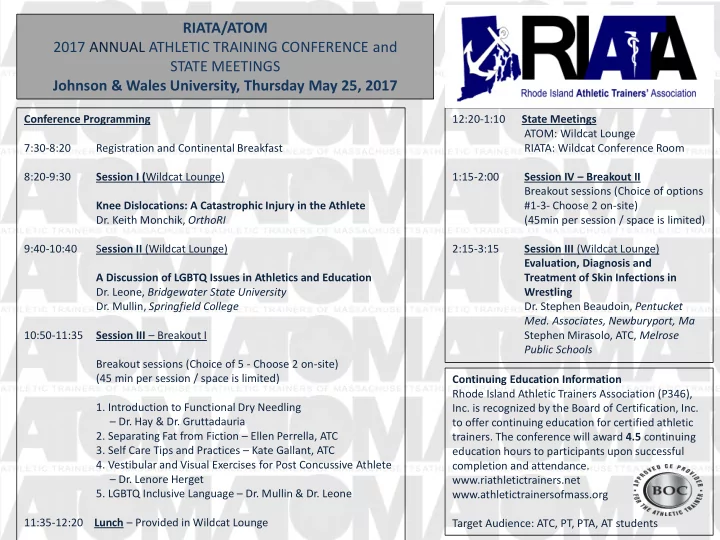
RIATA/ATOM 2017 ANNUAL ATHLETIC TRAINING CONFERENCE and STATE MEETINGS Johnson & Wales University, Thursday May 25, 2017 Conference Programming 12:20-1:10 State Meetings ATOM: Wildcat Lounge 7:30-8:20 Registration and Continental


slide-1
SLIDE 1

RIATA/ATOM 2017 ANNUAL ATHLETIC TRAINING CONFERENCE and STATE MEETINGS Johnson & Wales University, Thursday May 25, 2017

Conference Programming 7:30-8:20 Registration and Continental Breakfast 8:20-9:30 Session I (Wildcat Lounge) Knee Dislocations: A Catastrophic Injury in the Athlete

  • Dr. Keith Monchik, OrthoRI

9:40-10:40 Session II (Wildcat Lounge) A Discussion of LGBTQ Issues in Athletics and Education

  • Dr. Leone, Bridgewater State University
  • Dr. Mullin, Springfield College

10:50-11:35 Session III – Breakout I Breakout sessions (Choice of 5 - Choose 2 on-site) (45 min per session / space is limited)

  • 1. Introduction to Functional Dry Needling

– Dr. Hay & Dr. Gruttadauria

  • 2. Separating Fat from Fiction – Ellen Perrella, ATC
  • 3. Self Care Tips and Practices – Kate Gallant, ATC
  • 4. Vestibular and Visual Exercises for Post Concussive Athlete

– Dr. Lenore Herget

  • 5. LGBTQ Inclusive Language – Dr. Mullin & Dr. Leone

11:35-12:20 Lunch – Provided in Wildcat Lounge Continuing Education Information Rhode Island Athletic Trainers Association (P346),

  • Inc. is recognized by the Board of Certification, Inc.

to offer continuing education for certified athletic

  • trainers. The conference will award 4.5 continuing

education hours to participants upon successful completion and attendance. www.riathletictrainers.net www.athletictrainersofmass.org Target Audience: ATC, PT, PTA, AT students 12:20-1:10 State Meetings ATOM: Wildcat Lounge RIATA: Wildcat Conference Room 1:15-2:00 Session IV – Breakout II Breakout sessions (Choice of options #1-3- Choose 2 on-site) (45min per session / space is limited) 2:15-3:15 Session III (Wildcat Lounge) Evaluation, Diagnosis and Treatment of Skin Infections in Wrestling

  • Dr. Stephen Beaudoin, Pentucket
  • Med. Associates, Newburyport, Ma

Stephen Mirasolo, ATC, Melrose Public Schools

slide-2
SLIDE 2

Early Registration:

Online at https://www.riathletictrainers.net or mail in by May 12th

  • Name: __________________________________________________

Address:__________________________________________________ Phone: __________________________________________________ BOC and NATA Membership Number _________________________________________________________ Check off membership category and fee:  RIATA ($65)/ Affiliation: ______________________________________________________  ATOM ($65)/ Affiliation: ______________________________________________________  Student ($30)/School: ______________________________________________________  Health Professional ($70)/Affiliation: _____________________________________________

Registration after 5/12 is $85 for members, $100 for health professionals.

Please make checks out to Rhode Island Athletic Trainers’ Association and mail to: Rhode Island Athletic Trainers’ Assoc. 3 Keaney Dr Suite 1 Kingston, RI 02881 Refund Policy: Written notification must be given by May 12th for a refund. A $25.00 administrative fee will be applied. No refunds will be provided after May 12th Johnson & Wales University – Harborside Campus 265 Harborside Boulevard Providence, RI 02905 Parking is available in the lots in front

  • f and behind the Wildcat Center. All

programming will occur in this building. Please enter campus through the main gate off Allens Avenue.

slide-3
SLIDE 3

Knee Dislocations: A Catastrophic Injury in the Athlete

  • Dr. Keith Monchik, MD, FAAOS, CAQ- Sports Medicine is currently an Orthopedic

Surgeon at Orthopedics Rhode Island - Foundry Division in Providence, RI, as well as an Assistant Clinical Professor of Family Medicine at the Brown University Alpert School of Medicine. He is a graduate of both Franklin and Marshall College, and Ross University School of Medicine, where he completed his Doctorate as Valedictorian.

  • Dr. Monchik is one of the team orthopedic doctors for the athletes at Johnson &

Wales University, as well as many area high schools, and he is an active member of the advisory committee for Rhode Island Interscholastic League Sports Medicine. Learning Objectives: 1 . Recognition of Knee dislocations and how it differs from a patella dislocation

  • 2. Understanding of pathophysiology of a knee dislocation along with associated

neurovascular complication

  • 3. Treatment, both long and short term, of a knee dislocation

From Laws and Policies to Equality and Equity: A discussion of LGBTQ Issues in Athletics and Education Learning Objectives:

  • 1. Analyze current issues affecting LGBTQ populations in athletics and educational

settings.

  • 2. Discuss the role of educators, athletics staff, and support staff in the handling
  • f issues related to LGBTQ individuals.
  • 3. Identify three strategies to promote LGBTQ health and equity in athletic and

educational settings. Simples Steps in Advocacy for LGTBQ Students and Athletes: A Discussion on Inclusive Language – Breakout Session Learning Objectives:

  • 1. Discuss the impact of inclusive and gender-affirming language.
  • 2. Analyze their own practice concerning gender-inclusive language.
  • 3. Strategize ways to promote inclusive language.
  • Dr. James Leone PhD, MPH, MS, LAT, ATC, CSCS*D, CHES, FMHI is a professor for

the College of Education and Allied Sciences, as well as both the graduate and undergraduate athletic training programs at Bridgewater State University in Bridgewater, Massachusetts. He began his education at Bridgewater State College, where he earned a degree in Physical Education, before continuing on to Indiana State University, where he received his master’s degree in Athletic Training and Research Methods. From there, he earned his PhD in Health Education at Southern Illinois University, and finally his Master of Public Health from Northeastern University in Boston, Massachusetts. In addition to his many degrees, he is a Certified Athletic Trainer, Certified Strength and Conditioning Specialist, and Certified Health Education Specialist. Prior to starting at Bridgewater State in 2008, he has taught at George Washington University, Northeastern University, and Southern Illinois University.

  • Dr. Elizabeth Mullin PhD, CC-AASP, CSCS has been as assistant professor at

Springfield College since 2013, and previously taught at William Patterson University in Wayne, New Jersey. She is currently serving as the Vice President in the athletics division of the Massachusetts Association for Health, Phyiscal Education, Recreation and Dance; as a chair for Measurement and Evaluation with SHAPE America, and as a committee member for the National Strength and Conditioning Association Massachusetts State Advisory Board. She earned her Bachelor of Arts in Psychology from Mount Holyoke College, and a Masters in Exercise Science as well as a PhD in Physical Education and Sport Psychology from Springfield College. Dr. Mullin is a Certified Strength and Conditioning Specialist and a Certified Consultant-374, with the Association for Applied Sport Psychology. Evaluation, Diagnosis and Treatment of Skin Infections in Wrestling: Keeping the Skin in the Game

  • Dr. Stephen Beaudoin, MD has been an internal medicine physician with Pentucket

Medical Associates in Newburyport, MA since 1991. He also acts as the school physician for Pentucket Regional School District, and has been an assistant wrestling coach with the high school since 2003. He is a member of the Sports Medicine Committee for the Massachusetts Interscholastic Athletic Association and a member of the International Network of Wrestling Researchers. He is a graduate of both the Northeastern University School of Pharmacy and the University of Massachusetts Medical School. Steven Mirasolo, MEd, ATC, CSCS is the head athletic trainer and a physical education teacher for Melrose Public Schools. He is a graduate of Keene State College where he studied Physical Education, Sports Medicine and Alcohol and Chemical Dependency, as well as University of Massachusetts, Boston, where he received his Master of Education. In addition, he has several education licenses and is also a Certified Strength and Conditioning Specialist, and has worked as an official with the Massachusetts Interscholastic Wrestling Officials Association for 7 years Learning Objectives:

  • 1. Understand the history of skin infections in wrestling as the impact on the

wrestling community

  • 2. Diagnostic challenges and treatment options for Herpes Gladiatorum , Impetigo

and Ringworm

  • 3. The importance of the Athletic Trainer in the role of identification and prevention
  • f these infections
slide-4
SLIDE 4

Vestibular and Visual Exercises for Post Concussive Athlete Lenore Herget, PT, DPT, SCS, MEd, CSCS is a senior physical therapist at Mass General Hospital Sports Physical Therapy in Boston, Massachusetts. She holds a Bachelor of Science from Wheaton College and a Masters in Special Education from Mercy College. She completed her post baccalaureate pre medical studies at Hunter College, before graduating with her Doctorate in Physical Therapy from the MGH Institute of Health

  • Professions. She is a licensed physical therapist in Massachusetts, aboard certified

specialist in Sports Physical Therapy, as well as a Certified Strength and Conditioning

  • Specialist. Dr. Herget also works with the New England Patriots medical staff for

concussion rehabilitation, and is an adjunct faculty member with the MGH Academy and Institute of Health Professions, as well as Harvard Medical School. She volunteers with the Boston Marathon, as well as with several interscholastic Harvard teams, to complete baseline testing. Learning Objectives:

  • 1. Differentiate between the basic anatomy and physiology of the oculomotor and

vestibular systems; including the peripheral vestibular apparatus, its central connections, central integration of visual, vestibular and proprioceptive inputs and the function of these systems.

  • 2. Be proficient in performing a quick screen to assess for visuo-vestibular dysfunction;

including quick screens in oculomotor, vestibular, balance and cervicogenic contributions to concussion.

  • 3. Identify how variations in visual and vestibular rehabilitation are tailored to specific

school work and sport requirements. Introduction to Functional Dry Needling

  • Dr. Brian Hay, PT, DPT, MS, OCS is a physical therapist and chief programs officer

for Performance Physical Therapy in Pawtucket, Rhode Island. He received his Bachelor of Science in Health Sciences and his Master of Science in Physical Therapy, both from the University of New England, before earning his Doctorate

  • f Physical Therapy from Massachusetts General Hospital Institute of Health
  • Professionals. He acts as a Clinical Instructor for Brown University Warren Alpert

Medical School Sports Medicine and is a APTA Board Certified Orthopedic Clinical Specialist.

  • Dr. Robert Gruttadauria, DPT, OCS is an outpatient physical therapist for

Performance Physical Therapy in Pawtucket, RI and a clinical instructor for the University of RI DPT program. He received both his Bachelors in Kinesiology, as well as his Doctorate in Physical Therapy from the University of Rhode Island. He is a RI Licensed Physical Therapist, Certified Clinical Specialist in Orthopedics, and became certified in Functional Dry Needling in 2013 Learning Objectives:

  • 1. Understanding FDN: Methodology
  • 2. The indications, contraindications, and response expectations from FDN
  • 3. How to apply FDN to address deficits found in the FMS and SFMA

Separating Fat from Fiction: Exploring Myths, Realities and Assumptions Ellen Perrella, MS, ATC, LAT, CSCS is the Head Athletic Trainer and a faculty member at Mount Holyoke College in South Hadley, Massachusetts. She received a bachelor’s degree in physical education from the University of Utah, and she was previously first female athletic trainer to work with varsity football at the University of Colorado, Boulder, where she received her Master’s in Exercise Physiology. In addition to being a Certified Athletic Trainer, she is a Certified Strength and Conditioning Specialist and an instructor for the American Red Cross. Learning Objectives:

  • 1. To explain the difference between obesity (physical characteristic) and poor diet

and lack of exercise (behavioral patterns) as it relates to mortality and health.

  • 2. To list the psychological and physiological effects of dieting
  • 3. To identify the differences between cardiovascular and metabolic exercise

Self-Care: Tips and Practices for Healthcare Professionals Catherine Gallant, MS, LAT, ATC is the athletic trainer for Classical High School in Providence, RI, and works through Performance Physical Therapy in Pawtucket, RI. She received her Bachelor of Science in Biology from Emmanuel College in Boston, Massachusetts and her Master of Science in Athletic Training from Florida International University in Miami. She completed a graduate assistantship with the FIU Undergraduate Nursing program, and an internship with St. Thomas University, in Miami Gardens, Florida. Learning Objectives:

  • 1. Be able to identify symptoms of burnout in the workplace
  • 2. Be able to understand and implement the pillars of self-care
  • 3. Be able to create and implement a personalized self-care practice