SLIDE 1 (jeez y) Where is the Internet?
Answers from :
(G. Whilikers) Out there. (Mike) the way I see it, the "internet" has to be somewhere. a router collects the internet to my house sure. but somewhere on earth there HAS to be some where that the internet originates by sending out the first signal so others can collect it. where is that place? also is it like... a box or something? I'm so
- confused. one more for those who want to answer, if some maintenance guy
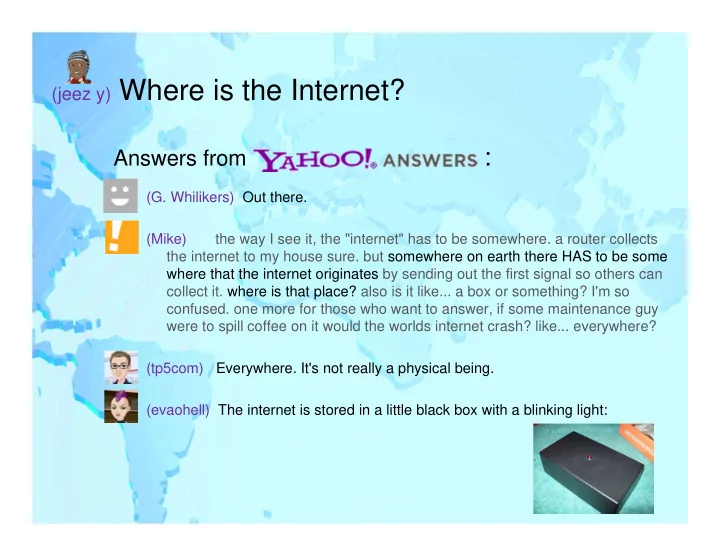
were to spill coffee on it would the worlds internet crash? like... everywhere? (tp5com) Everywhere. It's not really a physical being. (evaohell) The internet is stored in a little black box with a blinking light:
SLIDE 2 And what does it look like? ?
cambodia4kidsorg: ”What does the Internet look like?”
SLIDE 3 The Network Geography of the Internet*
Péter Hága
Eötvös Loránd University Budapest, Hungary * Spotter: A Model Based Active Geolocation Service, INFOCOM 2011 * On the Network Geography of the Internet, INFOCOM 2011 * On the Spatial Properties of Internet Routes, submitted to Journal on Selected Areas of Communications
GEOLOCATION SERVICE
SLIDE 4
Geolocation in general
SLIDE 5 Geolocation in general
- passive geolocation
- extracting location information from domain names (DNS)
- registries, Whois databases, commercial databases
- large and geographically dispersed IP blocks are allocated to
a single entity prohibiting the study of several geographic aspects
- active geolocation
- active probing (delay, topology)
- measurement nodes with known location
- constraint based techniques
SLIDE 6 Whois based location estimation
example for passive geoloc
Cumulative distribution of the maximal distances from Pamplona, Spain to 4000 Google IPs. The maximal distances are calculated from the network delays assuming 200000 km/sec signal propagation speed. The vertical line represents the real geographical distance between Pamplona and Mountain View, CA, showing that 47% of the nodes must be closer to Pamplona than Mountain View.
SLIDE 7
Spotter – theoretical background
SLIDE 8 Spotter – theoretical background
L T
- roundtrip travel time measured between the landmark (L) and the
target (T) node by ping
- RTT is transformed to geographic distance
- ”triangulation” from multiple landmarks
SLIDE 9 Travel time – distance relation
- reference dataset (nodes with known location)
- distance between the source and destination
- measured RTT
SLIDE 10 Standardized travel time – distance distribution
- Standardized values, fitted normal distribution
SLIDE 11
The distances are normally distributed for a given RTT each RTT point out a radial profile with d and d => which defines the spatial probability distribution of the target
Evaluation process
SLIDE 12
”Triangulation”
The target’s location must satisfy all the individual spatial constraints.
SLIDE 13 visit and use!
http://spotter.etomic.org http://spotter.etomic.org
Spotter - online geolocation service
- nline: free, easy to use
- ffline: batch mode
~15k addresses/day
- to fix: DNS resolve problem
SLIDE 14
Where is the WikiLeaks site (46.59.1.2)? hostip.info
SLIDE 15
Where is the WikiLeaks site (46.59.1.2)? IPligence
SLIDE 16
Where is the WikiLeaks site (46.59.1.2)? MaxMind
SLIDE 17
Where is the WikiLeaks site (46.59.1.2)? Spotter
SLIDE 18
Where is the WikiLeaks site (46.59.1.2)?
http://www.youtube.com/watch?v=qwlATf9xse4
SLIDE 19 Spotter’s accuracy
- Estimation accuracy for reference node set
(thanks to Bradley@CAIDA)
- Spotter – „pure probabilistic method”
- Spotter city – population density as extra constraint
SLIDE 20 Are there typical link lengths? How circuitous are the network paths? What is the extent of route asymmetry?
Some basic geographic properties
SLIDE 21 Router density visualization
- routers of the full-mesh PlanetLab
topology (700x700)
- discovered by traceroute
- both academic and commercial ISPs
- IP level network
- approx. 16.000 addresses
SLIDE 22
Link length frequency & distribution
SLIDE 23
Link length frequency
each unique link is represented once links are weighted up with their prevalence in the traceroute data set collected at one time # of identified IP level links: approx. 44.000
SLIDE 24 Link length distribution
300 km 3700 km
?
- logarithmic relation, where ?
- model behind the observation?
d d P ) ( d d P / 1 ) (
SLIDE 25
Circuitousness of network paths
SLIDE 26 Circuitousness of network paths
endpoints the
distance spherical length link aggregated ness circuitous relative
SLIDE 27
Circuitousness of network paths
Intra-continental routes: significant circuitousness Inter-continental routes: determined by the intercontinental gateways
SLIDE 28
Symmetry of network routes
SLIDE 29
Symmetry of network routes
A: United Kingdom – Hong Kong B: California, USA – Hong Kong C: California, USA – Singapore Ratio of the route lengths of the forward and the backward directions.
SLIDE 30 Around the world in 300 ms
from the United Kingdom to Hong Kong:
- forward direction: eastward through Europe and Asia
- backward direction: eastward through the USA
SLIDE 31
Where is the Internet?* And what does it look like?*
*as our dataset shows
SLIDE 32 for more info & for the online service please visit: http://spotter.etomic.org
GEOLOCATION SERVICE
Thank you for your attention!