JavaScript Lecture 17 CS 638 Web Programming Overview of lecture - - PDF document

javascript
SMART_READER_LITE
LIVE PREVIEW

JavaScript Lecture 17 CS 638 Web Programming Overview of lecture - - PDF document

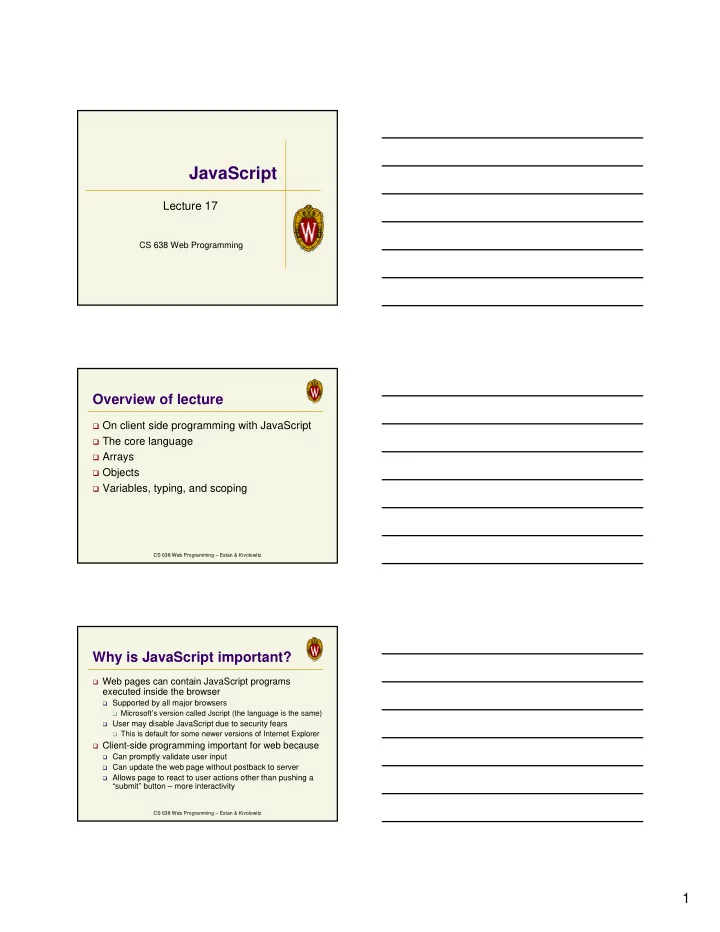
JavaScript Lecture 17 CS 638 Web Programming Overview of lecture On client side programming with JavaScript The core language Arrays Objects Variables, typing, and scoping CS 638 Web Programming Estan & Kivolowitz


slide-1
SLIDE 1

1

CS 638 Web Programming

JavaScript

Lecture 17

CS 638 Web Programming – Estan & Kivolowitz

Overview of lecture

On client side programming with JavaScript The core language Arrays Objects Variables, typing, and scoping

CS 638 Web Programming – Estan & Kivolowitz

Why is JavaScript important?

Web pages can contain JavaScript programs

executed inside the browser

Supported by all major browsers Microsoft’s version called Jscript (the language is the same) User may disable JavaScript due to security fears This is default for some newer versions of Internet Explorer

Client-side programming important for web because

Can promptly validate user input Can update the web page without postback to server Allows page to react to user actions other than pushing a

“submit” button – more interactivity

slide-2
SLIDE 2

2

CS 638 Web Programming – Estan & Kivolowitz

What is JavaScript?

Interpreted, object-oriented programming language

with dynamic typing

Introduced by Netscape with Netscape 2.0 in 1995 Standardized as ECMAScript by ECMA (European

Computer Manufacturers Association)

Not related to Java other than the name

Tightly integrated with browser

Can handle many types of events generated by the normal

interaction between user and browser

Can modify the internal objects based on which the

browser renders the web page

CS 638 Web Programming – Estan & Kivolowitz

<head> <title>JavaScript Hello world!</title> </head> <body> <script> document.write("Hello world!"); </script> </body>

CS 638 Web Programming – Estan & Kivolowitz

Overview of lecture

On client side programming with JavaScript The core language Arrays Objects Variables, typing, and scoping

slide-3
SLIDE 3

3

CS 638 Web Programming – Estan & Kivolowitz

Syntax similar to C++

Statement block delimited by “{“ and “}” Statements separated by ;

If single command per line, the ; can be left out

Spaces, indentation have no semantic value Comments after // or between /* and */ Identifiers contain $, _, letters and digits

Cannot start with a digit Variable names and keywords case sensitive

CS 638 Web Programming – Estan & Kivolowitz

The if and switch statements

if(expression) statement if (expression1) statement1 else if (expression2) statement2 … else if (expressionk) statementk else catch_all_statement switch(n){ case 1: // if n==1 statements1 break; case 2: // if n==2 statements2 break; default: // otherwise statements3 }

The case labels can be strings

  • r even expressions

CS 638 Web Programming – Estan & Kivolowitz

Loops

while (expression) statement do statement while (expression); for (init;test;incr) statement

break ends the innermost

loop or switch

continue jumps to the end

  • f loop

Labels can be used with

nested loops

  • uter: for(i=0;i<5;i++){

for(j=0;j<5;j++){ a[i][j]++; if(a[i][j]<0) break outer; } }

slide-4
SLIDE 4

4

CS 638 Web Programming – Estan & Kivolowitz

Functions and exceptions

Defined as

function fname (args){ statements; }

Invoked as

fname(args)

Execution of function

can be terminated with

return expression;

To throw an exception

throw expression;

To catch an exception

try{ statements1 }catch (e){ statements2 }finally{ statements3 }

CS 638 Web Programming – Estan & Kivolowitz

<body> <h1>Fibonacci numbers</h1> <script language="JavaScript" type="text/javascript"><!-- function fibonacci(n){ if(n==0) return 0; if(n==1) return 1; return fibonacci(n-1)+fibonacci(n-2); } for (i=0;i<25;i++){ document.write("F("); document.write(i); document.write(")="); document.write(fibonacci(i)); document.write("<br/>"); }

  • -></script>

</body>

CS 638 Web Programming – Estan & Kivolowitz

Overview of lecture

On client side programming with JavaScript The core language Arrays Objects Variables, typing, and scoping

slide-5
SLIDE 5

5

CS 638 Web Programming – Estan & Kivolowitz

JavaScript Arrays

Initialized by assigning an array literal a=[]or by

using constructor a=new Array(1,2,3)

Elements’ indices start with 0 Can grow by assignment to inexistent element The length property gives length – a.length Arrays are sparse: a=[’first’];

a[99]=’hundredth’ gives a two elements and a length of 100

Special value undefined returned when inexistent

element read – no exception thrown!

CS 638 Web Programming – Estan & Kivolowitz

<body> <h1>Fibonacci numbers</h1> <script language="JavaScript" type="text/javascript"><!-- f=[0,1]; function fibonacci(n){ if(n>=f.length){ f[n]=fibonacci(n-1)+fibonacci(n-2); } return f[n]; } for (i=0;i<25;i++){ document.write("F("+i+")="+fibonacci(i)+"<br/>"); }

  • -></script>

</body>

CS 638 Web Programming – Estan & Kivolowitz

Useful array methods

join() combines elements into a single string Default separator ‘,’ but can specify different one String.split() method gives array of substrings reverse() reverses the order of elements sort() sorts elements in alphabetic order slice(from,to) returns elements between indices

from and to

Negative “indices” give distance from end of array pop() deletes and returns last element push(e) adds e to end of array, returns new length shift() deletes and returns first element (shifts others) unshift(e) adds e to beginning of array (shifts others)

slide-6
SLIDE 6

6

CS 638 Web Programming – Estan & Kivolowitz

Overview of lecture

On client side programming with JavaScript The core language Arrays Objects Variables, typing, and scoping

CS 638 Web Programming – Estan & Kivolowitz

JavaScript objects

Objects are little more than associative arrays

  • bj.property is same as obj[”property”]

To create a new property, just assign to it Object methods are properties whose values are functions They can use the keyword this to refer to object

Prototype-based inheritance (no classes)

Object x also inherits all properties of x.prototype The constructor is just a function that uses the keyword

this to access the new object

“Class properties” simulated with properties of constructor CS 638 Web Programming – Estan & Kivolowitz

C# vs. JavaScript objects

class Circle{ private int x,y,radius; private const double pi=3.14; public Circle(int xc, int yc, int r){ x=xc;y=yc;radius=r; } public double getArea(){ return radius*radius*pi; } public double getDist(){ return Math.Sqrt((double)(x*x+y*y)); } } …. static void Main(string[] args){ Circle c = new Circle(2,4,3); Console.WriteLine("Area is {0}",c.getArea()); Console.WriteLine("Distance is {0}", c.getDist()); } function Circle(xc,yc,r){ this.x=xc; this.y=yc; this.radius=r; } Circle.prototype.getArea=function(){ return this.radius*this.radius*Circle.pi; } Circle.prototype.getDist=function(){ return Math.sqrt(this.x*this.x+this.y*this.y); } Circle.pi=3.14; c=new Circle(2,4,3); document.write("Area is "+c.getArea()+"<br/>"); document.write("Distance is “+c.getDist()+"<br/>");

slide-7
SLIDE 7

7

CS 638 Web Programming – Estan & Kivolowitz

Traversing an object

The for/in loop

point={x:2,y:4}; for (p in point) document.write(p);

Does not go through

inherited properties

For arrays, the for/in

loop goes through the indices of elements

The in operator

point={x:2,y:4}; has_x=”x” in point; has_z=”z” in point;

Checks inherited

properties

For arrays, the in operator

tests whether the element with the given index exists

CS 638 Web Programming – Estan & Kivolowitz

Overview of lecture

On client side programming with JavaScript The core language Arrays Objects Variables, typing, and scoping

CS 638 Web Programming – Estan & Kivolowitz

Most important types

Numbers – 15 or 0xff or 5.19 or 5.7e15 Strings – ’abc’ or ”abc” or ’a\’\nb’

Concatenation using +

Booleans – true or false Functions – sq=function(x){return x*x;} Arrays – [1,2,3] or [’abc’,[2,5],8] Objects – {x:2,y:3} or {color:”blue”,age:5}

No classes – all objects are of the same type Functions and arrays are also objects

slide-8
SLIDE 8

8

CS 638 Web Programming – Estan & Kivolowitz

JavaScript variables

All variables untyped – x=4;x=’xyz’;x=[] Variables are either global or local to function

No block scope!!!

Variables are declared using the var keyword

Assigning to unused name implicitly declares it as a global Reading an undeclared variable causes an error

reference reference

  • bject (arrays, functions)

value immutable string value value boolean, number Comparison Passed/copied by Types

CS 638 Web Programming – Estan & Kivolowitz

Some JavaScript operators

Assignment with operation lvalue, any +=,-=,*=,… Assignment lvalue, any = Bitwise operators, boolean operators, conditional operator (in)equality, (non)identity any, any ==,===,!==,!=== Comparisons (numeric or lexicographic) num./string, num./string <,<=,>,>= Shift operations integer, integer <<,>>,>>> Addition, subtraction number, number +,- Multiplication, division, remainder number, number *,/,% Increment, decrement Logical complement lvalue bolean ++,-- ! Property access Array index Function call

  • bject, identifier

array, integer function, argument . [] () Operation performed Operand type(s) Operator(s)