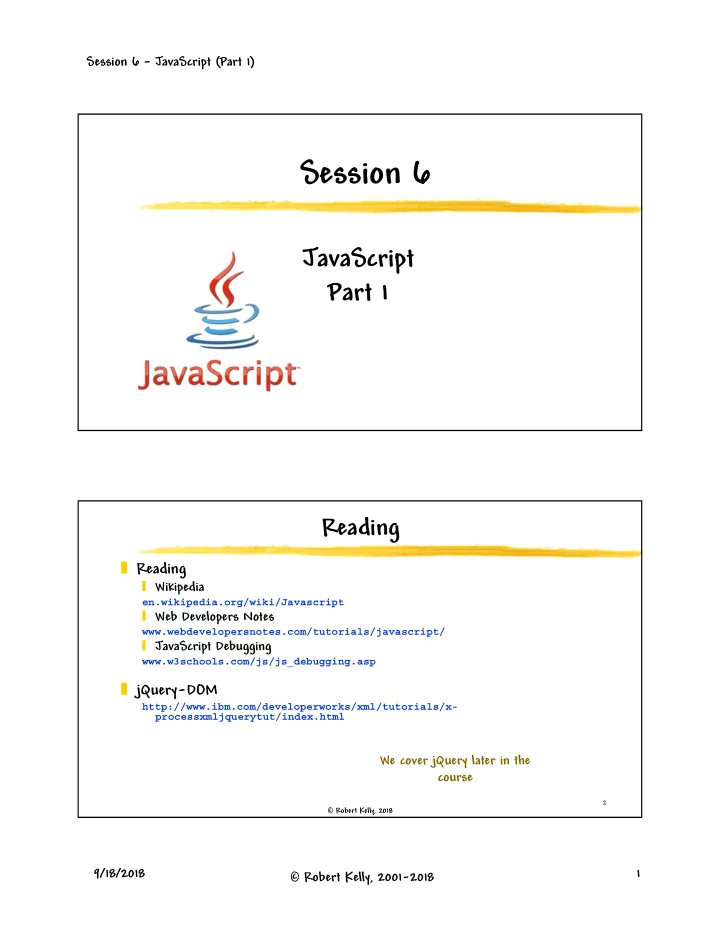
Session 6 JavaScript Part 1 Reading Reading Wikipedia - - PDF document

session 6
SMART_READER_LITE
LIVE PREVIEW

Session 6 JavaScript Part 1 Reading Reading Wikipedia - - PDF document

Session 6 JavaScript (Part 1) Session 6 JavaScript Part 1 Reading Reading Wikipedia en.wikipedia.org/wiki/Javascript Web Developers Notes www.webdevelopersnotes.com/tutorials/javascript/ JavaScript Debugging


slide-1
SLIDE 1

Session 6 – JavaScript (Part 1) 9/18/2018 1 Robert Kelly, 2001-2018

Session 6

JavaScript Part 1

Robert Kelly, 2018 2

Reading

Reading

Wikipedia

en.wikipedia.org/wiki/Javascript

Web Developers Notes

www.webdevelopersnotes.com/tutorials/javascript/

JavaScript Debugging

www.w3schools.com/js/js_debugging.asp

jQuery-DOM

http://www.ibm.com/developerworks/xml/tutorials/x- processxmljquerytut/index.html

We cover jQuery later in the course

slide-2
SLIDE 2

Session 6 – JavaScript (Part 1) 9/18/2018 2 Robert Kelly, 2001-2018

Robert Kelly, 2018

References

Reference

ECMAScript

www.ecma-international.org/publications/files/ECMA-ST/Ecma-262.pdf

Mozilla Guide

https://developer.mozilla.org/en-US/docs/Web/JavaScript/Reference

W3C

www.w3.org/TR/REC-html40/interact/scripts.html

3 Robert Kelly, 2018 4

Reference Book

JavaScript: The Definitive Guide by David Flanagan, O’Reilly Press, 6th Edition (might be available through Safari Books On-Line and Google Books)

the only complete JavaScript book I have seen that is written from a CS perspective

slide-3
SLIDE 3

Session 6 – JavaScript (Part 1) 9/18/2018 3 Robert Kelly, 2001-2018

Robert Kelly, 2018 5

Background Reading

Also possibly available through CS Library using Safari Books On-line

Head First HTML5 Programming: Building Web Apps with JavaScript by Eric Freeman and Elisabeth Robson, O’Reilly Press XML In a Nutshell, Chapter 19 (DOM) Not written for CS majors, but reasonably correct

Robert Kelly, 2018

Learning Goals

Understand differences of JavaScript as compared with Java Understand syntactic and semantic structure of JavaScript Understand use of events

6

slide-4
SLIDE 4

Session 6 – JavaScript (Part 1) 9/18/2018 4 Robert Kelly, 2001-2018

Robert Kelly, 2018

What is JavaScript?

A scripting language (i.e., a lightweight programming language) to use within a browser Usually embedded directly into HTML pages The sole surviving language for Web client programming An interpreted language (means that scripts execute without preliminary compilation)

7

The name officially refers to ECMAScript

Robert Kelly, 2018

Why Should You Learn JavaScript

Useful for

Client side form processing (e.g., field validation) More dynamic graphic UI Dynamic update of html pages - Ajax

8

slide-5
SLIDE 5

Session 6 – JavaScript (Part 1) 9/18/2018 5 Robert Kelly, 2001-2018

Robert Kelly, 2018

Ajax

JavaScript is essential to the use of Ajax Ajax provides a new Web interaction style Examples:

maps.google.com/maps nyc.bestparking.com/

9

With an Ajax application, parts (but not all) of a page will change based

  • n user input

Robert Kelly, 2018

Important Concepts

Low-level syntax of JavaScript is similar to Java, but the object model is very different A JavaScript can be set to respond to GUI events JavaScript treats functions as first class objects (you can use them in places where you would use other objects) JavaScript is a weakly typed language (implicit type conversion) Browsers provide access to the document tree with JavaScript using the Document Object Model (DOM) JavaScript code can request data from the server – for update of the document tree (and browser update of the page) The Browser Object Model (BOM) forms a hierarchy of objects that interact with the browser

10

slide-6
SLIDE 6

Session 6 – JavaScript (Part 1) 9/18/2018 6 Robert Kelly, 2001-2018

Robert Kelly, 2018 11

Hello JS

<html> <body> <h2> <script> document.write("Hello World!"); </script> </h2> </body> </html>

Script tag is used to insert JavaScript into a page Code within a script element is executed immediately when the page is loaded (if it is not in a function) Semicolon is optional (but mandatory for multiple statements on a line)

Robert Kelly, 2018

JavaScript Development

Major browsers have JavaScript debuggers available

Firefox Chrome

NetBeans has good syntax analysis features

12

Be careful in debugging – sometimes a JavaScript function will just return if it encounters an error More on JavaScript debugging once we cover libraries

slide-7
SLIDE 7

Session 6 – JavaScript (Part 1) 9/18/2018 7 Robert Kelly, 2001-2018

Robert Kelly, 2018

JavaScript Object Notation

Syntax similar to Java But what is the document object?

13

document.write("Hello World!");

String literal Method invocation Object name

Robert Kelly, 2018

Window as Global Execution Context

The document object represents the html document The window object represents the browser window that displays the document The window object is the global object (think of it as the default

  • bject)

The document object is a property of the window object

14

window.document.write(…) document.write(…) this.getServletContext(…) getServletContext(…)

Is similar to

slide-8
SLIDE 8

Session 6 – JavaScript (Part 1) 9/18/2018 8 Robert Kelly, 2001-2018

Robert Kelly, 2018

Script Tag – Type Attribute

Possible values

text/javascript text/ecmascript – A standard version of Javascript text/jscript – Microsoft’s version of Javascript text/vbscript – Runs only in IE text/vbs text/xml

With HTML 5, all you need is

15

<script> <script type=“text/javascript>

Robert Kelly, 2018 16

JavaScript Functions

Scripts that appear in the head element of the document are loaded first A non-function script in the head element will execute before the page loads (not too useful) A function defined in the head element will be loaded before anyone uses it, and so is available to any function call in JavaScript located in body

slide-9
SLIDE 9

Session 6 – JavaScript (Part 1) 9/18/2018 9 Robert Kelly, 2001-2018

Robert Kelly, 2018 17

JavaScript Variables

Syntax

var strname = “x”

  • r

strname = “x”

Variables declared within a function are local to the function Variables declared outside a function are properties of the window

  • bject (visible everywhere in the page)

Robert Kelly, 2018 18

Operations

Arithmetic Assignment Comparison Logical String Conditional

Syntax is very similar to Java (both are based on C) All Java keywords are reserved in JavaScript

slide-10
SLIDE 10

Session 6 – JavaScript (Part 1) 9/18/2018 10 Robert Kelly, 2001-2018

Robert Kelly, 2018

Popup Boxes

Alert box – user has to click OK to proceed Confirm box – user has to either click OK or cancel to proceed Prompt box – user enters a value, then clicks either OK or Cancel to proceed

19

alert(“Email must be filled out”); confirm(“sometext”); prompt(“sometext”, “defaultvalue”);

Methods of the Window object Popup boxes act as breakpoints for debugging

Robert Kelly, 2018

Conditional Statements

If, else statements

20

<script> //If the time is less than 10, //you will get a "Good morning" greeting. //Otherwise you will get a "Good day" greeting. var d = new Date() var time = d.getHours() if (time < 10) { document.write("Good morning!") } else { document.write("Good day!") } </script>

End of statement semicolons can be omitted if each statement is on a separate line

slide-11
SLIDE 11

Session 6 – JavaScript (Part 1) 9/18/2018 11 Robert Kelly, 2001-2018

Robert Kelly, 2018

External JavaScripts

Similar to style sheets

Script can either be embedded or referenced in an external file

21

<html> <head> <script src="xxx.js“></script> </head> <body> </body> </html>

Robert Kelly, 2018

Functions

To keep the browser from executing a script as soon as the page is loaded, write your script as a function. A function contains some code that will be executed only by an event or by a call to that function. You may call a function from anywhere within the page Functions are defined at the beginning of a page, in the <head> section (so that they are available when your page begins to load)

22

slide-12
SLIDE 12

Session 6 – JavaScript (Part 1) 9/18/2018 12 Robert Kelly, 2001-2018

Robert Kelly, 2018 23

Function Example

<html> <head> <script> function displaymessage() { alert("Hello World!") } </script> </head> <body> <form> <input type="button" value="Click me!" onclick="displaymessage()" > </form> </body> </html>

Robert Kelly, 2018

Events

Events are actions that can be detected by JavaScript Elements on a Web page have events that can be used to execute JavaScript functions Examples

Mouse click Image load Mouse over Form submittal

24

<input type="button“ value="Click me!“

  • nclick="displaymessage()" >

Notice that these event attributes are not camel case

slide-13
SLIDE 13

Session 6 – JavaScript (Part 1) 9/18/2018 13 Robert Kelly, 2001-2018

Robert Kelly, 2018

Typical Event Handlers

  • nclick - when the pointing device button is clicked over an element
  • nmouseover - when the pointing device is moved onto an element
  • nchange - when a control loses the input focus and its value has been

modified since gaining focus

  • nblur - when an element loses focus either by the pointing device or

by tabbing navigation

  • nfocus - when an element receives focus either by the pointing device
  • r by tabbing navigation
  • nsubmit –when the submit button of a form element is clicked

25 Robert Kelly, 2018

Are We on Track

Write an html page that contains a form with a text box and a submit button When the text box loses focus (after you enter text and hit tab) display an alert box with the text “CSE336”

26

Value of action attribute in form tag does not matter

slide-14
SLIDE 14

Session 6 – JavaScript (Part 1) 9/18/2018 14 Robert Kelly, 2001-2018

Robert Kelly, 2018

Were We on Track?

… <script> function f() { alert(“CSE336"); } </script> </head> <body> <h1>Track - JavaScript Example</h1> <form action="http://localhost:8080/CodeCSE336/JSPs/FormTester3.jsp" method="post" > <input type="text" name="JS-Input" value="Enter text" onblur="f();" /> <br /><input type="submit" /> </form></body></html>

27 Robert Kelly, 2018

Guidelines

White space is ignored Case sensitive Comments (// …)

28

slide-15
SLIDE 15

Session 6 – JavaScript (Part 1) 9/18/2018 15 Robert Kelly, 2001-2018

Robert Kelly, 2018

Objects

Object properties are accessed with the dot (.) operator Object methods invoked with the dot (.) operator and a parameter list ( () ) Built-in objects

String Date Array Boolean

29

var myDate=new Date() myDate.setFullYear(2010,0,14) var mycars=new Array() mycars[0]="Saab“ mycars[1]="Volvo“ mycars[2]="BMW"

Objects are really maps, where the map value can be a function Object encapsulation practice is not like Java

Robert Kelly, 2018

Have You Satisfied the Lecture Objectives?

Understand differences of JavaScript as compared with Java Understand syntactic and semantic structure of JavaScript Understand use of events

30