Java Classes (Java: An Eventful Approach, Ch. 6), 13 November 2012 - - PDF document

java classes
SMART_READER_LITE
LIVE PREVIEW

Java Classes (Java: An Eventful Approach, Ch. 6), 13 November 2012 - - PDF document

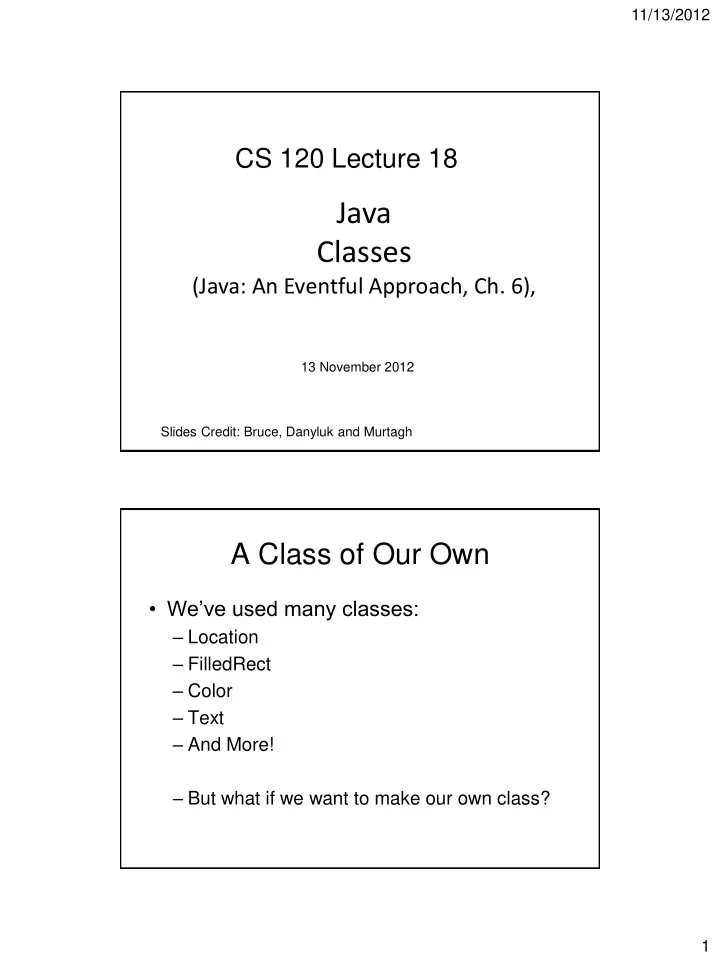
11/13/2012 CS 120 Lecture 18 Java Classes (Java: An Eventful Approach, Ch. 6), 13 November 2012 Slides Credit: Bruce, Danyluk and Murtagh A Class of Our Own Weve used many classes: Location FilledRect Color Text And


slide-1
SLIDE 1

11/13/2012 1

Java Classes

(Java: An Eventful Approach, Ch. 6),

Slides Credit: Bruce, Danyluk and Murtagh

CS 120 Lecture 18

13 November 2012

A Class of Our Own

  • We’ve used many classes:

– Location – FilledRect – Color – Text – And More! – But what if we want to make our own class?

slide-2
SLIDE 2

11/13/2012 2

What if…

We can free ourselves from the limitations of

  • vals and rectangles and move on to…

A Draggable Face

public class RevFaceDrag extends WindowController { private FunnyFace happy; // FunnyFace to be dragged private Location lastPoint; private boolean happyGrabbed = false; // Whether happy has been grabbed by the mouse public void begin() { // Make the FunnyFace happy = new FunnyFace( FACE_LEFT, FACE_TOP, canvas ); } public void onMousePress( Location point ){ lastPoint = point; happyGrabbed = happy.contains( point ); } public void onMouseDrag( Location point ) { if (happyGrabbed ) { happy.move( point.getX() – lastPoint.getX(), point.getY() – lastPoint.getY() ); lastPoint = point; } } }

slide-3
SLIDE 3

11/13/2012 3

Making a Funny Face

  • Physical Characteristics:

– Head – Mouth – Two Eyes

  • Behaviors

– Can check contains – Movable (by dragging)

Components of a Class

  • Instance Variables
  • Methods
  • Constructors (these are new!)
slide-4
SLIDE 4

11/13/2012 4

Instance Variables

  • The data stored in a class
  • Maintain the state of an object
  • Instance variables for FunnyFace:

private FramedOval head; private FramedOval mouth; private FramedOval leftEye, rightEye;

Methods

  • Methods: Sections of code executed at

certain times:

– onMousePress – onMouseDrag – begin

  • Special Types of Methods:

– Mutator Methods – Accessor Methods

slide-5
SLIDE 5

11/13/2012 5

Actual Parameters

  • Information given to a method when the method

is invoked

  • In the invocation of: happy.move (10, 20);

– happy is the object – move is the name of the method – the values 10 and 20 are passed to happy.move

  • Order of parameters matters!

A Mutator Method for FunnyFace

//Move the entire face by (dx,dy) public void move( double dx, double dy ) { head.move( dx, dy ); leftEye.move (dx, dy ); rightEye.move( dx, dy ); mouth.move( dx, dy ); }

slide-6
SLIDE 6

11/13/2012 6

Formal Parameters

  • dx and dy are the formal parameters
  • Formal Parameters:

– used in the method declaration – determine the order of actual parameters – determine the type of the actual parameters

Accessor Methods

  • Return information about an object

// Determine whether pt is inside FunnyFace public boolean contains( Location pt ) { return head.contains( pt ); }

slide-7
SLIDE 7

11/13/2012 7

Constructors

  • A constructor creates an object and

initializes relevant instance variables

  • Invoked by the name of the class

public FunnyFace( double left, double top, DrawingCanvas canvas ){ head = new FramedOval( left, top, FACE_WIDTH, FACE_HEIGHT, canvas ); mouth = new FramedOval( left+(FACE_WIDTH-MOUTH_WIDTH)/2, top+2*FACE_HEIGHT/3, MOUTH_WIDTH, MOUTH_HEIGHT, canvas ); leftEye = new FramedOval( left+EYE_OFFSET-EYE_RADIUS/2, top+2*FACE_HEIGHT/3, MOUTH_WIDTH, MOUTH_HEIGHT, canvas ); rightEye = new FramedOval( left+FACE_WIDTH-EYE_OFFSET- EYE_RADIUS/2, top+EYE_OFFSET, EYE_RADIUS, EYE_RADIUS, canvas ); }

slide-8
SLIDE 8

11/13/2012 8

Class Convention

public class Name { constant definitions variable declarations constructor methods }

Defining Methods Indirectly

  • What if we wanted to move the FunnyFace

to a specified location?

  • We can reuse methods already defined

public void moveTo( double x, double y ) { this.move( x – head.getX(), y – head.getY() ); }

slide-9
SLIDE 9

11/13/2012 9

this

public void moveTo( double x, double y ) { this.move( x – head.getX(), y – head.getY() ); }

  • We can use “this” to refer to object itself

Local Variables

  • Recall variables and their uses:

– Instance Variables: maintain the state of an object – Formal Parameters: Determine the information required by a method

  • Local Variables:

– Declared, initialized and used within a method – Locals do not retain their values between method invocations

slide-10
SLIDE 10

11/13/2012 10

Using Local Variables

public double elapsedMilliseconds() { // Return number of // milliseconds since last reset double diffTime; diffTime = System.currentTimeMillis() – startTime; return diffTime; }

  • diffTime is a local variable

Using Local Variables

  • To simplify difficult calculations
  • To eliminate redundant computations
slide-11
SLIDE 11

11/13/2012 11

Overloading

Evaluating 5 + 7 gives 12 Evaluating "Good" + " Day" gives "Good Day" + is an overloaded operator: it can add numbers and concatenate strings

  • The type of operation is determined by the types
  • f the operands

Overloading II

  • In Java, users cannot define new
  • verloaded operations
  • We can overload methods!
slide-12
SLIDE 12

11/13/2012 12

Overloading III

  • Consider:

public void moveTo( double x, double y ) {

this.move( x – head.getX(), y – head.getY() );

}

And

public void moveTo( Location pt ) {

this.move( pt.getX() – head.getX(), pt.getY() – head.getY() );

}

Overloading IV

  • What determines when each moveTo is

invoked?

  • Answer: The actual parameters
  • moveTo can be invoked either with two

doubles or with a Location

slide-13
SLIDE 13

11/13/2012 13

Review

  • Components of a class

– Instance Variables – Constructors – Methods

  • Formal vs Actual Parameters
  • Instance Variables and Local Variables
  • Overloading

Student To Do’s

  • HW09

– SEVEN!!!! Programs from chapter 7!

  • Practice examples on your own!
  • Read Java: An Eventful Approach

– Ch. 6 (Today)

26