DTrace Topics: -> java/lang/System.arraycopy <- - - PowerPoint PPT Presentation

dtrace topics
SMART_READER_LITE
LIVE PREVIEW

DTrace Topics: -> java/lang/System.arraycopy <- - - PowerPoint PPT Presentation

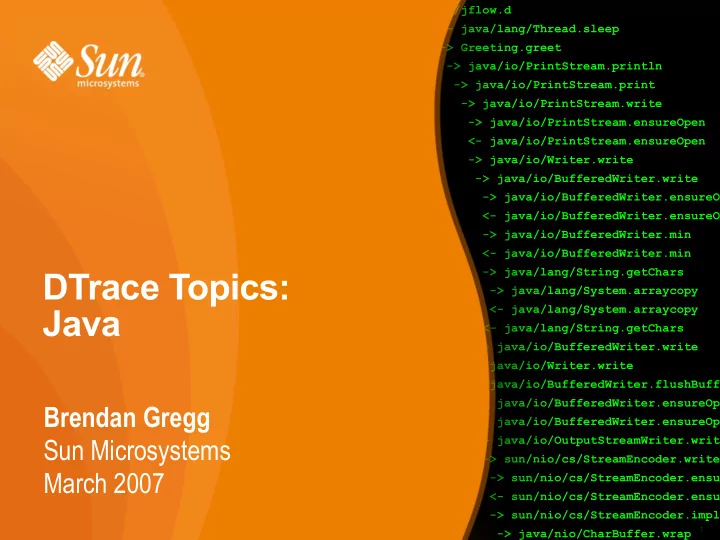
# ./jflow.d <- java/lang/Thread.sleep -> Greeting.greet -> java/io/PrintStream.println -> java/io/PrintStream.print -> java/io/PrintStream.write -> java/io/PrintStream.ensureOpen <- java/io/PrintStream.ensureOpen ->


slide-1
SLIDE 1

1

# ./jflow.d <- java/lang/Thread.sleep

  • > Greeting.greet
  • > java/io/PrintStream.println
  • > java/io/PrintStream.print
  • > java/io/PrintStream.write
  • > java/io/PrintStream.ensureOpen

<- java/io/PrintStream.ensureOpen

  • > java/io/Writer.write
  • > java/io/BufferedWriter.write
  • > java/io/BufferedWriter.ensureO

<- java/io/BufferedWriter.ensureO

  • > java/io/BufferedWriter.min

<- java/io/BufferedWriter.min

  • > java/lang/String.getChars
  • > java/lang/System.arraycopy

<- java/lang/System.arraycopy <- java/lang/String.getChars <- java/io/BufferedWriter.write <- java/io/Writer.write

  • > java/io/BufferedWriter.flushBuff
  • > java/io/BufferedWriter.ensureOp

<- java/io/BufferedWriter.ensureOp

  • > java/io/OutputStreamWriter.writ
  • > sun/nio/cs/StreamEncoder.write
  • > sun/nio/cs/StreamEncoder.ensu

<- sun/nio/cs/StreamEncoder.ensu

  • > sun/nio/cs/StreamEncoder.impl
  • > java/nio/CharBuffer.wrap

DTrace Topics: Java

Brendan Gregg Sun Microsystems March 2007

1

slide-2
SLIDE 2

2

DTrace Topics: Java

  • This presentation is about DTrace and Java, and is

part of the “DTrace Topics” collection.

  • These slides cover:

> DTrace Recap > Java and DTrace > The hotspot Provider > hotspot Examples > Resources

slide-3
SLIDE 3

3

DTrace Recap

  • A general understanding of DTrace is assumed

knowledge for this presentation.

  • If you are new to DTrace, try starting with the

presentation called “DTrace Topics: Intro”.

  • The next two slides are a short summary of DTrace,

if needed.

slide-4
SLIDE 4

4

What is DTrace

  • DTrace is a dynamic troubleshooting and analysis

tool first introduced in the Solaris 10 and OpenSolaris operating systems.

  • DTrace is many things, in particular:

> A tool, /usr/sbin/dtrace > A programming language interpreter, the D language > An instrumentation framework

  • DTrace operates with low overhead when in use,

and zero overhead when not.

  • DTrace is designed to be safe for production use.
slide-5
SLIDE 5

5

What is DTrace

  • DTrace can observe the entire software stack from
  • ne tool. It is like a combination of,

> truss, sotruss, apptrace, mdb, lockstat, prex/tnf*, C, awk

  • root and users with DTrace privileges can use it.
  • DTrace traces events at dynamic instrumentation

points called probes. There are thousands of them.

  • providers are libraries of related probes.
  • When probes fire, arbitry actions can be performed,

> Eg: print functions and arguments, measure latencies,

process data, walk process and kernel memory, ...

slide-6
SLIDE 6

6

Java and DTrace

  • In the first release of Solaris 10, DTrace provided a

jstack() action to read Java stack traces.

  • For JDK 1.4.2 and 5.0, prototype DTrace Java

providers were released as loadable VM agent libraries, first named “djvm” then “dvm”.

  • The hotspot DTrace Java provider was integrated

in JDK 6.0, ready for immediate use.

slide-7
SLIDE 7

7

jstack()

  • This can be used with:

> The profile provider, to sample frequent stack traces.

This can identify Java code hot spots.

> The pid provider, to show how Java interacts with user

libraries.

> The syscall provider, to determine what Java causes the

system to do.

slide-8
SLIDE 8

8

jstack() example

  • The following shows why Java caused a read():

# dtrace -n 'syscall::read:entry /execname == "java"/ { jstack(); }' [...] 0 75943 read:entry libc.so.1`_read+0x7 libX11.so.4`_X11TransSocketRead+0x25 libX11.so.4`_X11TransRead+0x17 libX11.so.4`_XRead+0x58 libX11.so.4`_XReply+0xcd libX11.so.4`XGetInputFocus+0x68 libmawt.so`Java_sun_awt_X11_XlibWrapper_XGetInputFocus+0x27 sun/awt/X11/XlibWrapper.XGetInputFocus(J)J sun/awt/X11/XBaseWindow.xGetInputFocus()J sun/awt/X11/XWindowPeer.handleFocusEvent(J)V sun/awt/X11/XDecoratedPeer.handleFocusEvent(J)V sun/awt/X11/XFocusProxyWindow.handleFocusEvent(J)V sun/awt/X11/XFocusProxyWindow.dispatchEvent(Lsun/awt/X11/IXAnyEve sun/awt/X11/XBaseWindow.dispatchToWindow(Lsun/awt/X11/IXAnyEvent;

syscall user libraries Java code

slide-9
SLIDE 9

9

djvm/dvm Provider

  • If possible, move the application to JDK 6.0 and use

the integrated hotspot provider.

  • If you are stuck on JDK 1.4.2 or 5.0, you can try the

djvm/dvm prototype provider.

  • They require command line configuration and the

application to be restarted.

  • The provider can be downloaded from,

> https://solaris10-dtrace-vm-agents.dev.java.net

  • Some examples of its usage are here,

> http://blogs.sun.com/ahl/entry/dtracing_java

slide-10
SLIDE 10

10

hotspot Provider Probes

  • hotspot provides numerous probes, including:

> Class events,

class-loaded

A class loaded

class-unloaded

A class unloaded

> Method invocation,

method-entry

A method begins

method-return

A method completed

> Object events,

  • bject-alloc

An object was allocated

> Garbage collect,

gc-begin

System wide GC begins

gc-end

System wide GC ended

slide-11
SLIDE 11

11

hotspot Provider Probes

> Thread events,

thread-start

A thread has started

thread-stop

A thread completed

> Monitor events > VM events

  • The method-* probes can degrade performance,

and are only enabled with the VM flag

ExtendedDTraceProbes.

  • The full reference for probes and their arguments is:

http://java.sun.com/javase/6/docs/technotes/guides/vm/dtrace.html

slide-12
SLIDE 12

12

hotspot Example #1

  • The hotspot provider will be demonstrated by

tracing a simple Java program.

  • The following Greeting.java code may look familiar,

many Java tutorials begin with something similar:

$ cat Greeting.java public class Greeting { public void greet() { System.out.println("Hello DTrace!"); } }

Greeting class

slide-13
SLIDE 13

13

hotspot Example #1

  • Now the test harness:

$ cat TestGreeting.java public class TestGreeting { public static void main(String[] args) { Greeting hello = new Greeting(); while (true) { hello.greet(); try { Thread.currentThread().sleep(1000); } catch (InterruptedException e) { } } } }

TestGreeting class

call greet method every second

slide-14
SLIDE 14

14

hotspot Example #1

  • Compiling, executing:
  • This simple program produces some known events

that we can trace.

$ javac TestGreeting.java $ java TestGreeting Hello DTrace! Hello DTrace! Hello DTrace! Hello DTrace! ^C

slowly scrolling output

slide-15
SLIDE 15

15

Example #1: jstack()

  • We will start with jstack() (not hotspot!). We know

that this program writes output, ie syscall::write

# dtrace -n 'syscall::write:entry /execname == "java"/ { jstack(); }' 0 75945 write:entry libc.so.1`_write+0x7 libjvm.so`__1cDhpiFwrite6FipkvI_I_+0xa0 libjvm.so`JVM_Write+0x36 libjava.so`writeBytes+0x154 libjava.so`Java_java_io_FileOutputStream_writeBytes+0x3f java/io/FileOutputStream.writeBytes([BII)V java/io/FileOutputStream.write([BII)V java/io/BufferedOutputStream.flushBuffer()V java/io/BufferedOutputStream.flush()V java/io/PrintStream.write([BII)V sun/nio/cs/StreamEncoder.writeBytes()V sun/nio/cs/StreamEncoder.implFlushBuffer()V [...continued...]

slide-16
SLIDE 16

16

Example #1: jstack()

> Read the stack trace above Greeting.greet carefully.

How many Java classes do you recognize?

sun/nio/cs/StreamEncoder.flushBuffer()V java/io/OutputStreamWriter.flushBuffer()V java/io/PrintStream.newLine()V java/io/PrintStream.println(Ljava/lang/String;)V Greeting.greet()V TestGreeting.main([Ljava/lang/String;)V StubRout libjvm.so`__1cJJavaCallsLcall_helper6FpnJJavaValue_pnMmethodHan libjvm.so`__1cCosUos_exception_wrapper6FpFpnJJavaValue_pnMmetho libjvm.so`__1cJJavaCallsEcall6FpnJJavaValue_nMmethodHandle_pnRJ libjvm.so`__1cRjni_invoke_static6FpnHJNIEnv__pnJJavaValue_pnI_j libjvm.so`jni_CallStaticVoidMethod+0x15d java`JavaMain+0xd30 libc.so.1`_thr_setup+0x52 libc.so.1`_lwp_start

Ah-ha!

slide-17
SLIDE 17

17

Example #1: Listing Probes

  • Now to see what the hotspot provider can do:

> 1014 probes, 498 unique probe names == deep visibility!

# dtrace -ln 'hotspot*:::' ID PROVIDER MODULE FUNCTION NAME 52103 hotspot_jni278338 libjvm.so jni_GetObjectRefType GetOb 52104 hotspot_jni278338 libjvm.so jni_GetObjectRefType GetOb 52105 hotspot_jni278338 libjvm.so jni_GetPrimitiveArrayCritical GetPr 52106 hotspot_jni278338 libjvm.so jni_GetPrimitiveArrayCritical GetPr 52107 hotspot_jni278338 libjvm.so jni_GetShortArrayElements GetSh [...] # dtrace -ln 'hotspot*:::' | wc -l 1015 # dtrace -ln 'hotspot*:::' | awk '{print $5}' | sort -u | wc -l 499

slide-18
SLIDE 18

18

Example #1: Tracing Probes

  • Watching all enabled hotspot events:
  • Output scrolls rather fast...

# dtrace -n 'hotspot*:::' dtrace: description 'hotspot*:::' matched 1014 probes CPU ID FUNCTION:NAME 0 66465 jni_GetArrayLength:GetArrayLength-entry 0 66466 jni_GetArrayLength:GetArrayLength-return 0 66529 jni_GetObjectField:GetObjectField-entry 0 66530 jni_GetObjectField:GetObjectField-return 0 66529 jni_GetObjectField:GetObjectField-entry 0 66530 jni_GetObjectField:GetObjectField-return 0 66475 jni_GetByteArrayRegion:GetByteArrayRegion-entry 0 66476 jni_GetByteArrayRegion:GetByteArrayRegion-return 0 66456 jni_ExceptionOccurred:ExceptionOccurred-entry 0 66457 jni_ExceptionOccurred:ExceptionOccurred-return [...]

slide-19
SLIDE 19

19

Example #1: Aggregating Probes

> Interesting, but some expected probes are missing (eg,

method-entry). We can enable additional probes...

# dtrace -n 'hotspot*::: { @[probename] = count(); }' dtrace: description 'hotspot*::: ' matched 1014 probes ^C ExceptionOccurred-entry 8 ExceptionOccurred-return 8 GetArrayLength-entry 8 GetArrayLength-return 8 GetByteArrayRegion-entry 8 GetByteArrayRegion-return 8 GetObjectField-entry 16 GetObjectField-return 16

slide-20
SLIDE 20

20

Example #1: Extended Probes

  • Extended probes are not activated by default as

they may degrade performance on busy apps.

  • They can be enabled using,

> An option to java: -XX:+ExtendedDTraceProbes > An option to jinfo: -flag +ExtendedDTraceProbes

# java -XX:+ExtendedDTraceProbes TestGreeting Hello DTrace! Hello DTrace! Hello DTrace! [...]

slide-21
SLIDE 21

21

Example #1: Extended Probes

> Now we see method-entry and method-return, which

  • ccurred 496 times while this was tracing (4 seconds).

# dtrace -n 'hotspot*::: { @[probename] = count(); }' dtrace: description 'hotspot*::: ' matched 1014 probes ^C ExceptionOccurred-entry 8 ExceptionOccurred-return 8 GetArrayLength-entry 8 GetArrayLength-return 8 GetByteArrayRegion-entry 8 GetByteArrayRegion-return 8

  • bject-alloc 8

GetObjectField-entry 16 GetObjectField-return 16 method-entry 496 method-return 496

slide-22
SLIDE 22

22

Example #1: Tracing Methods

  • The class and method name can be fetched from

the probe arguments:

# dtrace -qn 'hotspot*:::method-entry { printf("-> %4s.%s\n", stringof(copyin(arg1, arg2)), stringof(copyin(arg3, arg4))); }'

  • > Greeting.greet
  • > java/io/PrintStream.println
  • > java/io/PrintStream.print
  • > java/io/PrintStream.write
  • > java/io/PrintStream.ensureOpen
  • > java/io/Writer.write
  • > java/io/BufferedWriter.write
  • > java/io/BufferedWriter.ensureOpen
  • > java/io/BufferedWriter.min
  • > java/lang/String.getChars
  • > java/lang/System.arraycopy
  • > java/io/BufferedWriter.flushBuffer

[...]

Live class.method calls!

slide-23
SLIDE 23

23

Example #1: Aggregating Methods

> Identify most frequently called methods.

# dtrace -qn 'hotspot*:::method-entry { @calls[stringof(copyin(arg1, arg2)), stringof(copyin(arg3,arg4))] = count(); } END { printa("%48s.%-24s %@4d\n", @calls); }' ^C Greeting.greet 2 java/io/BufferedWriter.ensureOpen 2 java/io/BufferedWriter.minureOpen 2 java/io/BufferedWriter.writeeOpen 2 java/io/BufferedWriteropflushBuffer.ensureOpenr 2 java/io/BufferedWriteropyinureOpen.flushBuffer 2 java/io/OutputStreamWritersureOpenr.write 2 java/io/PrintStream.ensureOpen 2 [...truncated...] java/nio/CharBuffer$EncoarrayOffsetodeArrayLoop.arrayOffsetodeArrayLoop 20 java/nio/ByteBuffer$EncoarrayOffsetodeArrayLoop.arrayOffsetodeArrayLoop 30

slide-24
SLIDE 24

24

Example #1: Aggregating Methods

Wait a sec, These don't look right – the strings have been corrupted.

  • If you see such output, the end of the copyin string

needs to be manually terminated.

[...] java/nio/CharBuffer$EncoarrayOffsetodeArrayLoop.arrayOffsetodeArrayLoop 20 java/nio/ByteBuffer$EncoarrayOffsetodeArrayLoop.arrayOffsetodeArrayLoop 30

slide-25
SLIDE 25

25

Example #1: Aggregating Methods

  • Now a script is written to aggregate methods with

string termination:

# ./jagg.d Tracing... Hit Ctrl-C to end. ^C Greeting.greet 3 java/io/BufferedWriter.newLine 3 java/io/PrintStream.newLine 3 java/io/PrintStream.print 3 java/io/PrintStream.println 3 java/lang/Thread.currentThread 3 [...] java/nio/charset/CoderResult.isUnderflow 12 java/nio/Buffer.position 18 java/nio/CharBuffer.arrayOffset 18 java/nio/ByteBuffer.arrayOffset 24

slide-26
SLIDE 26

26

# cat jagg.d #!/usr/sbin/dtrace -qs dtrace:::BEGIN { printf("Tracing... Hit Ctrl-C to end.\n"); } hotspot*:::method-entry { this->class = (char *) copyin(arg1, arg2 + 1); this->class[arg2] = '\0'; this->method = (char *) copyin(arg3, arg4 + 1); this->method[arg4] = '\0'; @calls[stringof(this->class), stringof(this->method)] = count(); } dtrace:::END { printa("%48s.%-24s %@4d\n", @calls); }

slide-27
SLIDE 27

27

Example #1: Method Flow

  • With some more scripting, flow indented method

calls can be printed:

# ./jflow.d <- java/lang/Thread.sleep

  • > Greeting.greet
  • > java/io/PrintStream.println
  • > java/io/PrintStream.print
  • > java/io/PrintStream.write
  • > java/io/PrintStream.ensureOpen

<- java/io/PrintStream.ensureOpen

  • > java/io/Writer.write
  • > java/io/BufferedWriter.write
  • > java/io/BufferedWriter.ensureOpen

<- java/io/BufferedWriter.ensureOpen

  • > java/io/BufferedWriter.min

<- java/io/BufferedWriter.min [...]

slide-28
SLIDE 28

28

Example #1: jflow.d

# cat jflow.d #!/usr/sbin/dtrace -s #pragma D option quiet hotspot*:::method-entry { self->indent++; printf("%*s %s %s.%s\n", self->indent, "", "->", stringof(copyin(arg1, arg2)), stringof(copyin(arg3,arg4))); } hotspot*:::method-return { printf("%*s %s %s.%s\n", self->indent, "", "<-", stringof(copyin(arg1, arg2)), stringof(copyin(arg3,arg4))); self->indent--; }

slide-29
SLIDE 29

29

Example #1: Stack Flow

  • DTrace can observe all layers of the software stack.
  • The following example demonstrates this capability,

and was actually from the prototype provider,

http://blogs.sun.com/ahl/entry/dtracing_java

  • > java/io/InputStreamReader:read
  • > sun/nio/cs/StreamDecoder:read
  • > sun/nio/cs/StreamDecoder:read0
  • > libc.so.1:malloc
  • > libc.so.1:_smalloc

<- libc.so.1:_smalloc <- libc.so.1:malloc

  • > sun/nio/cs/StreamDecoder:read
  • > sun/nio/cs/StreamDecoder:ensureOpen

<- sun/nio/cs/StreamDecoder:ensureOpen [...]

Java Java libc

slide-30
SLIDE 30

30

Example #1: Object Allocation

  • The creation of a new object can be traced with
  • bject-alloc:

# dtrace -qn 'hotspot*:::object-alloc { printf("new %s\n", stringof(copyin(arg1, arg2))); }' new java/nio/HeapCharBuffer new java/nio/HeapCharBuffer new java/nio/HeapCharBuffer new java/nio/HeapCharBuffer [...]

slide-31
SLIDE 31

31

Example #1: Method Times

  • With method-entry and method-return probes, and

DTrace's ability to measure nanosecond timestamps, the time to execute methods can be measured.

  • This can help identify bottlenecks in Java code.
  • Things start to get a little harder. Be aware of,

> overlapping methods > multiple Java threads executing concurrently > Java threads context switching off the CPUs > DTrace overheads at nanosecond resolutions > recursive methods?

slide-32
SLIDE 32

32

Example #1: What's next

  • Further analysis can be performed using:

> Other hotspot probes > Other DTrace providers > Scripting to identify events of interest

  • The possibilities for analysis are near-endless. This

is great if you are troubleshooting a known problem – as DTrace should have the power to find it.

slide-33
SLIDE 33

33

Resources

  • To learn more about DTrace and Java,

http://java.sun.com/javase/6/docs/technotes/guides/vm/dtrace.html

  • Search the Internet for “DTrace Java”, in particular

are articles written by:

> Adam Leventhal > Kelly O'Hair

  • Find Examples of DTracing Java in

/usr/jdk/instances/jdk1.6.0/sample/dtrace/hotspot

  • Check my blog: http://blogs.sun.com/brendan
slide-34
SLIDE 34

34

dtrace:::END

Brendan Gregg brendan@sun.com

34