JASAL2019 Schedule (S) My Share (R) Research Saturday 30th - - PowerPoint PPT Presentation

jasal2019 schedule
SMART_READER_LITE
LIVE PREVIEW

JASAL2019 Schedule (S) My Share (R) Research Saturday 30th - - PowerPoint PPT Presentation

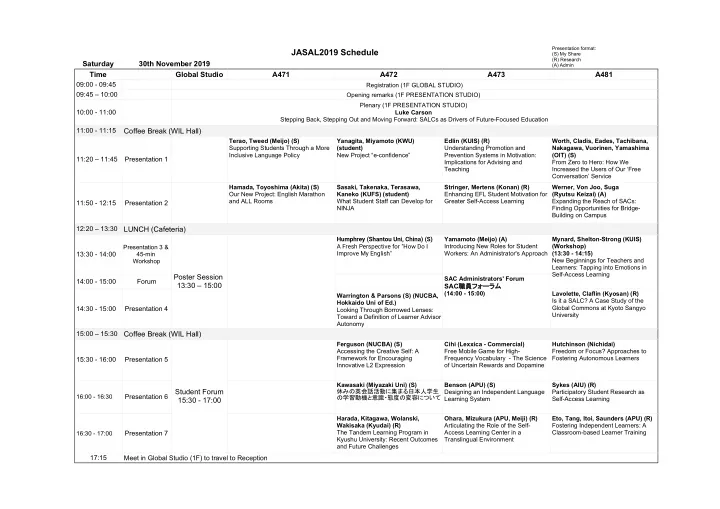
Presentation format: JASAL2019 Schedule (S) My Share (R) Research Saturday 30th November 2019 (A) Admin Time Global Studio A471 A472 A473 A481 09:00 - 09:45 Registration (1F GLOBAL STUDIO) 09:45 10:00 Opening remarks (1F


slide-1
SLIDE 1

JASAL2019 Schedule

Presentation format: (S) My Share (R) Research (A) Admin

Saturday 30th November 2019 Time Global Studio A471 A472 A473 A481

09:00 - 09:45

Registration (1F GLOBAL STUDIO)

09:45 – 10:00

Opening remarks (1F PRESENTATION STUDIO)

10:00 - 11:00

Plenary (1F PRESENTATION STUDIO) Luke Carson Stepping Back, Stepping Out and Moving Forward: SALCs as Drivers of Future-Focused Education

11:00 - 11:15

Coffee Break (WIL Hall)

11:20 – 11:45 Presentation 1

Terao, Tweed (Meijo) (S) Supporting Students Through a More Inclusive Language Policy Yanagita, Miyamoto (KWU) (student) New Project “e-confidence” Edlin (KUIS) (R) Understanding Promotion and Prevention Systems in Motivation: Implications for Advising and Teaching Worth, Cladis, Eades, Tachibana, Nakagawa, Vuorinen, Yamashima (OIT) (S) From Zero to Hero: How We Increased the Users of Our ‘Free Conversation’ Service

11:50 - 12:15 Presentation 2

Hamada, Toyoshima (Akita) (S) Our New Project: English Marathon and ALL Rooms Sasaki, Takenaka, Terasawa, Kaneko (KUFS) (student) What Student Staff can Develop for NINJA Stringer, Mertens (Konan) (R) Enhancing EFL Student Motivation for Greater Self-Access Learning Werner, Von Joo, Suga (Ryutsu Keizai) (A) Expanding the Reach of SACs: Finding Opportunities for Bridge- Building on Campus

12:20 – 13:30

LUNCH (Cafeteria)

13:30 - 14:00

Presentation 3 & 45-min Workshop

Poster Session 13:30 – 15:00

Humphrey (Shantou Uni, China) (S) A Fresh Perspective for "How Do I Improve My English" Yamamoto (Meijo) (A) Introducing New Roles for Student Workers: An Administrator's Approach Mynard, Shelton-Strong (KUIS) (Workshop) (13:30 - 14:15) New Beginnings for Teachers and Learners: Tapping into Emotions in Self-Access Learning

14:00 - 15:00 Forum

SAC Administrators' Forum

SAC職員フォーラム

(14:00 - 15:00)

14:30 - 15:00 Presentation 4

Warrington & Parsons (S) (NUCBA, Hokkaido Uni of Ed.) Looking Through Borrowed Lenses: Toward a Definition of Learner Advisor Autonomy Lavolette, Claflin (Kyosan) (R) Is it a SALC? A Case Study of the Global Commons at Kyoto Sangyo University

15:00 – 15:30

Coffee Break (WIL Hall)

15:30 - 16:00 Presentation 5

Student Forum 15:30 - 17:00

Ferguson (NUCBA) (S) Accessing the Creative Self: A Framework for Encouraging Innovative L2 Expression Cihi (Lexxica - Commercial) Free Mobile Game for High- Frequency Vocabulary - The Science

  • f Uncertain Rewards and Dopamine

Hutchinson (Nichidai) Freedom or Focus? Approaches to Fostering Autonomous Learners 16:00 - 16:30

Presentation 6

Kawasaki (Miyazaki Uni) (S) 休みの英会話活動に集まる日本人学生 の学習動機と意識・態度の変容について Benson (APU) (S) Designing an Independent Language Learning System Sykes (AIU) (R) Participatory Student Research as Self-Access Learning 16:30 - 17:00

Presentation 7

Harada, Kitagawa, Wolanski, Wakisaka (Kyudai) (R) The Tandem Learning Program in Kyushu University: Recent Outcomes and Future Challenges Ohara, Mizukura (APU, Meiji) (R) Articulating the Role of the Self- Access Learning Center in a Translingual Environment Eto, Tang, Itoi, Saunders (APU) (R) Fostering Independent Learners: A Classroom-based Learner Training

17:15 Meet in Global Studio (1F) to travel to Reception

slide-2
SLIDE 2

JASAL2019 Schedule

Sunday 1st December 2019 Time Presentation Studio (1F) A261 (Tech stream) A271

09:30 – 10:00 Registration (Global Studio) 10:00 - 10:25 Presentation 8

Thornton (Otemon) (R) Incentivising SAC Use: The Role of Different Reward Schemes in Service Uptake at a Self-Access Centre Andersson (Handai) (S) Can Learning Also Be Fun? Current and Future Considerations for Digital Game-Based L2 Learning

10:30 - 10:55 Presentation 9

Hays (TIU) (A) Peers Helping Peers: Daily Management of the English PLAZA Peeters (KUIS) (R) The Development of Peer Collaboration and Learner Autonomy in Online Social Networking Spaces Bennett (KUIS) (S) Transitioning into an Advisor

11:00 – 11:30 Coffee Break (WIL Hall) 11:30 - 11:55 Presentation 10

Peña Clavel (UNAM, Mexico) (S) A Theoretical Proposal for conceiving Mexican SALCs into Learning Ecosystems Chen Jingyi (Handai) (R) 自己管理型オンライン学習における動機 づけプロセス:仮想学習環境における日 本語学習の事例から Fukutome (Yamanashi Gakuin Uni) (S) Discovering the Roles of the Language Learning Advisor: My Personal Journey

12:00- 12:25 Presentation 11

Lee (Gifu Uni) (S) Managing a University English Club as an Advisory Instructor Allensworth (Handai) (R) Analysis of Reward and Motivation Systems in Commercial and Non- Profit Self-Access Learning Systems Hayashi & Cai (Handai) (R) 対面式タンデム学習における自律的な 学習とその変化

12:30 – 12:50 JASAL AGM (Presentation Studio) 12::50 – 13:15 Reflection & Closing Remarks (Presentation Studio) 13:15 – 14:00 Lunch (Global Studio)

slide-3
SLIDE 3

JASAL2019 Poster Presentations Part 1 (13:30 - 14:15)

Kevin Mueller, Tokyo International University Self-Access Learning Center Challenge: Balancing Human Resources, Student Demand, and Scheduling Considerations for Academic Advising and Conversation Practice The Global Teaching Institute (GTI) at Tokyo International University has two areas, Academic Advising (AA) and English Lounge (EL), where students can interact with faculty and high-proficiency peers outside of class in at Self- Access Learning Center called The English Plaza. With fifty faculty members and 26 student staff, human resources are limited as TIU has an approximate student population of 4,800 on Campus 1; 2,000 students major in English or take English content-based courses. Balancing human resources, student demand, and scheduling considerations are a challenge, and these three facets will be discussed. Richard Hill, Meijo University A Comparison of Two Social Areas In speaking practice centers, students can make appointments to meet one-on-one with a teacher or a learning advisor in order to develop their oral language skills. Alternatively, students can sit down with conversation partners or other students to converse freely on sofas without making an appointment in advance. From the presenter's experiences, learners are drawn to these social spaces for various reasons. While both spaces present opportunities to use the target language, their arrangements exhibit particular affordances and constraints. In this research presentation, I will show my conclusions from comparing these two spaces in order to reveal their unique qualities. Chelsea Schwartz, Juntendo University; Jarwin Martin, Temple University Academic Advising in Self-Access Learning This presentation will demonstrate the significance of academic advising in the self-access environment. Students

  • ften need clear and supportive guidance in attaining their academic goals. Once advised, this can help assist them in

being more autonomous in fulfilling their goals. This presentation aims to share some ideas that can be utilized in academic advising. Chris Pond, Scot Matsuo, Ritsumeikan University Enhancing Student Participation and Experience in Newly Constructed Self-Access Centers This presentation reports on efforts made in enhancing student participation and experience across two newly constructed SACs at a private university in the Kansai area. These SACs, across two campuses, are still in their infancy, and as the foundations for the culture of the centers are being laid the students’ participation is increasing. This presentation will focus on the opportunities provided for student self-access learning as well as students' own experiences of using the facilities. Through access to communication rooms, cultural events, and learning support, we will show how teachers, staff, and students collaborated to create a vibrant self-access language learning environment. Hoey Liu, Ryuhei Ikeda, Ayaka Satake (students), Otemon Gakuin University Internship at E-CO English Café at Otemon (E-CO) is a self-access centre at Otemon Gakuin University, which started an Internship Programme in Spring Semester 2018. To date, four students have taken part in this programme, learning administrative skills, organizing events and conducting research. In this poster presentation, interns will present the structure of the internship, their experiences, and discuss what they have learned by joining the internship. The greatest benefit of the E-CO Internship is that you can learn workplace skills and even get credits for it. Phoebe Lyon, Ewen MacDonald, Nicholas Thompson, Kanda University of International Studies Assessing the Impact of Encouraging Language Majors in Japan to Partake in Linguistic Risk-taking Activities This presentation summarises the rationale, background, methods and preliminary findings of an adaptation of a linguistic risk-taking passport initiative at a Japanese university. The aim is to encourage students to take various risks to build their confidence during their language learning journeys. The level, nature and frequency of linguistic risks taken by students was investigated, as well as students’ anxiety and confidence levels, willingness to communicate and their strategies for managing emotions. Initial findings indicated that many students were able to discover new

  • pportunities for practicing English and felt more comfortable and confident using English and taking risks.

Manami Ichinotani (student), Konan Women’s University

English Shop by Student Staff: Bringing my Experience in Study Abroad into the Event In this presentation, an activity developed at a self-access center while I was a student staff member will be presented and it is based on challenges I had in ordering food during my own study abroad. The goal of the activity is to have participants learn to

  • rder and serve food in English, for example in a café or ice cream shop. I will discuss the evolution of this activity, which was

revised 4 times over the course of 2 semesters, revisions which led to a more practical focus and I look forward to other ideas and suggestions from attendees.

slide-4
SLIDE 4

JASAL2019 Poster Presentations Part 2 (14:15 - 15:00)

Misato Saunders, Ritsumeikan Asia Pacific University Effective Ways to Study IELTS at the Self-Access Learning Center At Ritsumeikan Asia Pacific University (APU), many students apply for Exchange programs every year. In order to enter these programs, students must work really hard to improve their English skills, so many students visit the language advisors to get some advice at the SALC. As a language advisor, I strongly recommend them to take the IELTS test because by studying the IELTS, they can not only enter the program but also improve their practical English skills. In this session, I would like to share my IELTS advising and teaching at the SALC as a language advisor.

Anna Twitchell, Heather Yoder, Bethan Kushida, Jeffrey Goncalves, Kanda University of International Studies

Passport to Success: Students’ Preferred Tasks for Linguistic Risk-Taking This poster will present the results of a pilot study conducted at a private Japanese university. Inspired by an earlier study at the University of Ottawa and adapted for a monolingual EFL context, participants with a “risk- taking passport” chose from a list of in-class and out-of-class tasks that provided opportunities to use the target

  • language. This presentation will focus on the tasks that participants chose to do and will analyze which tasks

appealed to learners based on data collected from passport responses and participant interviews. Discussion will include implications for how teachers may encourage students to take linguistic risks. Yuri Imamura, Isra Wongsarnpigoon, Kanda University of International Studies Nurturing Learners’ Use of an English Speaking Area in a Multilingual Space

This presentation describes ongoing research on usage of an English speaking area located within a multilingual space at a self-access center in a university specializing in language studies. The research focuses on the effectiveness of events for promoting English usage in the area and raising awareness of its purpose. We also investigated learners’ attitudes about the events, the area, and their own language use. Preliminary results from questionnaire and interview data are introduced. They can aid educators who aim to support or establish environments for learners’ English speaking or who are interested in target language usage in language-learning spaces.

Katherine Shreves, Hokuriku Gakuin Encouraging Greater SAC Use: A Case Study of Instructor-Led Activities Designed for Students in the Department of Child Education at Hokuriku Gakuin University In order to encourage students towards greater engagement with Hokuriku Gakuin’s English Center, new instructor-led activities are being designed and implemented. Based on survey results from first-year students in the Department of Childhood Education, student-perceived needs and interests were identified. This presentation reports on the ongoing implementation of activities responding to these needs and interests. Participation in such activities has the potential to not only improve English ability but also aid in the development of skills useful for future teachers. Whether or not relevance to a particular course of study acts as a motivating factor for engagement is also discussed. Yuka Sakuma, Mami Okawa, Risa Matsui (students), Konan Women’s University How to Increase the Number of "e-space" Users The ‘e-space’ is the self-access English learning space in Konan Women’s University and as student staff, we noticed a smaller number of sophomore and junior students in the e-space and took steps to increase the number

  • f e-space users, especially among 2nd and 3rd year students. We first researched the current situation through a

survey questionnaire and I will present that data. Next, I will talk about what we did in the e-space to increase the number of student users, and share what changes we saw. I hope to have further suggestions and ideas from the attendees. 加藤 鉄生(Kato Tetsuo), 中部大学 Chubu University パラダイム転換期の持続可能ラーニング実践ー理系基礎科目学習からのアプローチ 教育から学習へのパラダイム転換機に「ソフトスキル」を持った学生の育成が大学には望まれている。すなわち「メタ認知ス キルを持った学生」であり、セルフモニタリング、セルフコーチングなど、自らの学び方の技術を身につけた学生を養成してい くことである。本発表では支援の必要な学習者層に持続可能な学習を定着化させる実践を行い、理系基礎科目の学際的な 学習を通じて学習の仕方を学ぶ機会を提供した手法と成果を報告する。