Japan's Renewable Energy Options The Economics of The Economics of - - PowerPoint PPT Presentation

japan s renewable energy options
SMART_READER_LITE
LIVE PREVIEW

Japan's Renewable Energy Options The Economics of The Economics of - - PowerPoint PPT Presentation

The Alternatives to Nuclear Power: Japan's Renewable Energy Options The Economics of The Economics of The Green Industrial Revolution W II MA3, PhD Woodrow (Woody) W. Clark II MA3, PhD Qualitative Economist Miyako


slide-1
SLIDE 1

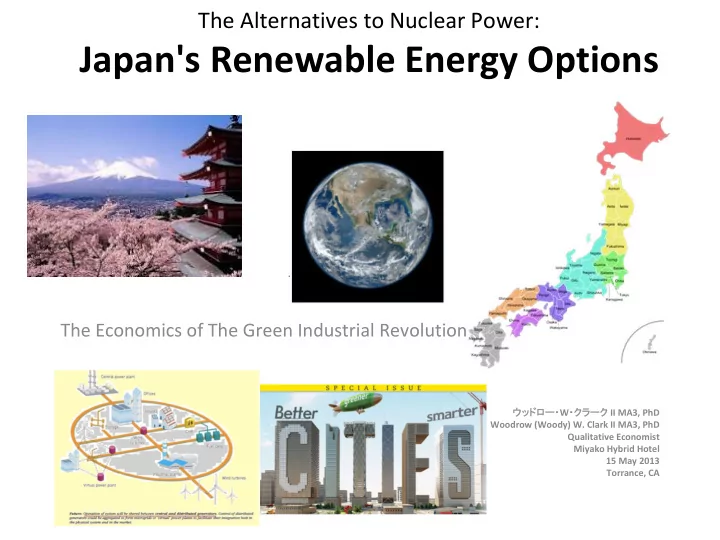
The Alternatives to Nuclear Power:

Japan's Renewable Energy Options

The Economics of The Economics of The Green Industrial Revolution

ウッドロー・W・クラーク II MA3, PhD Woodrow (Woody) W. Clark II MA3, PhD Qualitative Economist Miyako Hybrid Hotel 15 May 2013 Torrance, CA

slide-2
SLIDE 2

Sustainable Green Communities Sustainable Green Communities

slide-3
SLIDE 3

The Failure of Contemporary Economics

The Next Economics

Woodrow W. Clark II, MA3, PhD

(Springer Press, 2012)

slide-4
SLIDE 4

Paradigm Change: Paradigm Change: The World is Round The World is Round – – Not Flat Not Flat

slide-5
SLIDE 5
slide-6
SLIDE 6

U.S. to become biggest oil producer – IEA

(Mark Thompson, November 12, 2012)

The claim: Oil and gas boom puts US on track for “energy independence”: but at what social and environmental costs?

slide-7
SLIDE 7

Energy Supply to China

(2012)

slide-8
SLIDE 8

The Green Economic Revolution

is The Next Economics

slide-9
SLIDE 9
slide-10
SLIDE 10

Social Capitalism at Work

(The Next Economics, Chapter #7: Clark and Li, 2012)

slide-11
SLIDE 11

Northern Lights Special Issue

(Economist, 4 February 2013)

slide-12
SLIDE 12

Sustainable Communities: Chapter # 10: Sustainable Communities: Chapter # 10:

Frederickshavn Frederickshavn, DK Energy Independent Plan, 2015 , DK Energy Independent Plan, 2015

Electricidad distribuida

slide-13
SLIDE 13

Ch # 11: Ota City Pal‐Town Josai‐no‐mori

slide-14
SLIDE 14

Honda Clarity: H2 Fuel Cell Car

slide-15
SLIDE 15

* Precondition: Benefit for FCV users (price/convenience etc.) are secured, and FCVs are widely and smoothly deployed

2010 2011 2010 2011 2025 2026 2025 2026 2015 2016 2015 2016

  • Solving technical issues and promotion of review

regulations (Verifying & reviewing development progress as needed)

  • Verifying utility of FCVs

and H2 stations from socio‐economic viewpoint

Year

Note: Vertical axis indicates the relative scale between vehicle number & station number.

Contribute to diversity of energy sources and reduction of CO2 emissions Pha Phase 1 e 1 Technology Demonstration 【JHFC-2】 Phase 2 Technology & Market Demonstration 【Post JHFC】 【Starting Period】 Phase 3 Early Commercialization 【Expansion Period】 Phase 4 Full Commercialization 【Profitable business Period】

H2 Station Number Vehicle Number

Determine specifications of commercial type H2 stations Begin building commercial type H2 stations Increase of FCV numbers through introduction of more vehicle models Period in which preceded H2 station building is necessary

  • Approx. 1,000 H2 stations*
  • Approx. 2 million FCVs*
  • Expanding production and sales of FCVs

while maintaining convenience of FCV users

  • Reducing costs for H2 stations and

hydrogen fuel

  • Continuously conducting technology

development and review of regulations

Commercialization Scenario for FCVs and H2 Stations

Costs for H2 station construction and hydrogen reach targets, making the station business viable. (FCV 2,000 units/station)
slide-16
SLIDE 16

Renewable Hydrogen Station

16

slide-17
SLIDE 17

Solar is about to change our World

(Michael Sankowski, 18 April 2013)

slide-18
SLIDE 18

Average Size of Wind Turbines

slide-19
SLIDE 19

Development Phases of Renewable Energy Technologies

slide-20
SLIDE 20

Sustainable Communities (Springer Press, 2009)Chapter #4: Sustainable Community Design

slide-21
SLIDE 21

Sustainable Communities (Springer Press, 2009)Ch # 8: Google Sharp (1.6MW) Solar Campus:

Goal: carbon neutral by end of 07

slide-22
SLIDE 22

22

E-Charge Lane

Wind‐generated electricity Wind‐generated electricity Hydro‐ power electricity Hydro‐ power electricity Hydrogen refueling station Hydrogen refueling station Automated Platoon Driving Automated Platoon Driving Intervehicular communication Intervehicular communication Road‐to‐vehicle communication Road‐to‐vehicle communication Electricity charge lane Electricity charge lane Solar panels Solar panels

A Vision of Future Sustainable Mobility A Vision of Future Sustainable Mobility

slide-23
SLIDE 23

23

Contact Information

Woodrow Clark II, MA3, Ph.D.

Qualitative Economist Managing Director Clark Strategic Partners PO Box #17975 Beverly Hills, CA USA 90209 Email: wwclark13@gmail.com Direct Line +1 (310) 858‐6886 Fax Line +1 (310) 858‐6881

Web site: www.clarkstrategicpartners.net