Its Concept Dr. Hiroshi Akimoto fatomoko@maia.eonet.ne.jp 2010 2 - - PDF document

its concept
SMART_READER_LITE
LIVE PREVIEW

Its Concept Dr. Hiroshi Akimoto fatomoko@maia.eonet.ne.jp 2010 2 - - PDF document

Intellectual Property Strategy Network, Inc. (IPSN) Its Concept Dr. Hiroshi Akimoto fatomoko@maia.eonet.ne.jp 2010 2 3 [Objectives of the Company] One of the objectives of this company is to make assistance to a Japanese national


slide-1
SLIDE 1

2010年2月3日

Intellectual Property Strategy Network, Inc.

(IPSN)

Its Concept

  • Dr. Hiroshi Akimoto

fatomoko@maia.eonet.ne.jp

2010年2月3日

2 2010年2月3日 2

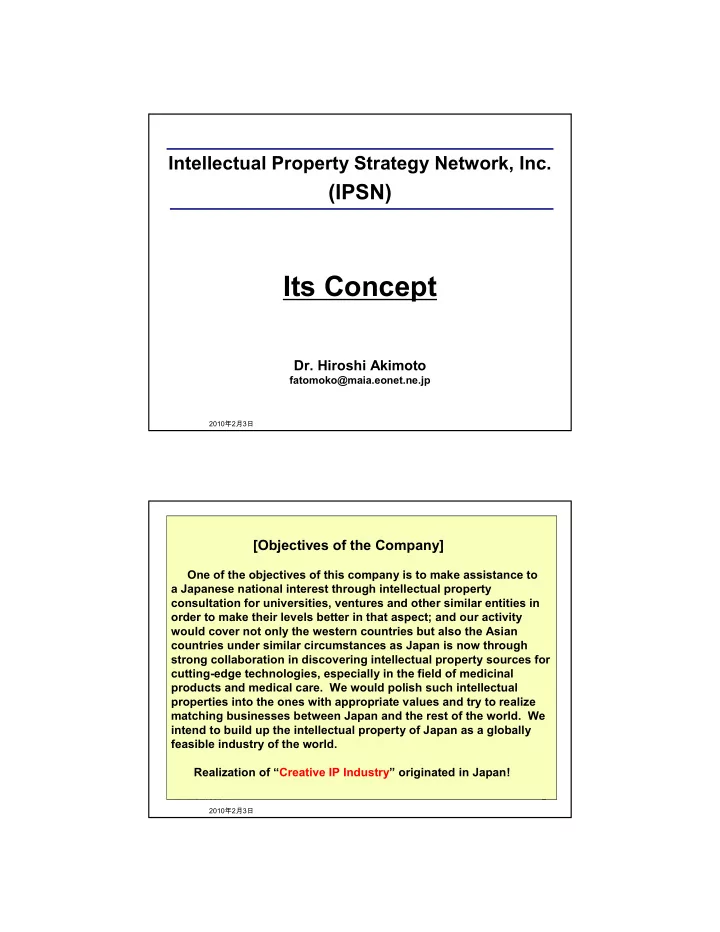
[Objectives of the Company]

One of the objectives of this company is to make assistance to a Japanese national interest through intellectual property consultation for universities, ventures and other similar entities in

  • rder to make their levels better in that aspect; and our activity

would cover not only the western countries but also the Asian countries under similar circumstances as Japan is now through strong collaboration in discovering intellectual property sources for cutting-edge technologies, especially in the field of medicinal products and medical care. We would polish such intellectual properties into the ones with appropriate values and try to realize matching businesses between Japan and the rest of the world. We intend to build up the intellectual property of Japan as a globally feasible industry of the world. Realization of “Creative IP Industry” originated in Japan!

slide-2
SLIDE 2

2010年2月3日 Clinical Research

3 3 May 18, 2009 May 3, 2009 April 28, 2009 3

Universities / Institutions Four key research centers JST-projects (20 institutions)

*MEXT **MHLW ***METI

“Industry”

IP strategy pros on bio/medical products Business support I n t e r n a t i

  • n

a l I P s t r a t e g y / t a c t i c s s u p p

  • r

t

Urgent proposal concerning Urgent proposal concerning iPS iPS cell IP strategy consortium cell IP strategy consortium

Accelerated realization and industrialization (Expedited establishment required!)

Support

Regenerative Medicine Research / information support

General producer function for IPs

(Consolidated management

  • f IP rights, information & licensing)

Consortium

Industry-government- academia Collaboration

Patent attorneys / attorneys (Human resources well-versed with U.S. or US strategies)

(April 24, 2008)

Prototype for JPMA Proposal Prototype for JPMA Proposal( (as a national project) as a national project)

*MEXT: Ministry of Education, Culture, Sports, Science and Technology **MHLW: Ministry of Health, Labour and Welfare ***METI: Ministry of Economy, Trade and Industry

2010年2月3日

Saitama Medical

  • St. Marianna

Kinki Kurume Chiba Gifu Nagasaki Kyushu Tokyo Metropolitan Tokyo Medical & Dental Shinshu Tokyo Institute

  • f Technology

Tottori Tokyo Women's Medical Osaka National Institute of Biomedical Innovation Kumamoto Jichi Medical National Institute of Advanced Industrial Science & Technology National Research Institute for Child Health Development Nagoya City

  • Toward proper protection of IPs for advanced technologies -

Funded by the JPMA (13 companies)

Japan Patent Attorneys Association iPS project leader

iPS iPS Intellectual Property Support Project Intellectual Property Support Project

Started on November 1, 2008 (Term: 1 year)

JPMA Intellectual Property Committee Chairperson & vice-chairperson Member (Chairman of LES Japan) 4 base

  • rganizations:

Kyoto Univ. Keio Univ. Tokyo Univ. & RIKEN Hokkaido Kanazawa Tokai Nagoya International Medical Center of Japan Nara Institute of Science & Technology National Cancer Center Tohoku Okayama Leader: Hiroshi Akimoto Deputy Leader: Shozo Nagai Project Member: 2 persons Secretariat: Masao Okina

“The Project covered most of the target institutions conducting iPS cell-related researches.”

Shift to generalized producer activity

JPMA Intellectual Property (IP) Support Project

Build-up by private sector

Intellectual Property Support Network, Inc. (IPSN) supported by the INCJ

INCJ: Innovation Network Corporation of Japan (Government-assisted public funding corporation)

Thirteen JPMA Board Member Companies: Daiichi Sankyo; Takeda; Astellas; Eisai; Dainippon Sumitomo; Mitsubishi Tanabe; Otsuka; Kissei; sanofi-aventis; Shionogi; Chugai; Banyu; and Pfizer. Donation Yokohama City
slide-3
SLIDE 3

2010年2月3日 Journal of Industry-Academia-Government Collaboration Vol.5 No.6 2009

Special Feature: New Challenge for Industry-Academia-Government Collaboration Approximately half of the global pharmaceutical market belongs to the United States. It seems imperative to obtain patent rights in the United States in order to survive as a strong presence in the pharmaceutical

  • industry. The Japan Pharmaceutical Manufacturers Association, consisting of major pharmaceutical

companies in Japan, is now running a project to assist research institutes including universities to obtain patent rights in the United States for iPS cell-related research outcomes.

Assisting Research Institutes to Obtain Patent Rights in the United States

  • The Japan Pharmaceutical Manufacturers Association created a project related to iPS cells -
  • Dr. Hiroshi Akimoto:

Intellectual Property Adviser & IP Support Project Leader

  • f the Japan Pharmaceutical

Manufacturers Association; Chairman of the Intellectual Property Committee of the Japan Bioindustry Association; Guest professor in the graduate school of the University of Tokyo; and Specially Appointed Professor of Kyushu University The Japan Pharmaceutical Manufacturers Association (JPMA) is now promoting a program called “IP Support Project” on its own to help out research institutes including universities in order to make iPS cell-related research outcomes into intellectual properties in the United States; the project is a one-year time-limited program started in November, 2008. Pharmaceutical products are strongly protected by intellectual property strategies. Approximately half of the global pharmaceutical market belongs to the United States. It is imperative to obtain patent rights enforceable in the United States based on a proper intellectual property strategy in order to survive as a strong presence in the pharmaceutical industry. At the same time, well-performing pharmaceutical companies are also committed to a principle that “creating good drugs always serves to help improve people’s health”. This project was created based on these two factors. The project supported by donations from 13 board member companies of the Japan Pharmaceuticals Association and consists of ex-employees of pharmaceutical companies. Based on the experiences in the pharmaceutical industry, the project members visit research institutes including universities where iPS cell-related researches are ongoing and explain the characteristics of the patent system and the way to consider intellectual property strategies fitted for the patent system in the United States in the presence of members from both research laboratories and intellectual property departments. The members also give advice on how to handle patent applications in the United States under confidentiality agreements when researchers are ready to explain the contents of their researches. Concerning research institutes including universities that are conducting iPS-cell related researches, we select them referring to the information open to the public from various sources, introduce the project’s activities to them and visit them one after another when the project’s visits are accepted by them in advance. The institutes in the figure in this article are the ones we visited or of which visiting appointments were fixed on May 29, 2009; other candidate institutes for our visits have been contacted and visiting dates are being fixed by devoted project members. Our visits were welcomed in every research institutes we have visited so far. Researchers commented that “it was the first time they had ever heard of such stories”; even the members of intellectual property departments said that “they had never thought of patent strategies” utilizing the characteristics of the U.S. patent system in such a way as many pharmaceutical companies are taking advantage of provisionary applications in the United States.

  • - - - - - - - - - - - - - - - - - - - - - - - - - - - - - - - - - - - - - - - - - - - - - - - - - - - - - -

Visiting research institutes to provide advices

2010年2月3日

Outcomes of the IP Support Project activities assisting universities and institutes that are conducting iPS cell-related researches in Japan:

  • Research contents in the universities and institutes in Japan are never

inferior to those conducted in the EU and the US.

  • Most institutions consider IPs in Japan only; and they are all little

conscious about global IP strategies, especially those in the US.

  • Many institutions expressed strong interest in the way of thinking we

proposed for global IP strategies.

  • Almost all institutions are strongly requesting a follow-up program after

the completion of this project. Reconfirmed a strong demand for an IP strategy support system covering wide range of cutting-edge medical technologies

6

[Summary of IP Support Project]

slide-4
SLIDE 4

2010年2月3日 Cutting-edge technologies (medical, pharmaceutical, engineering and fusion); Super Consortia; Bioventures JPMA (IP Committee); Bioindustry Association; Patent Attorneys Association; experts of each field; and auditors

Concept of IPSN Business Concept of IPSN Business

“Orchestration of wisdom” and “its commercialization”

by an industry-government-academia “All-in-One Japan IP system”

Total Strategic Capability: Assistance for global IP strategy & tactics; IP evaluation; IP rights securement; information management; licensing; and commercialization

Network

Industry; patent attorney offices; and law firms

TLO; VC; & TL companies Industry Policy

Research Institutes & BVs

Collaboration with Industry Total Support System (Being secured) (Ongoing) (Secured) (Ongoing) D i v i d e n d

Information access; IP securement & evaluation; and Licensing (TL)

Investment Investors (public & private) A l l

  • c

a t i

  • n

TLO; VC; and TL companies / Investment funds Government Agencies Support Foundation *MEXT **MHLW ***METI ****INCJ (Innovation Network

Corporation of Japan)

“All-in-One Japan IP system” Network *MEXT: Ministry of Education, Culture, Sports, Science and Technology **MHLW: Ministry of Health, Labour and Welfare ***METI: Ministry of Economy, Trade and Industry ****INCJ: Innovation Network Corporation of Japan Investment, membership fee & compensation Assistance for global IP strategy & tactics; IP evaluation; and IP packages Research and commercialization information exchange

Established on July 1, 2009 Consulting Investment Human Resources

[IPSN, Inc.]

2010年2月3日

Concept of IPSN Global Network

Building up new Asian networks Utilizing existing networks with the U.S. and Europe

IPSN

slide-5
SLIDE 5

2010年2月3日

(1) Diagnosis and evaluation of intellectual property and strategy (2) Intellectual property strategy support (Filing strategy / overseas filing strategy / patent prosecution strategy / patent management strategy / litigation strategy) (3) Licensing strategy support / representing clients for licensing negotiation (4) Offering a package of intellectual property rights of platform technologies and related technologies for commercialization (Package license) (5) Matching of needs between universities and business entities (offering zero-order information) (6) Licensing strategy support / representing clients for licensing negotiation

  • General Producer of Intellectual Property –

(A refuge temple for IP businesses)

Business Description (1)

2010年2月3日

Business Description (2)

(7) Overseas strategy promotion for universities and ventures Japan/US/Europe: Support for licensing strategy Asia (China/India): Support for licensing and business strategy (8) Intellectual property diagnosis / evaluation and commercialization / revitalization / activation support for venture businesses (9) Initial investment to start ventures originating in academia (10) Direct investment in ventures (11) Lectures and seminars exclusive to members by external experts (twice a year) (12) Commercialization of IP businesses Purchase and commercialization of IPs, high-quality IP consultation, commercialization of human resources training, and strengthening cooperation with potential competitors

  • General Producer of Intellectual Property –
slide-6
SLIDE 6

2010年2月3日

Business Description (3)

  • Cultivating & Securing Human Resources –

(13) Cultivating and securing human resources that can assume ------------

  • -----responsibilities of three-way strategies for R&D, IP and business!

A wider variety of knowledge and experience is provided in order to cultivate human resources (general producers) who constitute a team that assumes responsibilities of three-way strategies for R&D, IP and business in actual business practices. Accepting workers on loan from members.

  • Cultivating human resources through OJT training
  • Delegation of human resources training from member enterprises and
  • -ventures

=> Soliciting release of human resources produced in private sector => Establish an industry-academia coordination network system

  • for each of several large local block-units set in Japan by soliciting
  • ---release of human resources
  • Making up for insufficient IP human resources in the life science field

=> Expanding key centers with independency and establishing the

  • ---Network structure by further release of human resources

2010年2月3日 Securing IP human resources in All-in-One Japan system

Establishing an “IP Strategic System” in the Life Science Field

  • Making up for insufficient IP human resources! -

Establishing organization & system toward “orchestration of wisdom” in the private sector and “its commercialization" Expanding key centers with independency by improving the levels of academia and bioventures Establishing an industry-academia coordination network system for each of several large local block-units set in Japan

*MEXT **MHLW ***METI

  • Orchestration of

wisdom in the private sector

  • Human

resources from private sector

  • Human resources

cultivation 0 to 5 years 6 to 10 years 11 to 15 years Seminar in the Nikkei BP Journal (Mar. 16, ’09) Leveling-up of key centers Overall improvement Industry-academia cooperation & BV support system establishment Expanded network and cultivating “Innovative IP Industry” Network establishment and securing human resouces Overall support system

Cooperation Development Independency

Current issues

****INCJ (Innovation

Network Corporation of Japan) *MEXT: Ministry of Education, Culture, Sports, Science and Technology **MHLW: Ministry of Health, Labour and Welfare ***METI: Ministry of Economy, Trade and Industry ****INCJ: Innovation Network Corporation of Japan

Concept of IPSN Overall industrial policy-supporting system is essential.

slide-7
SLIDE 7

2010年2月3日 Nikkei Biotech: http://biotch.nikkeibp.co.jp/ 2009.3.2 Seminar in the Journal

Something to Say about Patent Strategies in Universities and Ventures Overcoming the Lack of Human Resources in Industry-Academia Collaboration Divisions

  • Dr. Hiroshi Akimoto, Guest Professor of the Graduate School, the University of Tokyo

Some people are crying out for utilizing patents in universities and venture; however, technology transfers are not necessarily proceeding very well. Reasons are that there are few experienced personnel from the pharmaceutical industry in industry-academia collaboration

  • divisions. Dr. Hiroshi Akimoto, former executive director of Takeda Pharmaceutical Co., Ltd. and currently the intellectual property

adviser of the Japan Pharmaceutical Manufacturers Association, pointed out issues there. Another issue here would be how to secure patent rights. For example, most

  • f the enterprises are active globally and it is important for most of them how

these rights are secured from a global point of view. Even when somewhat insufficient coverage of the patent rights is recognized, it would be permissible if such a deficient situation can be corrected by some countermeasures, however, there are many cases where any corrective measures are ineffective when the time limit to file a patent application is passed or presentations have been made already. Recently, even universities are conscious about global patent applications, however, global activities and general situations at hand for each enterprise vary from industry to industry. It is questionable whether patent applications are filed considering such circumstances of each industry. Lack of human resources in industry-academia collaboration divisions or TLOs It may be necessary to consolidate them into several key blocks in Japan. On the other hand, it will not be easy for university researchers to file patent applications taking industrial situations into consideration. Especially among university professors in Japan, there still exists mentality with which they value publications more than patent applications; therefore, they rarely conduct researches considering eventual patent applications which industries may look for or those which are adapted to industrial situations. Under these circumstances, industry-academia collaboration divisions or TLOs are created as organizations to compensate such a situation; however, I am afraid they do not seem to be functioning sufficiently. The reason why industry-academia collaboration divisions or TLOs are not functioning very well comes down to the lack of human resources. There may be sufficient personnel in the fields of electronics or engineering but the lack of human resources is prominent in the fields of medicinal products or life science.

  • - - - - - - - - - - - - - - -
  • Dr. Hiroshi Akimoto: Awarded with PhD from the University of Tokyo; joined

Takeda Pharmaceutical Co., Ltd after a stint in the University of Pennsylvania; reached finally the position of executive director and concurrently the head of intellectual property department of the company; currently Intellectual Property Advisor of the Japan Pharmaceutical Manufacturers Association, Chairman of the Intellectual Property Committee of the Japan Bioindustry Association, Specially Appointed Professor of Kyushu University etc. Patents have values only when they are utilized in the industry; Patent applications considering the situation in the industry and enterprises It is impossible to carry out basic researches in private enterprises as universities and ventures do; therefore, business enterprises are expecting a lot form researches in universities and

  • ventures. However, technology transfers to the private sector from

universities and ventures are not proceeding very well. Universities may have discontent that “business enterprises are not paying attention to many patents they filed” but blindly filing for patents is not recommended here. Patents or intellectual properties are considered of value when inventions are effectively utilized in industry. There must be a mismatch between universities and business enterprises arising from different perceptions of the situation. There are several reasons why business enterprises do not show interests in patents from universities: the first question will be whether universities are conducting researches business enterprises may be interested in. Even when patents are obtained, it will be difficult to solicit technology transfer if such patents do not cover basic technologies or specific fields that business enterprises are seeking for. For example, we once compared the numbers of publications and those of citations among the top universities in terms of numbers of international patent applications related to RNAi. As a result, the University of Massachusetts and Max Planck Institute published many pioneering papers and they also showed high numbers in terms of international patent applications, scientific papers and citations. In contrast, there are some cases of universities in Japan and in the United States where numbers of citations are low and, therefore, scientific impacts are also low in spite of their high numbers of international patent applications and scientific papers. The industry would not take notice of such inventions. In other words, high numbers

  • f patents and papers are not of value but the important factor is their

usefulness in the industry.

2010年2月3日

Target Technological Areas and Research Institutes/Business Enterprises

[Technical Areas]

  • Cutting-edge medical technology (Super Consortia)
  • Cutting-edge fusion technology (medical & engineering collaboration)
  • Cutting-edge technology in general (other than medical)

[Target research institutes/business enterprises]

  • Institutes, universities, pharmaceutical companies and the like

in the cutting-edge (medical related) technology area (including institutes, universities and others intended for the IP support project of the JPMA)

  • Ventures/investment funds involved in

cutting-edge (medical) technology in the life science field: Innovation Network Corporation of Japan (INCJ) and Small and Medium-sized Enterprise Investment Business Corporation

  • Ventures and business enterprises of cutting-edge technology
  • utside of life science field
  • Cutting-edge life science technology
slide-8
SLIDE 8

2010年2月3日

Difference from Intellectual Ventures

IPSN is different from IVs since it gives advice on global IP

strategies and tactics when universities and BVs (including BVs

  • riginated in universities) in Japan file patent applications, and

supports to improve the quality of IPs and help them to obtain IPs of real value.

IPSN is different from IVs since it does not own patents in principle

but operates with nonexclusive licenses or limited-time exclusive licenses given from the patent owners. Patents for licensing will strictly be owned by universities or other similar institutions.

IPSN is different from IVs since it conducts licensing and other

business negotiations only through requests from universities or

  • ther institutions but respects their independency and never

interferes with their own intentions to negotiate themselves.

IPSN is expected to have a complementary role with universities

and other institutions so that wide-ranging negotiations for licensing will become possible and the success rates will be higher.

Licensing of platform technologies often encounters difficulty in

case it is not a package license but the features of our IPSN will help to create a packaged license with values and the success rates will be higher than those achieved by IVs.

2010年2月3日

Social Meaning Derived from IPSN Activity

  • 1. Increased values of IPs in universities and

ventures in Japan

  • 2. Increased success rates of commercialization in

cutting-edge technology field by strengthening IP portfolios in universities and ventures in Japan

  • 3. IP personnel cultivated and secured in Japan
  • 4. Technology transfer promotion based on a

global network that has a particular focus on Asia

  • 5. “Creative IP industry” realized and established in

Japan